China Advances Brahmaputra Mega Dam Despite Downstream Concerns
Source:The Hindu ↗
Why It Matters
This issue directly impacts India's national security, water security in the Northeast, and ecological stability in the Himalayan region, making it a critical topic for GS Paper 2 (IR and neighboring countries) and GS Paper 3 (Environment and Infrastructure).
Summary
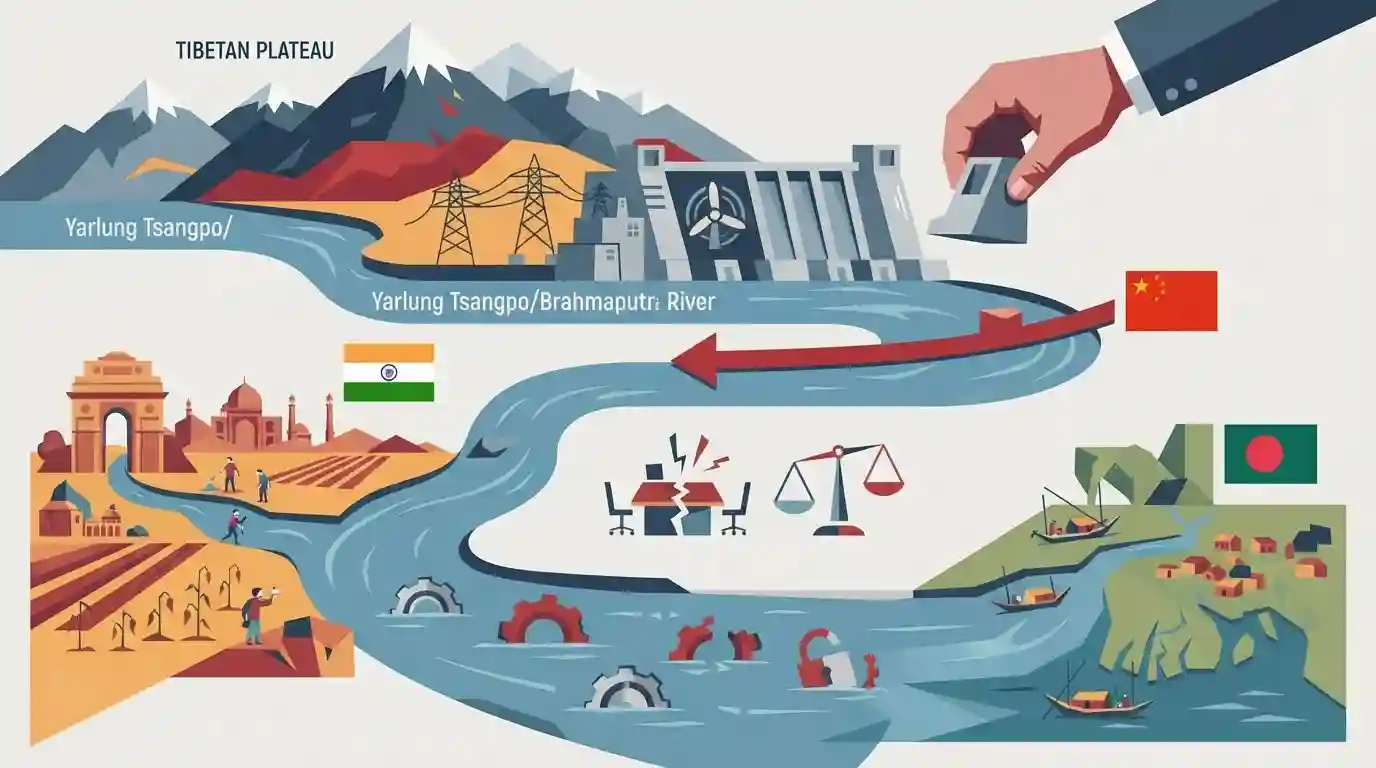
China's decision to proceed with a mega-dam on the Brahmaputra River in Tibet highlights major geopolitical, ecological, and water security challenges for downstream countries like India and Bangladesh, underscoring the lack of institutionalized transboundary water management agreements.
Key Points
- China is moving forward with its controversial mega-dam project on the lower reaches of the Brahmaputra River (known as Yarlung Tsangpo in Tibet) despite fresh ecological, geological, and geopolitical concerns raised by lower riparian states like India and Bangladesh.
- The project involves massive hydropower generation in an ecologically fragile, seismically active Himalayan region, threatening downstream water security, flow patterns, and ecology.
- Lack of a formal water-sharing treaty or robust institutional bilateral mechanism between India and China exacerbates anxieties regarding weaponization or unilateral control of water resources.
Important Terms
Transboundary River

An international river flowing through multiple nations, such as the Brahmaputra shared by China, India, and Bangladesh, presenting unique challenges for cooperative governance and data sharing.
UPSC context
Relevant for GS Paper II (International Relations - Water Diplomacy) and GS Paper III (Environment and Disaster Management).
Hydro-politics
The strategic use of water resources and large hydraulic infrastructure, such as mega-dams, by an upstream nation to exert geopolitical influence over downstream countries.
UPSC context
Important for GS Paper II (International Relations, India's Neighborhood Policy) examining transboundary security and regional cooperation.
Brahmaputra Mega Dam (Motuo Dam)
A massive hydropower project proposed by China on the lower reaches of the Yarlung Tsangpo (Brahmaputra) in Tibet near the Great Bend, raising severe ecological and strategic alarms downstream.
UPSC context
Tested in GS Paper II (International Relations - India-China bilateral issues) and GS Paper III (Infrastructure and Environmental Impact Assessment).
Static Concepts Connected
What are the core principles governing international transboundary water law and India-China river mechanisms?
- Bilateral Treaty Gap: No formal treaty exists between India and China for the Brahmaputra; cooperation relies solely on MoUs for hydrological data sharing during flood seasons.
- Customary Norms: Customary norms like equitable utilization and the no-significant-harm rule lack robust enforcement mechanisms when dealing with an absolute upper riparian state.
- Institutional Mechanism: The Expert Level Mechanism (ELM) was established in 2006 to handle hydrological data sharing, emergency management, and flood forecasting.
Cross-Topic Patterns
Transboundary Rivers vs. Customary International Water Law
Unilateral dam construction on transnational rivers in geologically unstable regions tests international customary law, including the UN Watercourses Convention and principles of 'no significant harm'.
Hydro-Hegemony & Himalayan Infrastructure Geopolitics
China's upper riparian advantage in Tibet mirrors broader weaponization of geography across the Himalayan arc, linking hydro-hegemony with border disputes and critical infrastructure development.

Upper riparian advantage + lack of a binding water treaty on the Brahmaputra will likely feature in a multi-statement IR/Geography Q.
Linked PYQs · 2
Linked PYQs · 2
- 2014MainsGS2
With respect to the South China sea, maritime territorial disputes and rising tension affirm the need for safeguarding maritime security to ensure freedom of navigation and over flight throughout the region. In this context, discuss the bilateral issues between India and China.
- 2017MainsGS3
Not many years ago, river linking was a concept but it is becoming a reality in the country. Discuss the advantages of river linking and its possible impact on the environment.
