Brahmaputra Mega Dam Project and Downstream Water Security
Source:The Hindu ↗
આ શા માટે મહત્વનું છે
This article is crucial for understanding India-China bilateral relations, hydro-diplomacy, and the strategic and environmental vulnerabilities faced by India's northeastern region due to upstream infrastructure development.
સારાંશ
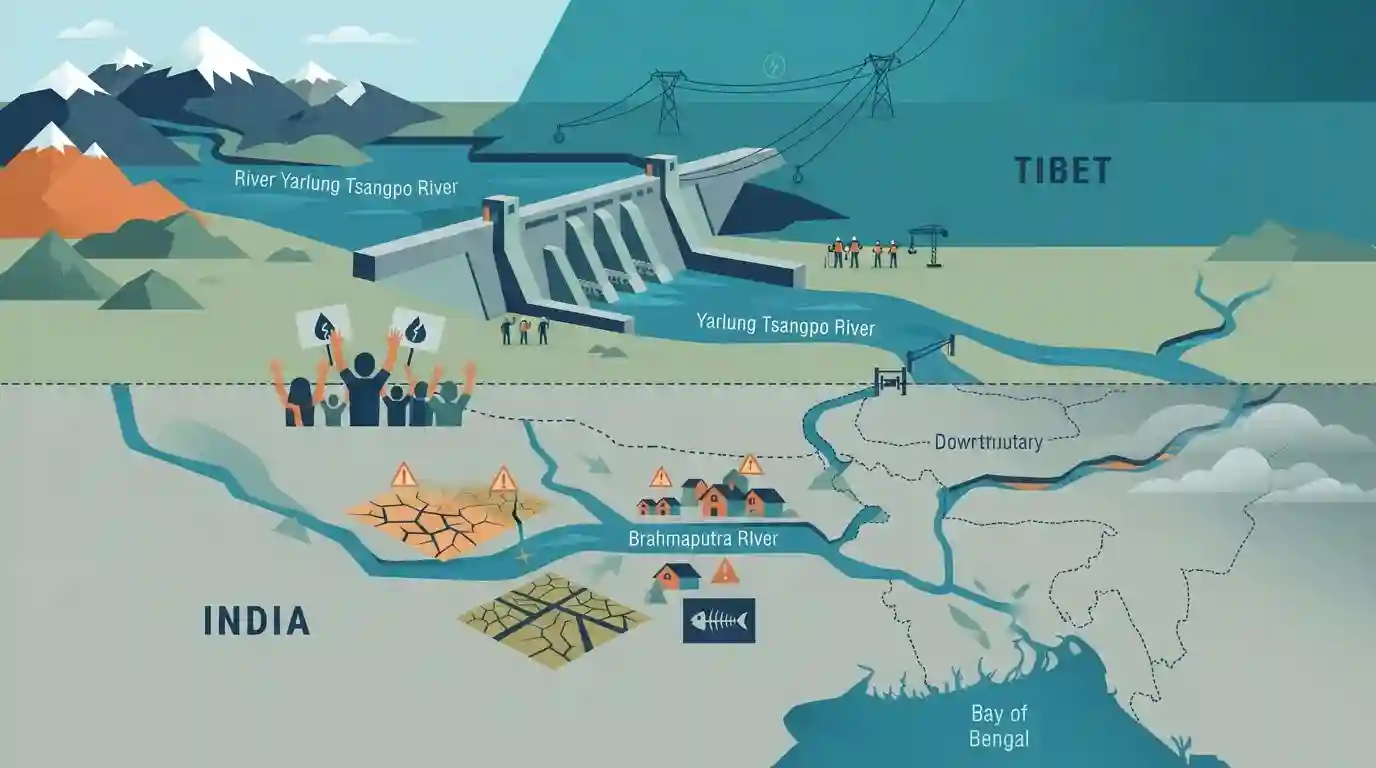
China is advancing its controversial mega-dam project on the Brahmaputra River (Yarlung Tsangpo) in Tibet, raising serious ecological, strategic, and water-security concerns for downstream nations like India, despite local and international apprehensions.
મુખ્ય મુદ્દા
- China is moving forward with plans to build a mega-dam on the Brahmaputra River (Yarlung Tsangpo) in Tibet despite growing environmental concerns and downstream apprehensions from countries like India and Bangladesh.
- The mega-dam project poses potential risks to downstream water security, ecology, biodiversity, and flow patterns in India's northeastern states, particularly Arunachal Pradesh and Assam.
- The lack of a formal water-sharing treaty or a robust institutionalized bilateral mechanism between India and China exacerbates anxieties regarding data sharing and unilateral water manipulation.
મહત્વપૂર્ણ શબ્દો
China

A neighboring upper riparian nation advancing a controversial mega-dam project on the Yarlung Tsangpo in Tibet, raising transboundary water and security concerns for India.
UPSC context
UPSC GS Paper II (International Relations - India-China Relations & Geopolitics of Water Security). Evaluates bilateral friction points and transboundary river politics.
India
A lower riparian nation dependent on the Brahmaputra river system, facing severe ecological, strategic, and flood-safety challenges due to upstream mega-dam construction.
UPSC context
UPSC GS Paper II (International Relations & Security) and GS Paper III (Disaster Management). Focuses on water security, transboundary diplomacy, and regional stability.
પ્રિલિમ્સ ટ્રેપ
India and China operate under a comprehensive bilateral water-sharing treaty for the Brahmaputra River.
Aspirants often assume India and China share a binding water-sharing treaty for the Brahmaputra similar to the Indus Waters Treaty with Pakistan, whereas only limited hydrological data-sharing MoUs exist.
સંલગ્ન સ્થિર ખ્યાલો
What are the key principles governing upper and lower riparian rights in transboundary river systems?
- Positional Advantage: Upper Riparian State holds physical geographical advantage to construct dams, divert flows, and withhold data.
- Harmon Doctrine: Harmon Doctrine under strict international law asserts absolute territorial sovereignty, though largely superseded by equitable utilization norms.
- International Law: No specific global treaty covers all transboundary rivers; governed instead by framework conventions like the 1997 UN Watercourses Convention.
આંતર-વિષય પેટર્ન
Transboundary Waters + Northeast Security Strategy
Transboundary water disputes in the Brahmaputra basin directly intersect with international humanitarian law, riparian rights under customary international law, and strategic security in India's Northeast.
Hydro-Hegemony + Mekong Basin Parallels
The upper riparian advantage in Tibet parallels China's similar hydro-hegemony maneuvers across the Mekong basin affecting Southeast Asian nations.

Upper vs lower riparian rights + lack of India-China water treaty will likely feature as a statement-based IR/Geography question.
સંલગ્ન PYQ · 2
સંલગ્ન PYQ · 2
- 2024MainsGS3
India has a long and troubled border with China and Pakistan fraught with contentious issues. Examine the conflicting issues and security challenges along the border. Also give out the development being undertaken in these areas under the Border Area Development Programme (BADP) and Border Infrastructure and Management (BIM) Scheme.
- 2023MainsGS3
Dam failures are always catastrophic, especially on the downstream side, resulting in a colossal loss of life and property. Analyze the various causes of dam failures. Give two examples of large dam failures.
