China Economic Plan: Accelerating Science and Tech Autarky
Source:The Hindu ↗
Why It Matters
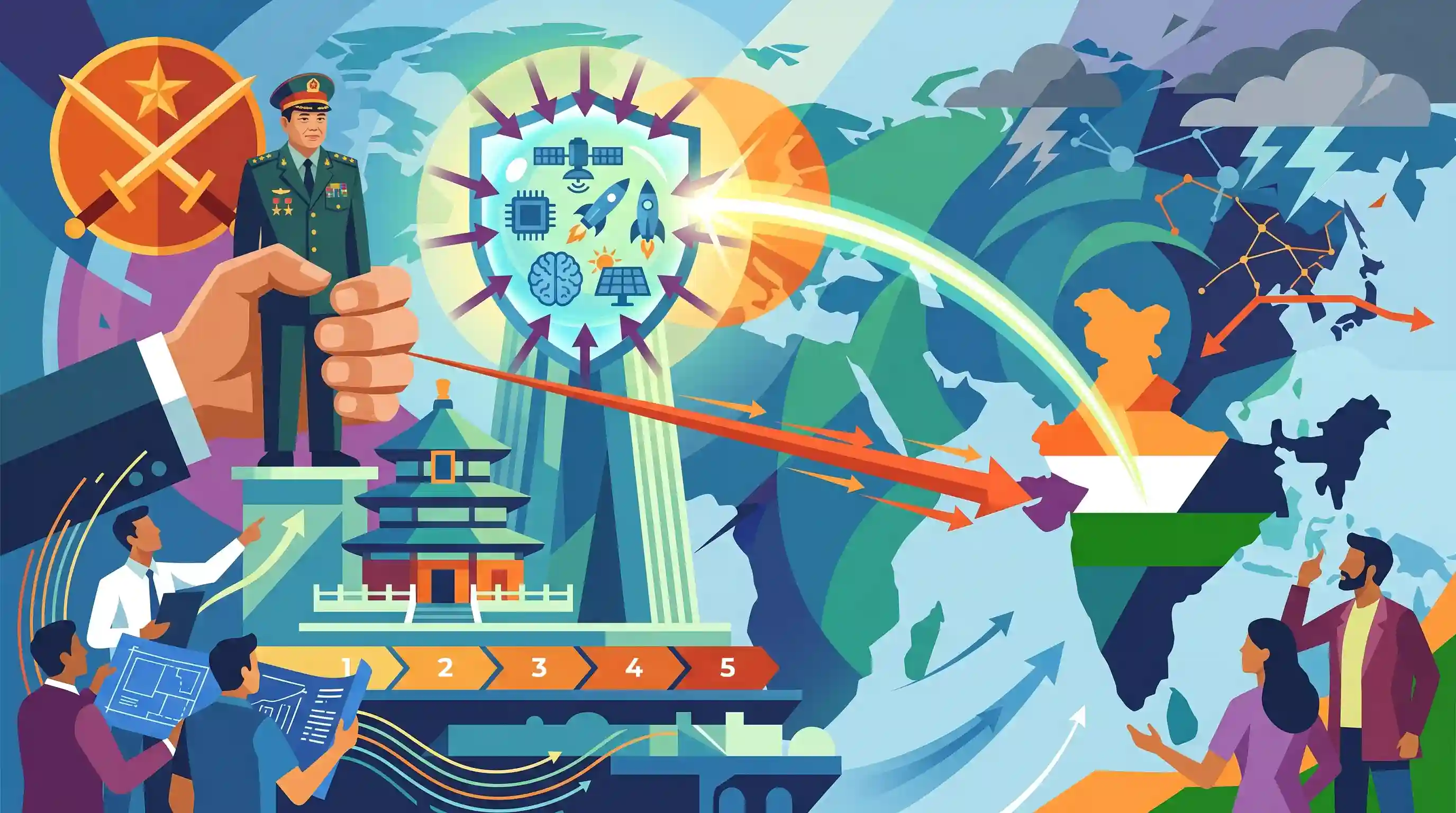
China's push for technological autarky and structural changes in its top military leadership have direct implications for global supply chains, international tech competition, and India's strategic environment in the Indo-Pacific.
Summary
Concluding a four-day meeting on its upcoming five-year economic plan, the Chinese Communist Party emphasized speeding up self-reliance in science and technology to navigate profound global changes and rising uncertainty. Additionally, the party announced the elevation of Zhang Shengmin to vice chair of the Central Military Commission, marking a significant change in its top military leadership.
Key Points
- China's ruling Communist Party announced a focus on accelerating self-reliance in science and technology within its next five-year economic plan.
- This strategic shift is a response to profound and complex global changes and rising uncertainties, likely reflecting the ongoing tech war and decoupling efforts by the West.
- In military leadership changes, Zhang Shengmin was elevated to vice chair of the Central Military Commission.
Important Terms
Central Military Commission (CMC)

The supreme military command body in China, overseeing all armed forces. It ensures the principle of 'the Party commands the gun' by being chaired by the CCP General Secretary.
UPSC context
GS Paper 2 (International Relations); critical for assessing China’s military command, border security dynamics, and regional strategic posture.
15th Five-Year Plan (2026–2030)
China’s socio-economic roadmap for 2026–2030, prioritizing high-quality development, domestic consumption, and technological independence to achieve long-term modernization goals.
UPSC context
GS Paper 3 (Planning/Economy); essential for understanding the economic trajectory of a major trade partner and regional competitor.
Technological Self-Reliance
A strategic policy to achieve indigenous breakthroughs in core sectors like semiconductors and AI, reducing vulnerability to foreign supply chain disruptions and sanctions.
UPSC context
GS Paper 3 (Science & Tech); relevant to global technology competition and India's 'Atmanirbhar Bharat' initiatives.
Chinese Communist Party (CCP)
The founding and sole ruling party of the People's Republic of China, exercising total authority over the state, military, and economy through centralized planning.
UPSC context
GS Paper 2 (International Relations); fundamental to understanding the political structure and foreign policy motivations of a neighboring superpower.
New Quality Productive Forces
A recent Chinese economic concept emphasizing innovation-driven growth in frontier sectors like quantum computing and green energy to replace traditional manufacturing.
UPSC context
GS Paper 3 (Economy); important for analyzing shifts in global industrial leadership and emerging technology trends.
Indigenization of Technology
The process of developing and manufacturing critical technology within one's own country to eliminate dependence on foreign intellectual property or imports.
UPSC context
GS Paper 3 (Science & Tech); a recurring theme in UPSC regarding national security and economic sovereignty.
Prelims Trap
The 15th Five-Year Plan is an extension of the 'Made in China 2025' initiative to dominate global low-cost manufacturing.
Made in China 2025 concluded in 2025. The 15th Five-Year Plan is its successor, shifting focus from manufacturing dominance to core technological self-reliance.
Static Concepts Connected
What is China's 'Dual Circulation' strategy?
- Internal Circulation: Prioritizing domestic consumption, indigenous innovation, and technological self-reliance as the primary engines of economic growth.
- External Circulation: Maintaining foreign trade and investment, but strategically directing it to support and strengthen the domestic supply chain against external shocks.
- Strategic Objective: Insulating China's economy from Western sanctions and export controls by reducing reliance on imported critical technologies like semiconductors.
Decoupling vs. De-risking in global trade
- Decoupling: A complete systemic separation of two major economies, drastically cutting trade, investment, and tech ties (e.g., extreme scenarios of the US-China tech war).
- De-risking: A strategy to reduce over-reliance on a single country for critical raw materials and technologies, without entirely ending bilateral trade (a term popularized by the EU).
Cross-Topic Patterns
Tech Sovereignty & India's PLI
China's tech self-reliance mirrors India's Atmanirbhar Bharat and PLI schemes, both fundamentally aiming to secure domestic semiconductor and electronics manufacturing against geopolitical supply shocks.
PLA Rocket Force & Nuclear Deterrence
Promoting a Rocket Force general to the CMC signals China's focus on nuclear modernization and missile arsenals, directly impacting India's strategic calculations and border deterrence.

Expect a GS-2 question linking China's tech self-reliance push with India's semiconductor mission and global supply chain 'de-risking'.
Linked PYQs · 2
Linked PYQs · 2
- 2024MainsGS2
‘The West is fostering India as an alternative to reduce dependence on China's supply chain and as a strategic ally to counter China's political and economic dominance.’ Explain this statement with examples.
- 2021MainsGS2
“The USA is facing an existential threat in the form of a China, that is much more challenging than the erstwhile Soviet Union.” Explain.
