US China Trade War Escalation and Critical Minerals Controls
Source:The Hindu ↗
Why It Matters
This article is crucial for UPSC candidates as it highlights the systemic shift from multilateralism to protectionism in the global economic order. The US-China tech and trade decoupling directly impacts global supply chains, inflation dynamics, and geopolitical alignments, which are frequent themes in GS2 (International Relations) and GS3 (Economy & Security). It provides direct context for questions regarding global supply chain diversification and India's strategic opportunities.
Summary
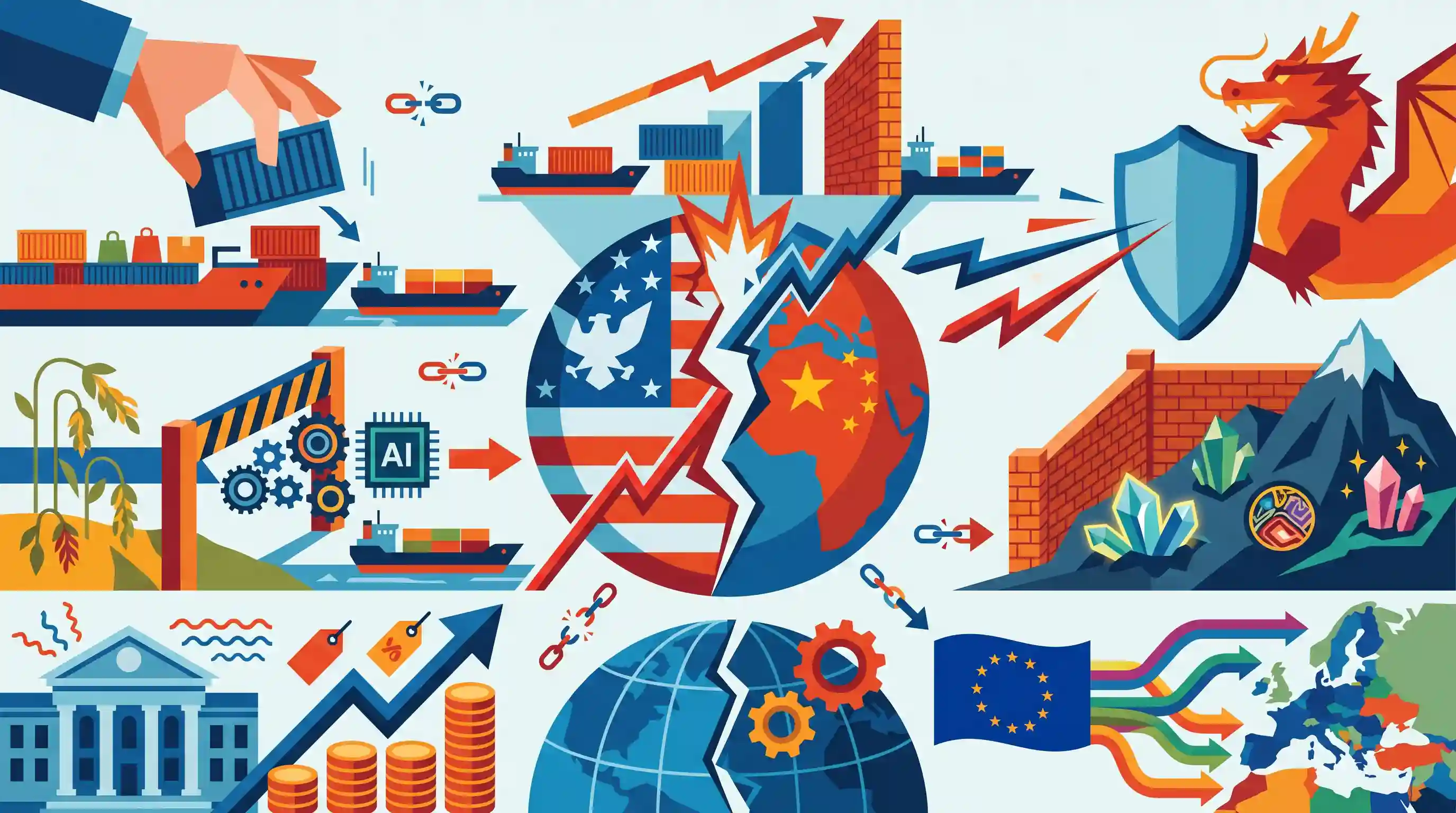
The U.S.-China trade war has drastically escalated following President Donald Trump's threat to impose an additional 50% tariff on Chinese imports, which could push aggregate U.S. levies to 145%. Condemning the move as unilateral bullying, Beijing has vowed to "fight to the end" and utilize sweeping countermeasures. The confrontation has expanded beyond traditional tariffs into critical technology and resource domains, featuring aggressive U.S. export controls on semiconductors and AI chips, countered by China's restrictions on rare earth minerals essential for global supply chains. As agricultural trade, maritime shipping, and tech investments get caught in the crossfire, the resulting protectionism threatens global macroeconomic stability, prompting inflation warnings from the Federal Reserve and forcing international blocs like the EU to diversify their trade dependencies.
Key Points
- China has threatened severe countermeasures in response to U.S. President Donald Trump's threat of an additional 50% tariff, potentially taking total U.S. tariffs on Chinese goods up to 104%-145%.
- The spiraling trade war encompasses tit-for-tat retaliations, with the U.S. restricting advanced semiconductor and AI chip exports, while China leverages export controls on critical rare earth minerals (gallium, germanium, antimony).
- Agricultural trade has been heavily weaponised, with China periodically pausing or imposing high tariffs on U.S. imports of soybeans, pork, and poultry.
- U.S. Federal Reserve Chair Jerome Powell warned that the escalating tariffs could trigger inflation, while the EU announced intentions to pivot toward other global trading partners.
- The sustained weaponization of trade and technology indicates a deepening U.S.-China decoupling, profoundly disrupting global supply chains and undermining multilateral free trade.
Important Terms
Section 301 investigations

A US legal tool under the Trade Act of 1974 allowing the government to unilaterally investigate and penalize foreign trade practices deemed unfair, unreasonable, or discriminatory to American commerce.
UPSC context
GS Paper II/III: Tests understanding of unilateral trade measures versus multilateral rules and their impact on global trade governance.
Phase One trade deal
A 2020 agreement where China committed to structural reforms and $200 billion in additional US imports to de-escalate the trade war; its partial fulfillment remains a point of contention.
UPSC context
GS Paper II: Important for analyzing bilateral trade diplomacy and the effectiveness of transitional agreements in resolving economic conflicts.
World Trade Organization (WTO)
The only global international organization dealing with the rules of trade between nations, providing a forum for negotiations and a mechanism for settling trade disputes.
UPSC context
GS Paper II: Vital for topics on international institutions and the challenges facing the rules-based multilateral trading system.
BRICS
An influential group of emerging economies (Brazil, Russia, India, China, South Africa, etc.) positioned as a geopolitical and economic counterweight to Western-led institutions like the G7.
UPSC context
GS Paper II: Key for discussing multipolarity, global South leadership, and shifting balances in international power dynamics.
Federal Reserve
The central banking system of the United States, which manages monetary policy; its interest rate decisions significantly influence global capital flows and inflationary pressures.
UPSC context
GS Paper III: Crucial for understanding global macroeconomic stability and the "taper tantrum" effects on emerging economies like India.
G7
An informal bloc of advanced industrialized democracies (US, UK, France, Germany, Italy, Canada, Japan) that coordinates global policy on economic, security, and environmental issues.
UPSC context
GS Paper II: Relevant for studying the influence of developed nations on global economic order and security frameworks.
Prelims Trap
"China holds a natural monopoly over the global reserves of rare earth elements."
Aspirants confuse processing dominance with natural reserves. China controls ~85% of global REE refining and processing capacity, but holds only about 30-40% of the world's actual natural reserves.
Static Concepts Connected
What are the WTO rules governing tariff imposition and non-discrimination?
- Bound Tariffs: WTO members commit to specific ceiling rates. Unilateral hikes above these bound rates, such as US Section 301 tariffs, generally violate core multilateral commitments.
- MFN Principle: Normal trade tariffs applied to one member must apply equally to all. Unilateral, country-specific tariffs violate the Most-Favored-Nation rule without a valid exception.
- Trade Remedies: Lawful tariff increases are only permitted as Anti-Dumping Duties, Countervailing Duties, or Safeguards, which strictly require formal investigations of unfair trade practices.
What makes Gallium, Germanium, and Antimony critical to global supply chains?
- Gallium & Germanium: Extracted mostly as by-products of zinc and aluminum processing, they are irreplaceable in manufacturing advanced semiconductors, fiber-optic systems, and solar panels.
- Antimony: A strategically vital metalloid used heavily in military applications, including armor-piercing ammunition, night vision goggles, and industrial flame retardants.
- Processing Bottleneck: China wields immense geopolitical leverage by dominating not just the raw mining, but the complex metallurgical refining required to make these minerals commercially usable.
Cross-Topic Patterns
China Plus One & India's PLI
Surging US tariffs accelerate the relocation of global manufacturing. This amplifies the relevance of India's Production Linked Incentive (PLI) schemes to capture migrating electronics and semiconductor supply chains.
Tariffs, Fed Rates & Imported Inflation
Protectionist tariffs cause cost-push inflation in the US, forcing the Federal Reserve to maintain higher interest rates. This can trigger capital flight (FPI outflows) from emerging economies like India.

China's rare earth export controls + US tech tariffs + India's KABIL strategy will likely form a composite supply-chain question in 2026.
Linked PYQs · 5
Linked PYQs · 5
- 2025MainsGS3
What are the challenges before the Indian economy when the world is moving away from free trade and multilateralism to protectionism and bilateralism? How can these challenges be met?
- 2018MainsGS3
How would the recent phenomena of protectionism and currency manipulations in world trade affect macroeconomic stability of India?
- 2024MainsGS2
‘The West is fostering India as an alternative to reduce dependence on China's supply chain and as a strategic ally to counter China's political and economic dominance.’ Explain this statement with examples.
- 2021MainsGS2
“The USA is facing an existential threat in the form of a China, that is much more challenging than the erstwhile Soviet Union.” Explain.
- 2025MainsGS3
India aims to become a semiconductor manufacturing hub. What are the challenges faced by the semiconductor industry in India? Mention the salient features of the India Semiconductor Mission.
