China moves to restrict US investments in domestic technology
Source:Indian Express ↗
Why It Matters
Highlights the growing trend of weaponizing capital flows and foreign direct investments (FDI) in strategic tech sectors, underlining a systemic US-China tech decoupling with profound implications for global supply chains, technological innovation, and macroeconomic stability.
Summary
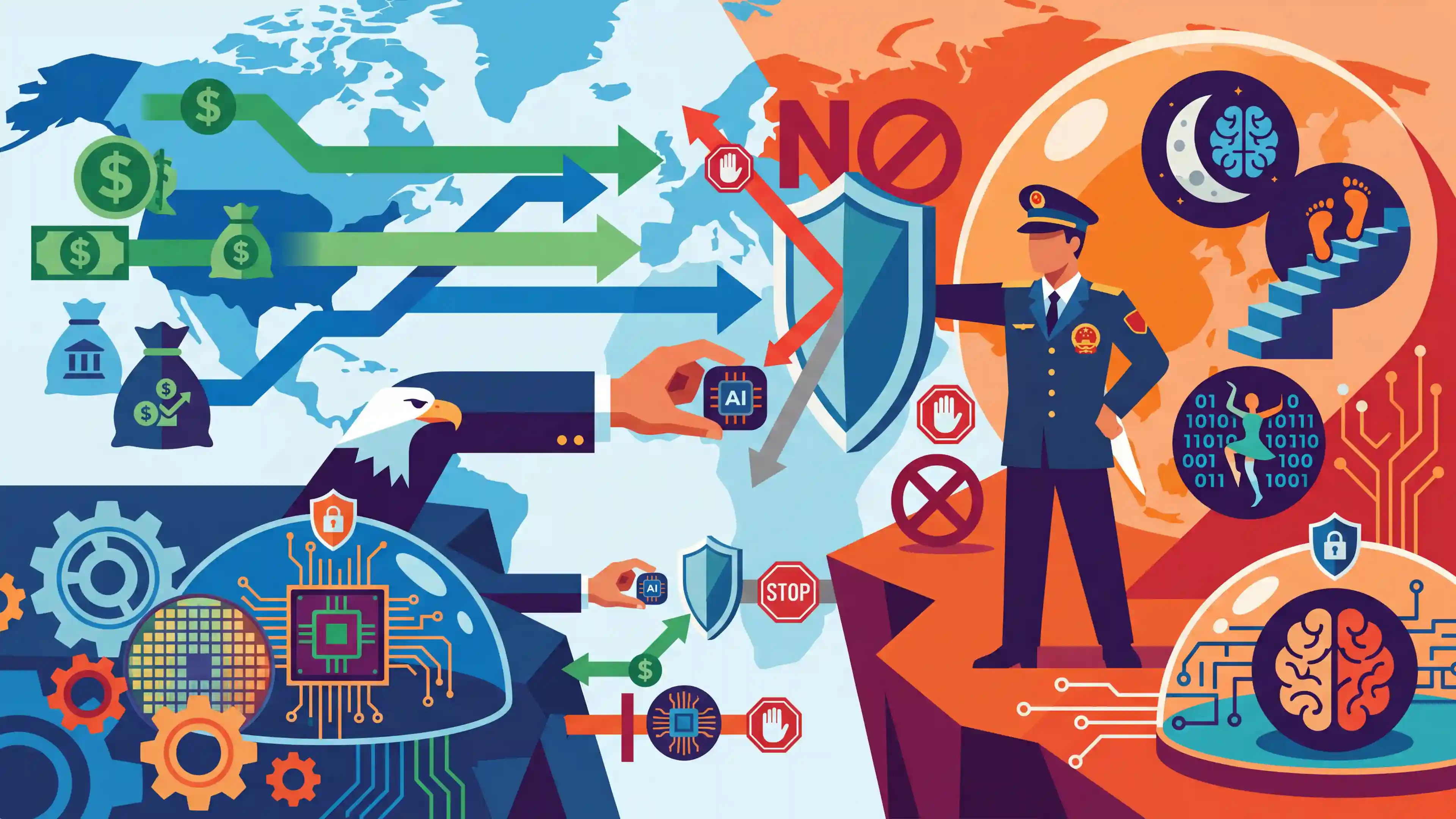
China is moving to restrict US investments in domestic technology companies, specifically mandating that major AI startups like Moonshot AI, StepFun, and ByteDance reject US venture capital without explicit approval from the National Development and Reform Commission (NDRC). Prompted by Meta's recent $2 billion acquisition of the Chinese AI firm Manus, the move represents a retaliatory measure against similar US restrictions on funding Chinese tech firms. This development highlights an accelerating US-China technological decoupling, where foreign direct investment (FDI) in critical sectors like AI, semiconductors, and quantum computing is increasingly treated as a national security issue rather than free trade.
Key Points
- China's National Development and Reform Commission (NDRC) has instructed domestic tech firms, including top AI startups, to reject US investments unless they obtain explicit government approval.
- The tightening of capital flows follows concerns raised by Meta's recent $2 billion acquisition of the Chinese AI startup Manus.
- The restrictions are targeted heavily at emerging technologies, including artificial intelligence, semiconductors, and quantum computing.
- This move serves as a reciprocal countermeasure to Washington's own restrictions on US investments in Chinese high-tech firms, escalating the ongoing US-China tech decoupling.
Important Terms
National Development and Reform Commission (NDRC)

China's premier macroeconomic planning body under the State Council. It formulates development strategies, manages national reserves, and exercises broad authority over foreign investment approvals and national security reviews.
UPSC context
GS-II/III. Key for understanding state-led economic governance and its influence on global supply chains and trade diplomacy.
Technological Decoupling
The strategic separation of two nations' technology sectors and supply chains to reduce interdependence, often motivated by national security, data privacy, and intellectual property concerns.
UPSC context
GS-II (International Relations). Essential for analyzing the U.S.-China rivalry and its implications for India’s strategic autonomy.
Foreign Direct Investment (FDI)
An investment made by an entity in one country into business interests located in another, establishing a lasting interest and significant management control over the foreign enterprise.
UPSC context
GS-III (Economy). Fundamental for questions on investment models, global trade wars, and national security screening of capital.
Protectionism
Government policies, such as tariffs, quotas, or investment curbs, designed to restrict international trade and protect domestic industries from foreign competition or strategic influence.
UPSC context
GS-III (Economy/Trade). Vital for understanding the shift from globalization toward economic sovereignty and industrial policy.
ByteDance
The Chinese parent company of TikTok; a global technology giant currently at the center of U.S.-China regulatory battles over data sovereignty and algorithmic control.
UPSC context
GS-III (Internal Security/Technology). A primary case study for cross-border data regulation and digital geopolitical tensions.
Manus AI
An AI startup whose $2 billion acquisition by Meta was blocked by Chinese regulators, serving as a landmark catalyst for China's retaliatory investment restrictions.
UPSC context
GS-III (Science & Technology). Illustrates the rising use of investment blocks as a tool in global technology competition.
Prelims Trap
"India requires mandatory government approval for all inbound FDI in the Artificial Intelligence and semiconductor sectors to protect national security."
False. India permits 100% FDI under the automatic route for most tech sectors. Mandatory government screening primarily applies to investments originating from countries sharing land borders with India (Press Note 3).
Static Concepts Connected
How does India screen foreign direct investment (FDI) for national security?
- Press Note 3: Mandates that investments from entities based in countries sharing a land border with India require mandatory government approval.
- Government Route: Strategic sectors like defence, telecom, and space require prior clearance from relevant ministries or the DPIIT, unlike the automatic route.
- FEMA 1999: The primary legislative framework enabling the government and RBI to regulate cross-border capital flows and enforce FDI restrictions.
What are "Dual-Use" technologies and how are they regulated globally?
- Definition: Technologies that have both civilian and military applications, such as Artificial Intelligence, quantum computing, and advanced semiconductors.
- Wassenaar Arrangement: A multilateral export control regime (which India joined in 2017) designed to prevent the destabilizing accumulation of dual-use goods.
- WTO Article XXI: The GATT security exception that nations increasingly invoke to justify trade and investment barriers on dual-use technological innovations.
Cross-Topic Patterns
FDI Screening & Press Note 3
China's NDRC restrictions mirror India's 2020 move requiring government approval for FDI from land-bordering nations, highlighting a global shift from free capital flows to strategic investment screening.
Dual-Use Tech & Export Regimes
The blocking of AI and semiconductor capital flows connects directly to the Wassenaar Arrangement, where states control the cross-border flow of dual-use goods and technologies.

Expect a 2026 Prelims question linking Geo-economic fragmentation, AI/quantum tech decoupling, and India’s FDI screening mechanisms.
Linked PYQs · 5
Linked PYQs · 5
- 2018MainsGS3
How would the recent phenomena of protectionism and currency manipulations in world trade affect macroeconomic stability of India?
- 2021MainsGS2
“The USA is facing an existential threat in the form of a China, that is much more challenging than the erstwhile Soviet Union.” Explain.
- 2023MainsGS3
Introduce the concept of Artificial Intelligence (AI). How does Al help clinical diagnosis? Do you perceive any threat to privacy of the individual in the use of Al in healthcare?
- 2014MainsGS3
Foreign Direct Investment (FDI) in the defence sector is now set to be liberalized. What influence this is expected to have on Indian defence and economy in the short and long run?
- 2011PrelimsGS1
Both Foreign Direct Investment (FDI) and Foreign Institutional Investor (FII) are related to investment in a country. Which one of the following statements best represents an important difference between the two?
