US and China Diplomatic Engagement and Non-Proliferation Concerns
Source:Indian Express ↗
Why It Matters
US-China relations fundamentally shape the global geopolitical landscape. Understanding the duality of their diplomatic engagements and security disputes—especially regarding nuclear testing and non-proliferation—is critical for analyzing international relations, global security architecture, and India's strategic positioning.
Summary
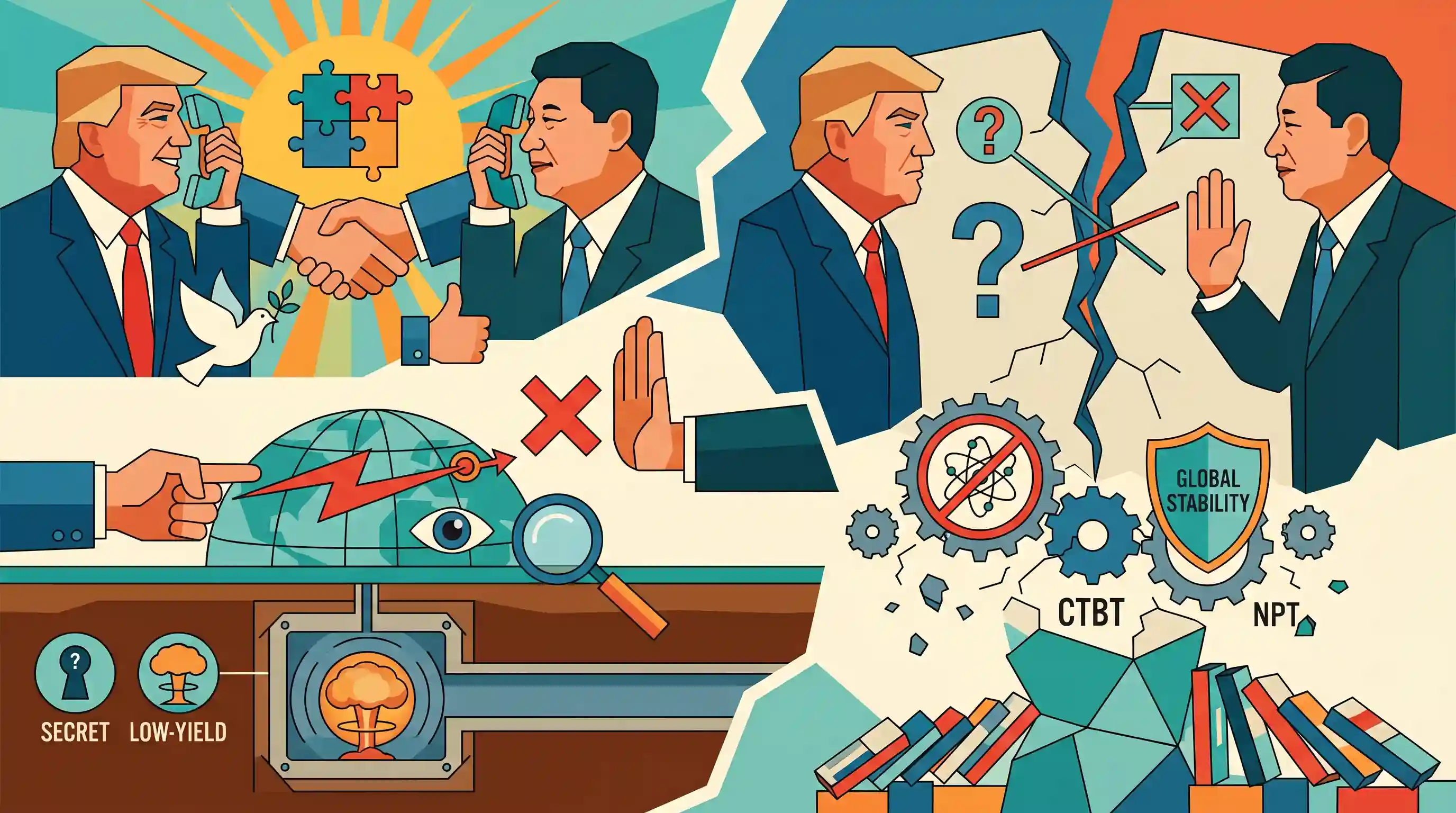
Recent developments in US-China relations present a complex picture, highlighted by an 'excellent' diplomatic phone call between Donald Trump and Xi Jinping, juxtaposed against serious US allegations that China conducted a secret, low-yield nuclear test. These contrasting events emphasize the enduring strategic mistrust between the two superpowers and raise significant concerns regarding global nuclear non-proliferation commitments and the integrity of international treaties like the CTBT.
Key Points
- US President Donald Trump and Chinese President Xi Jinping recently held a phone call described as 'excellent', signaling ongoing high-level diplomatic engagement despite underlying strategic tensions.
- Simultaneously, the US has leveled allegations claiming that China may have conducted a secret, low-yield nuclear test.
- The US claims regarding Chinese nuclear testing raise significant concerns regarding global nuclear non-proliferation and adherence to the Comprehensive Nuclear-Test-Ban Treaty (CTBT).
- These parallel developments underscore the complex and dual-track nature of US-China bilateral relations, characterized by both direct diplomatic dialogue and profound security mistrust.
Important Terms
Comprehensive Nuclear-Test-Ban Treaty (CTBT)

A multilateral treaty banning all nuclear explosions in all environments. It has not entered into force as key countries, including India, China, and the US, have not ratified it.
UPSC context
GS-II (International Treaties). Tests knowledge of global disarmament efforts and India's specific objections regarding a time-bound disarmament framework.
Treaty on the Non-Proliferation of Nuclear Weapons (NPT)
A 1968 treaty aiming to prevent the spread of nuclear weapons, promote peaceful nuclear energy, and achieve disarmament. It distinguishes between nuclear-weapon states (pre-1967) and non-nuclear states.
UPSC context
GS-II (International Groupings). Tests understanding of India's stance against 'nuclear apartheid' and the treaty's discriminatory nature.
Nuclear Non-Proliferation
International efforts to prevent the spread of nuclear weapons and technology to countries that do not already possess them.
UPSC context
GS-II & III. Critical for questions on global security, disarmament, and India’s 'No First Use' nuclear doctrine.
Strategic Mistrust
A condition where major powers perceive each other's long-term intentions as inherently hostile, leading to a cycle of suspicion that hampers diplomatic cooperation and fuels arms races.
UPSC context
GS-II (Bilateral Relations). Used to analyze the structural tensions in US-China or India-China relations and their global geopolitical impact.
International Atomic Energy Agency (IAEA)
The world's central intergovernmental forum for scientific and technical cooperation in the nuclear field, serving as the watchdog for nuclear safeguards and peaceful use.
UPSC context
GS-II (International Institutions). Tests knowledge of monitoring mechanisms for nuclear compliance and global energy security.
Horizontal vs. Vertical Proliferation
Horizontal proliferation refers to the spread of nuclear weapons to new states; vertical proliferation refers to the qualitative or quantitative improvement of existing nuclear arsenals.
UPSC context
GS-III (Internal Security/Technology). Tests technical understanding of arms race dynamics and the limitations of existing international treaties.
Prelims Trap
"China and the US have refused to sign the CTBT, aligning with India's stance."
The US and China have signed the CTBT but not ratified it. India is a non-signatory. UPSC often tricks aspirants by swapping "signed" with "ratified".
Static Concepts Connected
What is the "zero-yield" standard of the CTBT?
- Absolute Ban: It strictly prohibits any nuclear weapon test explosion or any other nuclear explosion, regardless of size or strategic purpose.
- Annex 2 Requirement: To enter into force, it requires ratification by 44 specific nuclear-capable states (Annex 2). India, Pakistan, and North Korea have not signed.
- US & China Status: Both nations are signatories to the treaty but have stalled on formal ratification, creating challenges in verifying clandestine low-yield tests.
How does India's 'No First Use' (NFU) policy compare to China's?
- China's Unconditional NFU: China is the only NPT-recognized nuclear weapon state maintaining a strict, unconditional NFU policy since 1964.
- India's Conditional NFU: India adopted NFU in 1998, but added a caveat retaining the right to nuclear retaliation against major chemical or biological attacks.
- Western Doctrines: Countries like the US and Russia do not maintain NFU policies, keeping the option of preemptive nuclear strikes under extreme circumstances.
Cross-Topic Patterns
Tactical nukes evade global arms control
While treaties like New START cap strategic high-yield weapons, low-yield tactical nuclear weapons remain largely unregulated, fueling regional security dilemmas and new arms races.
Economic engagement amidst military mistrust
Superpowers now routinely compartmentalize their relations, allowing high-level economic or trade dialogue to proceed even amidst severe military deterrence and nuclear mistrust.

Expect a 2026 question mixing CTBT’s 'zero-yield' standard, Annex 2 ratification hurdles, and comparing India's NFU to China's.
Linked PYQs · 3
Linked PYQs · 3
- 2021MainsGS2
“The USA is facing an existential threat in the form of a China, that is much more challenging than the erstwhile Soviet Union.” Explain.
- 2015PrelimsGS1
Consider the following countries: 1. China 2. France 3. India 4. Israel 5. Pakistan Which among the above are Nuclear Weapons States as recognized by the Treaty on the Non-Proliferation of Nuclear Weapons, commonly known as Nuclear Non-Proliferation Treaty (NPT)?
- 2018PrelimsGS1
What is/are the consequence/consequences of a country becoming the member of the 'Nuclear Suppliers Group'? 1. It will have access to the latest and most efficient nuclear technologies. 2. It automatically becomes a member of "The Treaty on the Non-Proliferation of Nuclear Weapons (NPT)". Which of the statements given above is/are correct?
