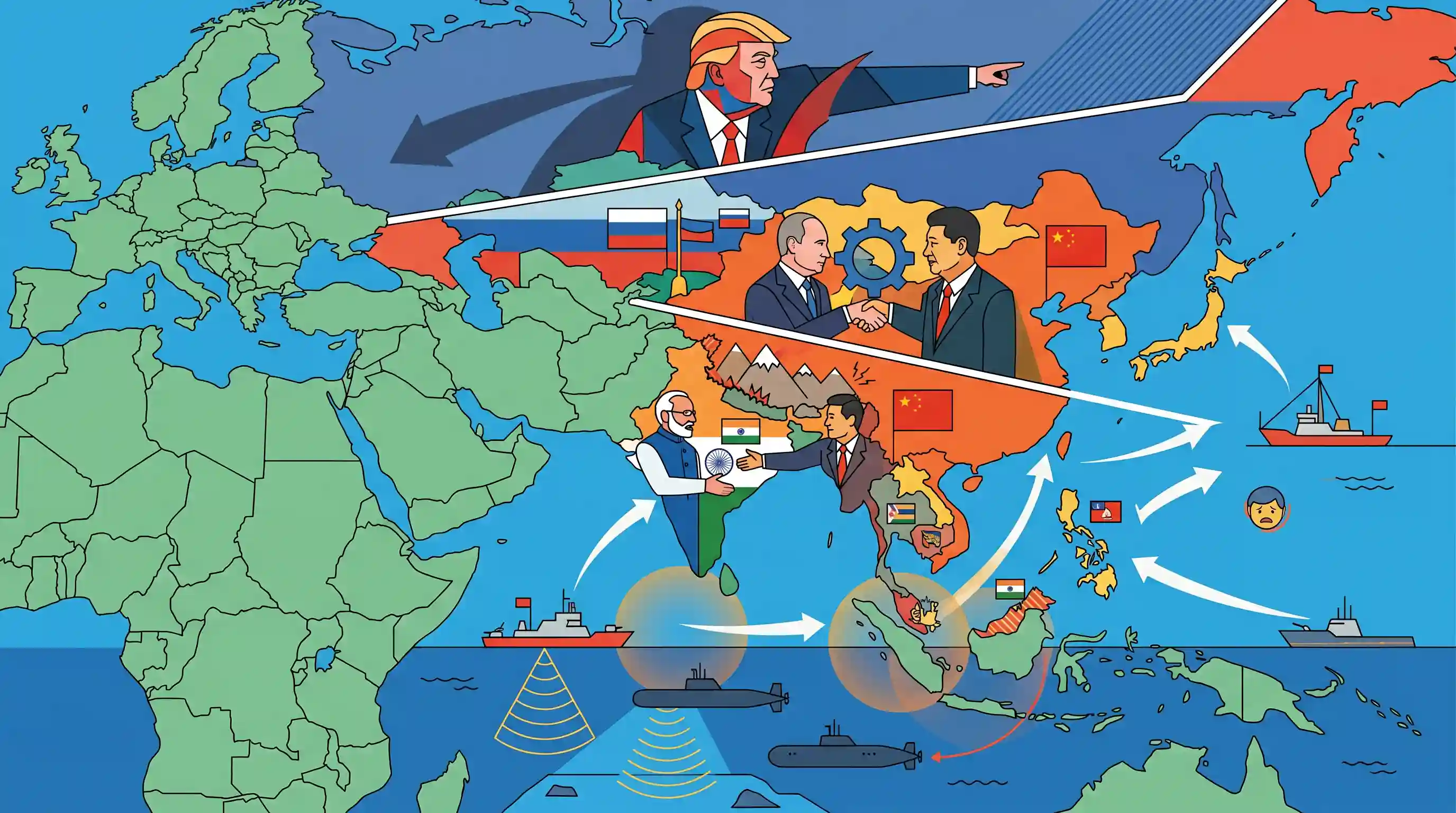
China Strategic Alignment and Maritime Expansion Developments
Source:Indian Express ↗
Why It Matters
These developments are central to India's strategic calculus. The Russia-China alignment affects global multipolarity, while India's diplomatic engagement with Beijing and China's maritime expansion directly impact India's continental and maritime security interests.
Summary
Recent geopolitical developments concerning China highlight multiple shifting dynamics. A potential visit by Russian President Vladimir Putin to China points to a strengthening Russia-China strategic axis, particularly amidst evolving political scenarios in the US involving Donald Trump. Concurrently, India’s appointment of a new Ambassador to China marks a renewed diplomatic effort to manage strained bilateral ties and the unresolved border situation. On the security front, China’s ongoing ocean mapping activities underscore its expanding maritime capabilities and ambitions, raising strategic concerns across the Indo-Pacific region.
Key Points
- The prospect of a visit by Russian President Vladimir Putin to China, potentially in the context of shifting US political dynamics involving Donald Trump, underscores the deepening strategic convergence between Moscow and Beijing.
- India has appointed a new Ambassador to China, a critical diplomatic development aimed at navigating the complex bilateral relationship amidst the ongoing border standoff.
- China's continued focus on ocean mapping and maritime surveillance reflects its expanding naval capabilities and strategic ambitions, which present security implications for the Indo-Pacific region.
Prelims Trap
"UNCLOS strictly prohibits foreign military vessels from conducting hydrographic surveys in a state's EEZ without permission."
UNCLOS requires coastal state consent for Marine Scientific Research (MSR) in the EEZ, but lacks explicit regulations for foreign military hydrographic surveys, creating a legal grey area.
Static Concepts Connected
How does UNCLOS regulate Marine Scientific Research and surveys in the EEZ?
- MSR Consent: Under UNCLOS, coastal states have sovereign rights to regulate and authorize MSR within their 200-nautical-mile EEZ.
- Foreign State Obligations: Foreign states must normally obtain explicit consent from the coastal state to conduct economic or scientific research in its EEZ.
- The Military Loophole: UNCLOS does not explicitly define or restrict 'military hydrographic surveys,' allowing nations to collect dual-use naval data without coastal state consent.
What is the WMCC in the context of India-China relations?
- Origin (2012): The Working Mechanism for Consultation and Coordination on India-China Border Affairs (WMCC) was established in 2012.
- Composition & Mandate: It comprises both diplomatic and military officials to manage tensions and implement confidence-building measures along the 3,488 km LAC.
- Limitation: It does not discuss the final boundary settlement (handled by Special Representatives) but focuses strictly on peace and tranquility at the border.
Cross-Topic Patterns
Dual-use mapping and IOR security
Chinese hydrographic data (seafloor topography, thermal layers) directly aids submarine stealth in the Indian Ocean, linking maritime law loopholes to Indian naval security and ASW (Anti-Submarine Warfare) preparedness.
Russia-China axis forces defense indigenization
The 'No Limits' partnership risks India's reliance on Russian arms during LAC conflicts, serving as the geopolitical catalyst for India's accelerated defense indigenization and Western tech transfers (like iCET).

Expect a Prelims question on UNCLOS EEZ provisions specifically contrasting Marine Scientific Research with military hydrographic surveys.
Linked PYQs · 3
Linked PYQs · 3
- 2021MainsGS2
“The USA is facing an existential threat in the form of a China, that is much more challenging than the erstwhile Soviet Union.” Explain.
- 2014MainsGS2
With respect to the South China sea, maritime territorial disputes and rising tension affirm the need for safeguarding maritime security to ensure freedom of navigation and over flight throughout the region. In this context, discuss the bilateral issues between India and China.
- 2025MainsGS3
Why is maritime security vital to protect India's sea trade? Discuss maritime and coastal security challenges and the way forward.
