Trilateral engagement and tech restrictions shape regional geopolitics
Source:Indian Express ↗
Why It Matters
The China-Pakistan-Afghanistan nexus poses direct strategic and security challenges for India, particularly regarding CPEC's passage through PoK and regional stability. Additionally, the US-China tech war over semiconductors and AI has profound implications for global supply chains, presenting structural shifts that India must navigate as it seeks to build its own semiconductor ecosystem.
Summary
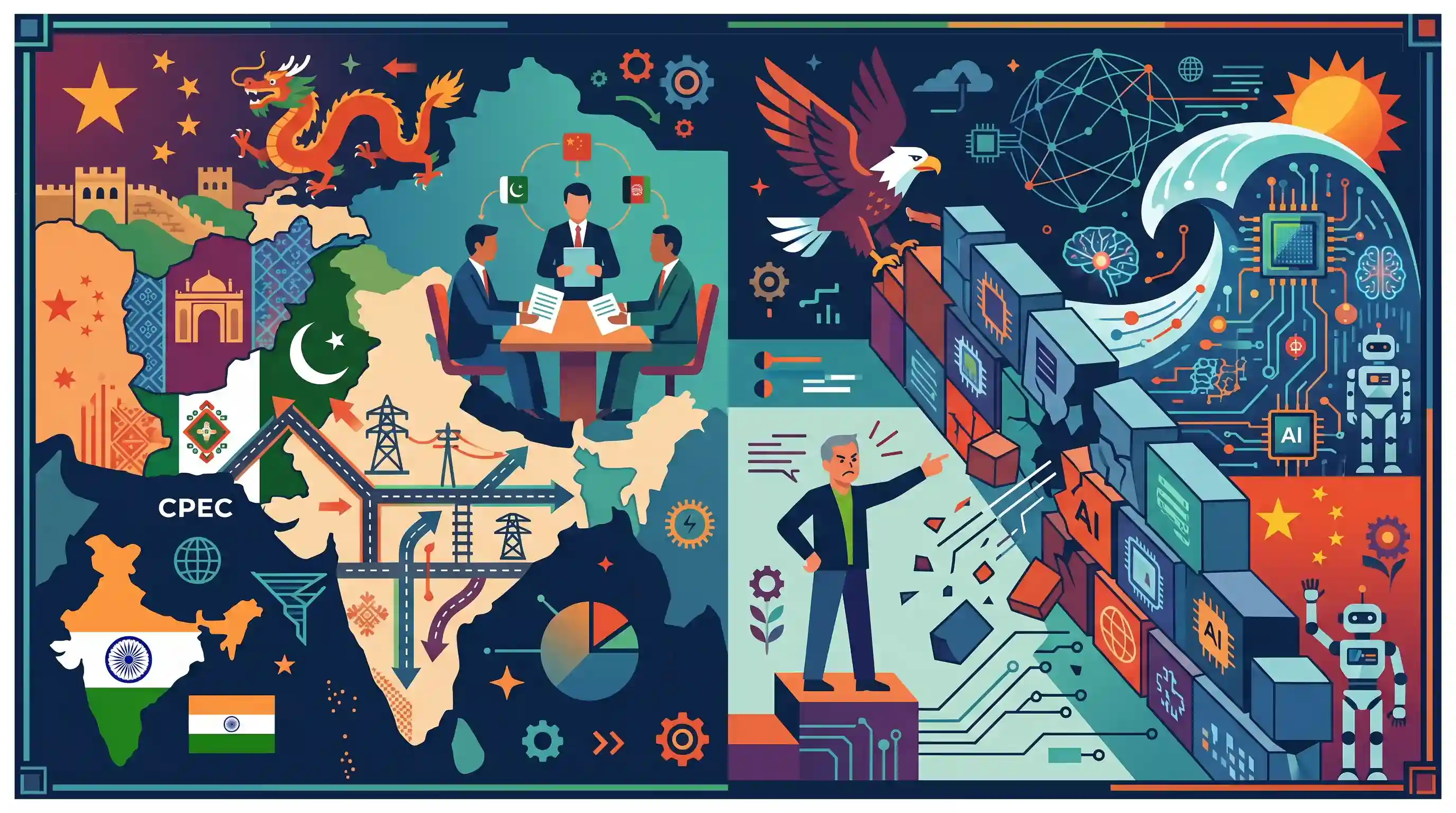
The article covers two significant developments concerning China's geopolitical and technological strategies. First, Beijing hosted a trilateral meeting with Pakistan and Afghanistan, signaling China's deepening engagement in South Asia and efforts to integrate Afghanistan into the China-Pakistan Economic Corridor (CPEC). Second, NVIDIA CEO Jensen Huang criticized US export controls aimed at restricting China's access to advanced semiconductors and Artificial Intelligence, declaring the policy a 'failure.' Together, these events underscore China's expanding influence in its neighborhood and the limitations of US efforts to technologically contain Beijing.
Key Points
- China hosted a trilateral dialogue in Beijing with Pakistan and Afghanistan, reflecting its proactive diplomatic and strategic maneuvering in South Asia following the US withdrawal from Afghanistan.
- The meeting focuses on regional security, counter-terrorism, and the potential extension of the China-Pakistan Economic Corridor (CPEC) into Afghanistan.
- NVIDIA CEO Jensen Huang characterized US technological export controls—designed to curb China's access to advanced AI chips and semiconductors—as a 'failure.'
- The statement highlights the limits of Western containment strategies, suggesting that China is finding ways to indigenize technology and bypass restrictions in the ongoing US-China tech war.
- These parallel events showcase China's dual focus: strengthening its geopolitical and geoeconomic footprint in its immediate neighborhood while contesting Western hegemony in critical emerging technologies.
Important Terms
Belt and Road Initiative (BRI)

China's global infrastructure strategy linking Asia, Africa, and Europe via land and sea routes. It expands Chinese influence through large-scale investments in transportation, energy, and digital networks.
UPSC context
GS-II: International Relations. Tests understanding of China’s global footprint and its geopolitical impact on India’s strategic interests and regional connectivity.
China-Pakistan Economic Corridor (CPEC)
A $62 billion flagship BRI project connecting China’s Xinjiang to Pakistan’s Gwadar port. It integrates roads, railways, and energy infrastructure, recently expanding to include Afghanistan for regional trade.
UPSC context
GS-II: India and its neighborhood. Tests awareness of territorial integrity issues (PoK) and shifting power dynamics in South Asia.
NVIDIA
A leading American technology firm specializing in AI semiconductors. Its CEO recently critiqued US export controls as 'failed' after the company’s direct market share in China plummeted to zero.
UPSC context
GS-III: Science and Technology. Tests knowledge of semiconductor supply chains, tech-diplomacy, and the impact of trade wars on global innovation.
Strategic Depth
A geopolitical concept referring to the distance between core assets and potential front lines, often sought through regional alliances to ensure security and resource access.
UPSC context
GS-II: Internal Security/IR. Tests understanding of regional power struggles and how China-Pakistan-Afghanistan cooperation affects India’s western borders.
Prelims Trap
CPEC is exclusively a bilateral economic corridor between China and Pakistan, excluding all other nations.
While initially launched as a strictly bilateral agreement, recent trilateral frameworks have formalized the extension of CPEC into Afghanistan.
Static Concepts Connected
Why does India officially oppose the China-Pakistan Economic Corridor (CPEC)?
- Territorial sovereignty: The corridor traverses Gilgit-Baltistan in Pakistan-occupied Kashmir (PoK), which India asserts is an illegal occupation of its sovereign territory.
- Strategic encirclement: It facilitates a two-front threat by deepening the China-Pakistan military-economic nexus near India's sensitive western borders.
- BRI concerns: India opposes the broader Belt and Road Initiative (BRI) for lacking transparency, violating ecological norms, and pushing nations into debt traps.
What are the structural vulnerabilities in the global semiconductor supply chain?
- Mineral dependencies: Manufacturing relies heavily on raw materials like silicon, gallium, germanium, and rare earth elements—markets largely dominated by China.
- Fabrication bottlenecks: While the US leads in intellectual property and chip design, actual fabrication is heavily concentrated in East Asia (like Taiwan's TSMC).
- Equipment chokepoints: Advanced chip manufacturing requires Extreme Ultraviolet (EUV) lithography machines, a technology monopolized by a single European company, ASML.
Cross-Topic Patterns
Semiconductor chokepoints as modern oil
The US-China AI chip war mirrors resource geopolitics. Western export controls on technology are heavily countered by China's retaliatory export curbs on critical chip-making minerals like gallium and germanium.
CPEC expansion vs. Chabahar Port
Integrating Afghanistan into CPEC creates a direct geopolitical rival to India's investments in Iran's Chabahar Port, challenging New Delhi's strategy to bypass Pakistan for Central Asian access.

CPEC's Afghan extension and semiconductor supply chokepoints are highly likely to appear as multi-statement questions in 2026.
Linked PYQs · 4
Linked PYQs · 4
- 2024MainsGS2
‘The West is fostering India as an alternative to reduce dependence on China's supply chain and as a strategic ally to counter China's political and economic dominance.’ Explain this statement with examples.
- 2021MainsGS2
“The USA is facing an existential threat in the form of a China, that is much more challenging than the erstwhile Soviet Union.” Explain.
- 2016PrelimsGS1
'Belt and Road Initiative' is sometimes mentioned in the news in the context of the affairs of
- 2018MainsGS2
What are the key areas of reform if the WTO has to survive in the present context of "Trade War', especially keeping in mind the interest of India?
