Strait of Hormuz Blockade and Geopolitical Friction
Source:The Hindu ↗
Why It Matters
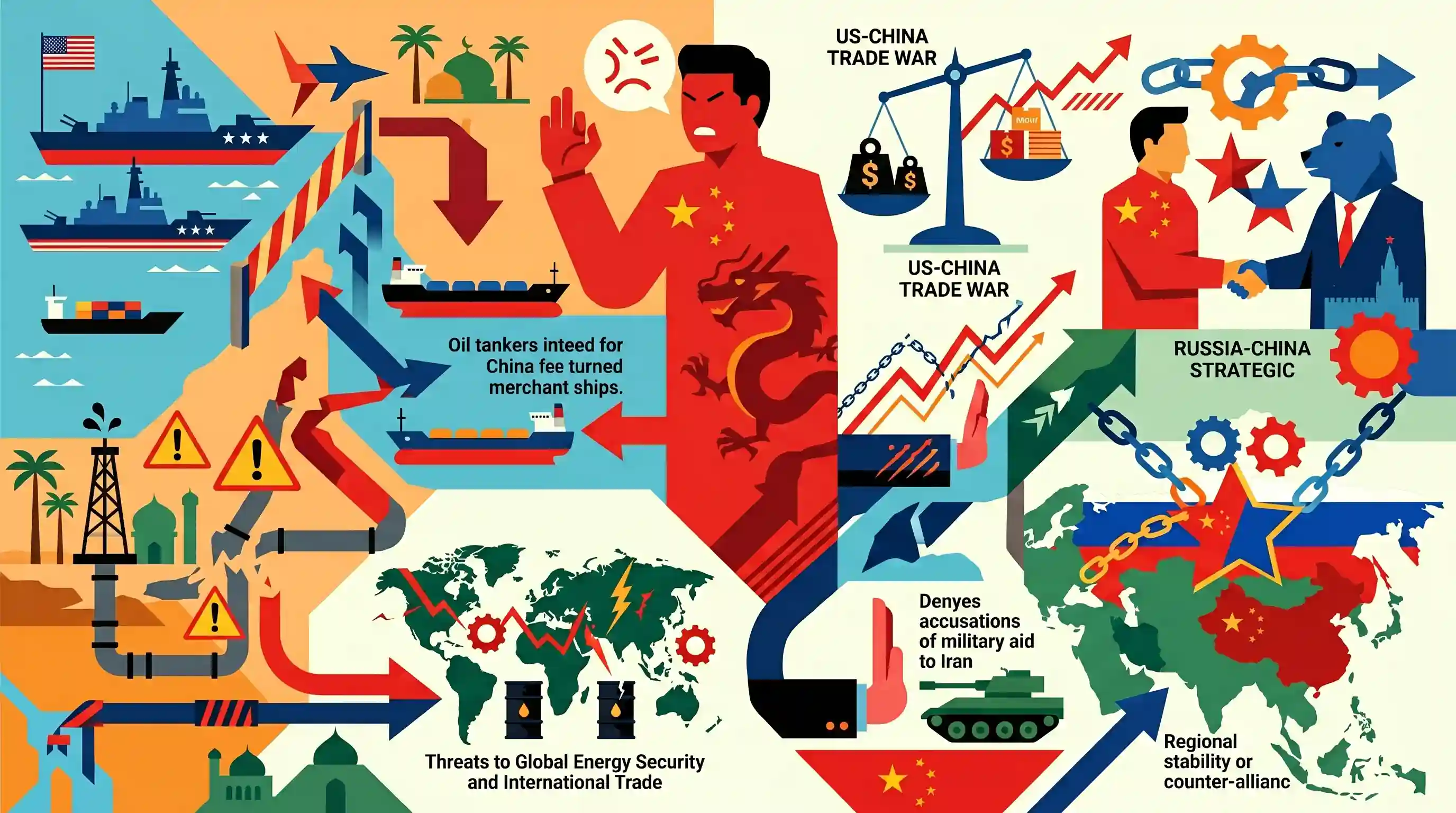
The Strait of Hormuz is a vital global maritime chokepoint for oil transport. A blockade by the US and the resulting geopolitical friction involving China, Russia, and Iran carry severe implications for global energy security and supply chains, directly affecting energy-dependent nations like India. The incident also highlights the weaponization of economic policies (tariffs) and the hardening of anti-US strategic alignments (Russia-China-Iran).
Summary
China has strongly criticized the US military blockade of the Strait of Hormuz, calling it a "dangerous and irresponsible" action that threatens global energy security and international trade. The blockade targets Iranian oil exports, which heavily affect major importers like China. Amidst the standoff, China denied US President Donald Trump's accusations of providing military aid to Iran and warned of retaliation against threatened tariff hikes. The escalating crisis has also prompted strategic diplomatic discussions between China and Russia, highlighting shifting geopolitical alignments in response to US actions in the Middle East.
Key Points
- China strongly condemned the US blockade of the Strait of Hormuz, terming it a "dangerous and irresponsible" move that threatens global trade and stability.
- The blockade is intended to cripple Iran's oil exports, which directly impacts China as a major importer of Iranian crude.
- China denied US allegations of providing military assistance to Tehran and threatened countermeasures against proposed US tariff hikes.
- Russian Foreign Minister Sergey Lavrov visited Beijing to coordinate with China regarding the escalating US-Iran conflict and the blockade.
- Tensions continue to rise due to increased US military deployment in the region, despite a temporary ceasefire technically remaining in place.
Prelims Trap
Under UNCLOS, coastal states bordering the Strait of Hormuz can temporarily suspend transit passage citing national security.
UNCLOS guarantees non-suspendable 'transit passage' through international straits. Unlike 'innocent passage' in regular territorial waters, transit passage cannot be unilaterally suspended by coastal states.
Static Concepts Connected
What are the key geographic features and bypass routes for the Strait of Hormuz?
- Location: Connects the Persian Gulf to the Gulf of Oman. It is physically bounded by Iran to the north, and Oman (Musandam Peninsula) and the UAE to the south.
- Trade volume: Handles approximately 25% of global seaborne oil trade and nearly 20% of global liquefied natural gas (LNG) exports, making it a critical energy chokepoint.
- Bypass pipelines: Regional exporters use Saudi Arabia's East-West Pipeline (to the Red Sea) and the UAE's Abu Dhabi Crude Oil Pipeline (to the Gulf of Oman) to bypass the strait.
How does 'Transit Passage' differ from 'Innocent Passage' under UNCLOS?
- Transit Passage: Applies to straits used for international navigation (like Hormuz). It provides non-suspendable, continuous transit rights for all civilian and military vessels, including submerged submarines.
- Innocent Passage: Applies to territorial seas. Coastal states can temporarily suspend it for security reasons, and military submarines are required to navigate on the surface and show their flag.
Cross-Topic Patterns
Chokepoints and India's SPR
Hormuz disruptions directly test India's Strategic Petroleum Reserves (SPR) capacity and accelerate its push to diversify crude imports away from the Middle East.
Sino-Russian Axis & Sanction Bypassing
US pressure on Iran drives a deeper Beijing-Moscow-Tehran strategic alignment, potentially militarizing regional infrastructure and creating alternative non-dollar trade mechanisms.

Expect a multi-statement question mapping Hormuz bordering nations, bypass pipelines (ADCOP), and UNCLOS transit passage rules in 2026.
Linked PYQs · 4
Linked PYQs · 4
- 2025MainsGS2
"Energy security constitutes the dominant kingpin of India's foreign policy, and is linked with India's overarching influence in Middle Eastern countries.” How would you integrate energy security with India's foreign policy trajectories in the coming years?
- 2017MainsGS2
The question of India's Energy Security constitutes the most important part of India's economic progress. Analyze India's energy policy cooperation with West Asian countries.
- 2021MainsGS2
“The USA is facing an existential threat in the form of a China, that is much more challenging than the erstwhile Soviet Union.” Explain.
- 2025MainsGS2
"The reform process in the United Nations remains unresolved, because of the delicate imbalance of East and West and entanglement of the USA vs. Russo-Chinese alliance.” Examine and critically evaluate the East-West policy confrontations in this regard.
