China Takes Taiwan Dispute with Japan to UN under Article 51
Source:The Hindu ↗
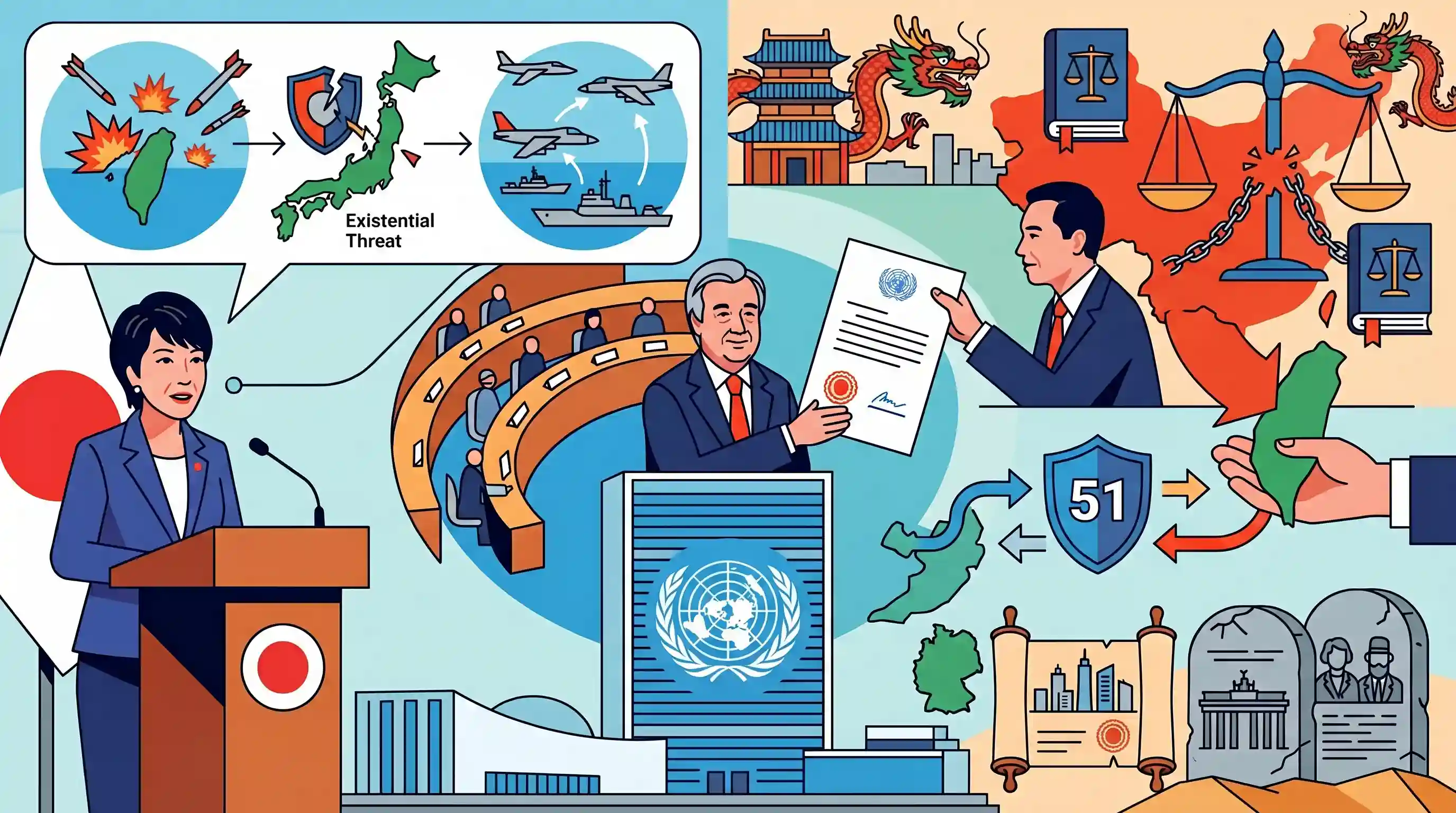
Why It Matters
The dispute underscores the fragile security environment in the Indo-Pacific and highlights Japan's evolving security posture away from strict pacifism. For UPSC aspirants, it demonstrates how nations use "lawfare"—leveraging UN Charters (Article 51) and historical declarations (Potsdam, Cairo)—to build legal narratives and deter foreign intervention in territorial conflicts.
Summary
China has escalated its diplomatic dispute with Japan to the United Nations over Japanese Prime Minister Sanae Takaichi's comments regarding Taiwan. Takaichi suggested that an armed attack on Taiwan could be considered an existential threat to Japan, potentially triggering the deployment of Japanese military forces. In response, China's UN Ambassador Fu Cong submitted a letter to UN Secretary-General Antonio Guterres, characterizing the remarks as a grave violation of international law. China reiterated its "One China" policy and invoked Article 51 of the UN Charter, asserting its right to self-defence against any armed intervention by Japan. The letter also cited historical agreements like the Cairo and Potsdam declarations to validate Beijing's sovereignty over Taiwan.
Key Points
- China filed a formal complaint at the UN against Japanese PM Sanae Takaichi's remark that a Chinese attack on Taiwan could trigger Japan's military deployment.
- Takaichi suggested a Taiwan crisis might be classified as a situation threatening Japan's survival, which allows Japan to use military force under its revised security laws.
- China invoked Article 51 of the UN Charter, claiming the right to self-defence if Japan initiates an armed intervention over Taiwan.
- China utilized historical international agreements (Cairo and Potsdam declarations) and UNGA Resolution 2758 to assert that Taiwan is an integral part of its territory and firmly an internal affair.
Important Terms
UN Charter (Article 51)

A provision recognizing a state's inherent right to individual or collective self-defence if an armed attack occurs, until the UN Security Council takes necessary measures.
UPSC context
GS-II (International Law); tests legal justifications for military force and sovereignty-related use of force in international relations.
One China Principle
Beijing's core diplomatic position that there is only one sovereign state called China, with the PRC as the sole legitimate government and Taiwan as its part.
UPSC context
GS-II (IR); essential for understanding China's territorial claims, cross-strait tensions, and Indo-Pacific geopolitical dynamics.
UNGA Resolution 2758
A 1971 resolution recognizing the People’s Republic of China (PRC) as the sole legitimate representative of China at the UN, expelling the representatives of Taiwan.
UPSC context
GS-II (International Relations); tests knowledge of Taiwan's legal exclusion from the UN and China's diplomatic dominance in multilateral forums.
Cairo Declaration (1943)
A 1943 WWII agreement between the US, UK, and China stating that territories stolen by Japan, specifically including Taiwan (Formosa), must be restored to China.
UPSC context
GS-I (World History) and GS-II (IR); provides the historical-legal basis often cited by China to justify sovereignty over Taiwan.
Potsdam Declaration (1945)
A 1945 proclamation defining terms for Japan's unconditional surrender, reaffirming that the territorial restoration terms of the Cairo Declaration must be implemented.
UPSC context
GS-I (World History); crucial for analyzing the post-WWII international order and current maritime/territorial disputes in East Asia.
One China Policy
The diplomatic acknowledgement by countries (like India and the US) that the PRC is China's sole legal government, while maintaining unofficial economic/cultural ties with Taiwan.
UPSC context
GS-II (Indian Foreign Policy); tests India’s strategic shift since 2010 and its balancing act between Beijing and Taipei.
Prelims Trap
UNGA Resolution 2758 explicitly recognizes Taiwan as an inalienable province of the People's Republic of China.
The 1971 resolution expelled Chiang Kai-shek's representatives and recognized PRC as the sole UN representative, but crucially remained silent on Taiwan's sovereign status.
Static Concepts Connected
What are the limitations of Article 51 (Self-Defence) under the UN Charter?
- Trigger condition: Requires an actual 'armed attack' to occur; its application for anticipatory or pre-emptive self-defence remains highly debated in international law.
- UNSC supremacy: Measures taken must be immediately reported to the UN Security Council and must cease once the UNSC takes necessary action.
- Collective defense: Allows mutual defense treaties to be legally activated if a member is attacked, permitting allied intervention.
How does Japan's Article 9 affect its military posture in the Indo-Pacific?
- Pacifist core: Constitutionally renounces war as a sovereign right to settle disputes and forbids the maintenance of traditional armed forces.
- 2015 Reinterpretation: Permits 'collective self-defence' to deploy the Self-Defense Forces if an ally is attacked and the situation poses an existential threat to Japan's survival.
Cross-Topic Patterns
Taiwan crisis & semiconductor supply chains
Armed conflict over Taiwan threatens vital East China Sea SLOCs, directly jeopardizing India's semiconductor imports and domestic electronics manufacturing missions.
Japan's re-militarization and the Quad
Japan's shift toward 'collective self-defence' transforms the Quad from a purely diplomatic dialogue into a more credible security deterrent against Chinese assertiveness in the Indo-Pacific.

Expect a 2026 prelims question pairing UN Charter Article 51's 'collective self-defence' with Japan's Article 9 reinterpretation.
Linked PYQs · 3
Linked PYQs · 3
- 2022PrelimsGS1
Which one of the following statements best reflects the issue with Senkaku Islands, sometimes mentioned in the news?
- 2019MainsGS2
‘The time has come for India and Japan to build a strong contemporary relationship, one involving global and strategic partnership that will have a great significance for Asia and the world as a whole.’ Comment.
- 2020MainsGS2
What is the significance of Indo-US defence deals over Indo-Russian defence deals? Discuss with reference to stability in the Indo-Pacific region.
