China Suspends Critical Mineral Export Bans to United States
Source:The Hindu ↗
Why It Matters
The weaponization of critical minerals is a major theme in modern geopolitics. The U.S.-China technology rivalry directly impacts global supply chains, semiconductor manufacturing, and renewable energy transitions. Understanding these dynamics is crucial for India as it navigates its strategic partnerships and attempts to position itself as a reliable node in global supply chains under the 'China-Plus-One' strategy.
Summary
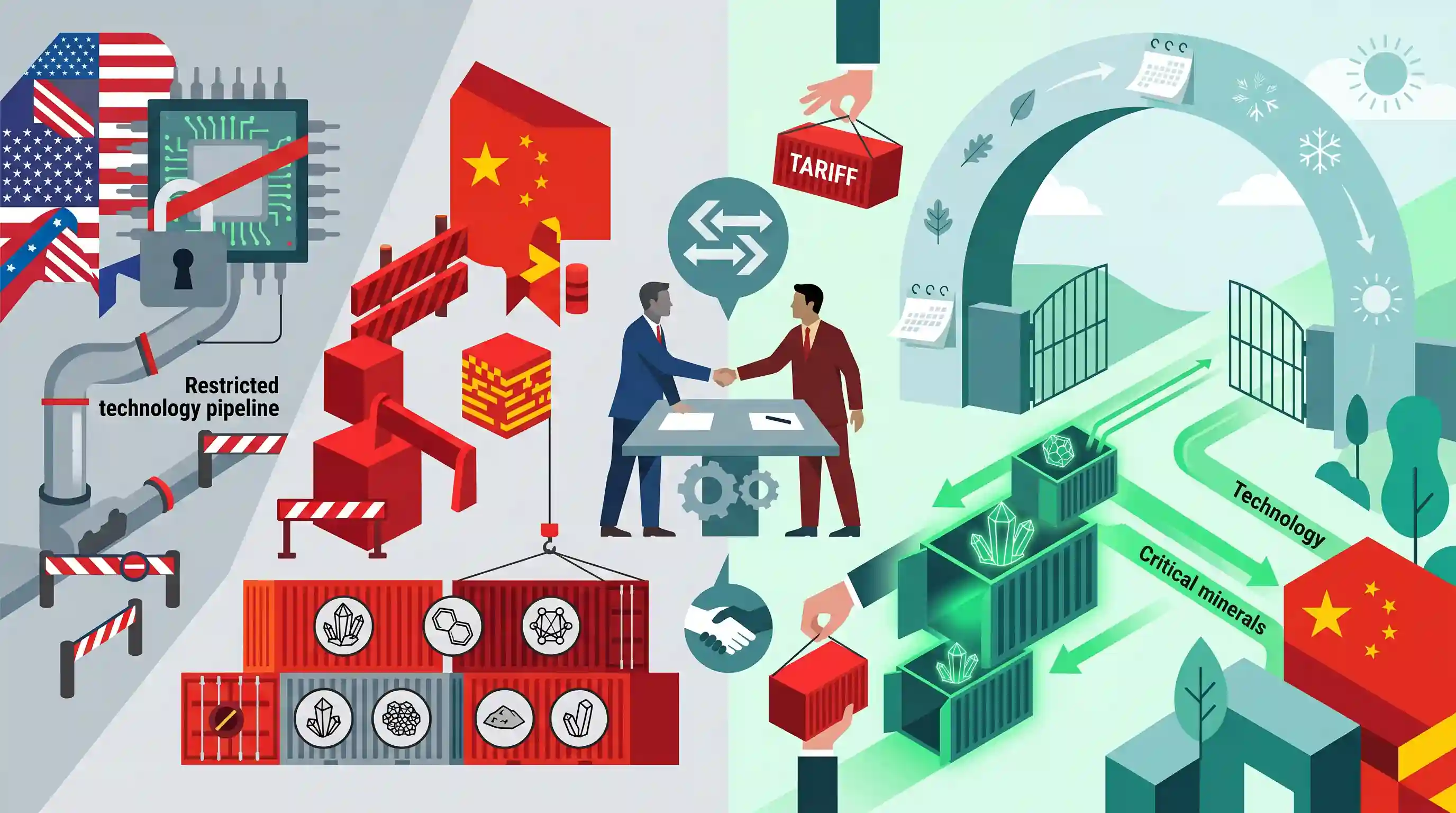
China has temporarily suspended its export bans on critical dual-use minerals—including gallium, germanium, antimony, and graphite—to the United States until late 2026. This follows similar recent reprieves for rare earths and lithium battery materials. The export controls were initially deployed as countermeasures against U.S. restrictions on advanced semiconductor chips. The suspension represents a significant de-escalation in the U.S.-China technology and trade war, emerging as a diplomatic outcome of recent negotiations between Presidents Xi Jinping and Donald Trump to stabilize bilateral relations and pause sweeping tariff measures.
Key Points
- China has suspended its ban on exporting critical minerals including gallium, germanium, and antimony to the United States until November 27, 2026.
- The suspension also relaxes stricter end-user and end-use checks on dual-use graphite exports to the U.S.
- This policy shift follows earlier October suspensions on the export of rare earth elements and lithium battery materials to the U.S.
- The export controls were originally implemented in retaliation against U.S. restrictions on the sale of advanced semiconductor chips to China.
- The rollback is a direct outcome of negotiations between President Xi Jinping and President Donald Trump aimed at managing tariffs and stabilizing bilateral trade relations.
Important Terms
Dual-use items

Items, software, or technology that have legitimate civilian applications but can also be adapted for military purposes, such as advanced sensors or specialty chemicals.
UPSC context
GS-III (Internal Security) and GS-II (International Relations). Tests understanding of strategic trade controls and non-proliferation regimes.
Gallium and Germanium
Rare metals essential for high-speed semiconductors, fiber optics, and defense tech like night-vision goggles. China produces approximately 80% and 60% of global supply, respectively.
UPSC context
GS-III (Economy/Science). Relevant for semiconductor missions and global supply chain vulnerabilities.
SCOMET List
India's specific list for regulating the export of dual-use items (Special Chemicals, Organisms, Materials, Equipment, and Technologies) under the Foreign Trade Policy.
UPSC context
Prelims and GS-III (Economy). Essential for questions on India's export policy and strategic autonomy.
Critical Minerals
Naturally occurring elements (e.g., lithium, rare earths, graphite) essential for modern technology and green energy that face significant supply chain disruption risks.
UPSC context
GS-III (Energy/Economy). Crucial for net-zero goals and the Mineral Security Partnership (MSP).
Antimony
A semi-metal used in flame retardants, ammunition, and lead-acid batteries. It is increasingly controlled by China to gain leverage in trade negotiations.
UPSC context
GS-III (Industrial Policy/Defense). Focuses on mineral-based industrial inputs and geopolitical leverage.
MOFCOM (Ministry of Commerce)
China's cabinet-level executive agency responsible for formulating trade policy, managing export licenses, and implementing trade countermeasures.
UPSC context
GS-II (International Relations). Key actor in the U.S.-China trade war and global trade governance.
Prelims Trap
"Gallium and Germanium are rare earth elements predominantly controlled by China..."
Gallium, Germanium, and Antimony are critical and strategic minerals (often dual-use), but they are not part of the 17 designated Rare Earth Elements (REEs) on the periodic table.
Static Concepts Connected
What is the US-led Mineral Security Partnership (MSP)?
- Objective: Formed to catalyze public and private investment in critical mineral supply chains globally.
- China-plus-one Strategy: Aims to reduce global dependency on China for critical minerals (like Cobalt, Lithium, Rare Earths).
- India's Membership: India formally joined the 14-member MSP in 2023, boosting its clean energy transition and securing strategic high-tech raw materials.
How did the MMDR Amendment Act 2023 change India's critical mineral rules?
- Atomic List Revision: Removed six key minerals (including Lithium, Niobium, Titanium) from the restricted 'Atomic Minerals' list.
- Private Mining: Allowed private sector exploration and mining for these newly reclassified critical and strategic minerals.
- Central Auction Power: Empowered the Central Government to exclusively auction concessions for a notified list of 24 critical minerals.
Cross-Topic Patterns
Mineral Security Partnership (MSP)
China's weaponization of mineral exports validates India’s recent entry into the US-led Mineral Security Partnership (MSP), designed to build "China-plus-one" supply chains for the clean energy transition.
Semiconductor Mission & EV PLIs
India's domestic manufacturing ambitions under the India Semiconductor Mission and EV battery PLIs remain acutely vulnerable to raw material chokepoints historically controlled by China's export regimes.

Expect a match-the-following Prelims question pairing critical minerals (Gallium, Antimony) with their specific high-tech applications.
Linked PYQs · 3
Linked PYQs · 3
- 2025PrelimsGS1
Consider the following statements : Statement I: Some rare earth elements are used in the manufacture of flat television screens and computer monitors. Statement II : Some rare earth elements have phosphorescent properties. Which one of the following is correct in respect of the above statements?
- 2021MainsGS2
“The USA is facing an existential threat in the form of a China, that is much more challenging than the erstwhile Soviet Union.” Explain.
- 2024MainsGS2
‘The West is fostering India as an alternative to reduce dependence on China's supply chain and as a strategic ally to counter China's political and economic dominance.’ Explain this statement with examples.
