China Urges Restraint Amid Escalating India Pakistan Military Conflict
Source:The Hindu ↗
Why It Matters
The ongoing escalation demonstrates a significant shift in sub-conventional warfare dynamics, particularly the extensive use of drones to target vital infrastructure. Additionally, China's swift diplomatic response highlights its strategic interest and efforts to position itself as a stabilizing mediator in South Asian geopolitics, adding a complex trilateral dimension to regional security.
Summary
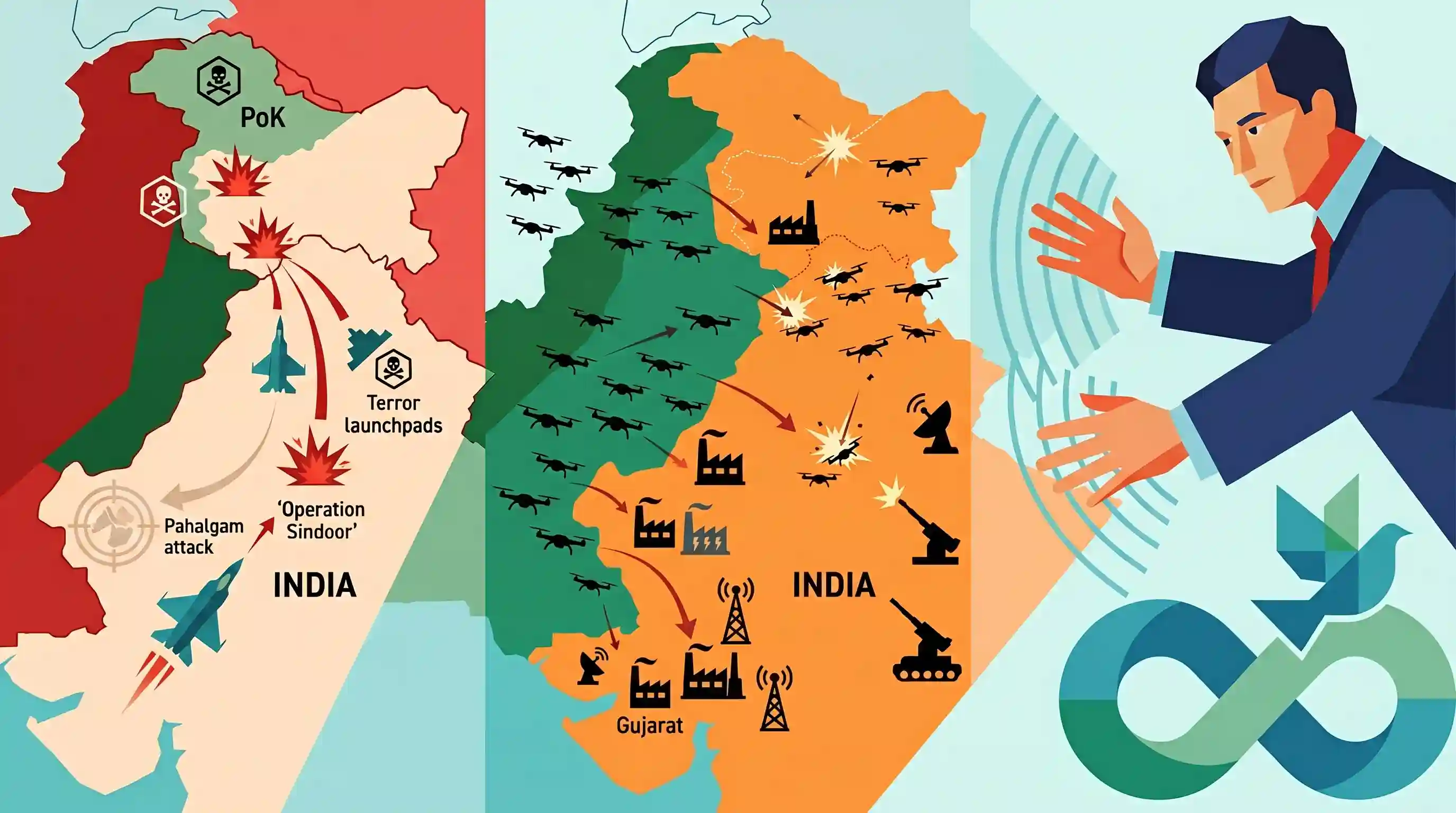
China's Foreign Ministry has urged India and Pakistan to exercise calm and restraint amid escalating military tensions. The conflict intensified following 'Operation Sindoor,' wherein Indian armed forces conducted precision strikes on terror launchpads in Pakistan and PoK in retaliation for the April 22 Pahalgam attack. In response, Pakistan launched a wave of drone attacks targeting 26 locations across India, including vital installations from J&K to Gujarat, which the Indian Defence Ministry stated were successfully thwarted. Expressing deep concern, China offered to play a constructive role in ensuring peace and stability in the region.
Key Points
- China strongly urged India and Pakistan to exercise restraint and seek political settlement following recent military escalations.
- Tensions spiked under Operation Sindoor, initiated by Indian precision strikes on terror launchpads in Pakistan and PoK in response to the April 22 Pahalgam attack.
- Pakistan retaliated with a major wave of drone attacks targeting 26 locations across India, stretching from J&K to Gujarat, attempting to strike airports and air bases.
- India's Defence Ministry confirmed that all attempts by Pakistani drones to hit vital installations were successfully thwarted.
- China expressed deep concern over the escalation and stated its willingness to play a constructive role in maintaining peace and stability in the region.
Important Terms
Operation Sindoor

Indian military operation launched in May 2025, involving precision strikes on terror infrastructure in Pakistan and PoK following the Pahalgam attack.
UPSC context
GS III: Internal Security. Tests understanding of punitive deterrence and shifts in India's military response to cross-border terrorism.
Cross-border Terrorism
Terrorism originating in one country to target another, involving cross-border training, funding, and logistical support for militants.
UPSC context
GS III: Challenges to Internal Security. Primary driver of India-Pakistan instability and international diplomatic lobbying.
Drone Warfare
The use of unmanned aerial vehicles (UAVs) for reconnaissance and offensive strikes, often providing low-cost, high-impact options for asymmetric warfare.
UPSC context
GS III: Security and Science/Tech. Focuses on technological advancements in conflict and India’s need for anti-drone defense systems.
PoK (Pakistan occupied Kashmir)
The territory of Jammu and Kashmir under Pakistani control since 1947, which India officially claims as an integral part of its sovereign territory.
UPSC context
GS II: International Relations. Core territorial dispute and site of recent Indian military counter-terror operations.
Strategic Restraint
A policy of avoiding military escalation despite provocation, prioritizing diplomatic and economic responses over immediate armed force.
UPSC context
GS II: India’s Foreign Policy. Analyzes the evolution from defensive posturing to proactive response mechanisms.
Precision Strikes
Targeted attacks intended to neutralize specific high-value assets or infrastructure with minimal collateral damage to civilians or non-combatants.
UPSC context
GS III: Defence Policy. Modern military doctrine focusing on calibrated responses to provocations without triggering full-scale war.
Prelims Trap
India permits UN or third-party mediation to de-escalate military conflicts with Pakistan.
India strictly adheres to the 1972 Shimla Agreement, mandating that all disputes with Pakistan be resolved bilaterally. It categorically rejects any third-party intervention.
Static Concepts Connected
What is the diplomatic basis for India rejecting third-party mediation with Pakistan?
- Shimla Agreement: Signed in 1972, it legally binds both nations to settle their differences by peaceful means strictly through bilateral negotiations, precluding external mediation.
- Lahore Declaration: The 1999 declaration reiterated the commitment of both nations to bilateralism and the Shimla framework to resolve all outstanding issues, including Jammu & Kashmir.
How does India counter asymmetric drone threats to its critical infrastructure?
- C-UAS Deployment: Deployment of Counter-Unmanned Aerial Systems (C-UAS) utilizing radio frequency (RF) jamming, GPS spoofing, and directed energy weapons (lasers) to neutralize rogue drones.
- Dynamic Geo-fencing: Implementation of dynamic virtual perimeters around sensitive military installations and civilian airports to block unauthorized UAV entry via software restrictions.
- Border Sensor Grids: Integration of multi-sensor grids (radar, electro-optic, and infrared) along the western frontier by the BSF to detect low-flying weaponized payloads.
Cross-Topic Patterns
Two-front asymmetric warfare
Large-scale drone waves by Pakistan combined with China’s diplomatic posturing reflect the shifting nature of the two-front threat toward technology-driven, asymmetric gray-zone conflicts.
China's global mediator ambitions
Beijing's mediation offer aligns with its broader strategy to project global leadership, mirroring its successful brokering of the Saudi-Iran detente and its peace plans for Ukraine.

Anti-drone technologies (C-UAS, RF jamming) and India's bilateral doctrines (Shimla Agreement) are highly likely targets for 2026 exams.
Linked PYQs · 3
Linked PYQs · 3
- 2023MainsGS3
The use of unmanned aerial vehicles (UAVs) by our adversaries across the borders to ferry arms/ammunitions, drugs, etc., is a serious threat to the internal security. Comment on the measures being taken to tackle this threat.
- 2024MainsGS3
India has a long and troubled border with China and Pakistan fraught with contentious issues. Examine the conflicting issues and security challenges along the border. Also give out the development being undertaken in these areas under the Border Area Development Programme (BADP) and Border Infrastructure and Management (BIM) Scheme.
- 2015MainsGS2
Terrorist activities and mutual distrust have clouded India-Pakistan relations. To what extent the use of soft power like sports and cultural exchanges could help generate goodwill between the two countries? Discuss with suitable examples.
