China Proposes Regulatory Guidelines for AI Digital Human Industry
Source:The Hindu ↗
Why It Matters
As AI and virtual reality technologies advance globally, issues like deepfakes, "grief tech", and virtual relationships pose unprecedented ethical, societal, and security challenges. Understanding China's regulatory response provides critical insights into how states might govern emerging tech ecosystems to balance innovation with public safety and national security.
Summary
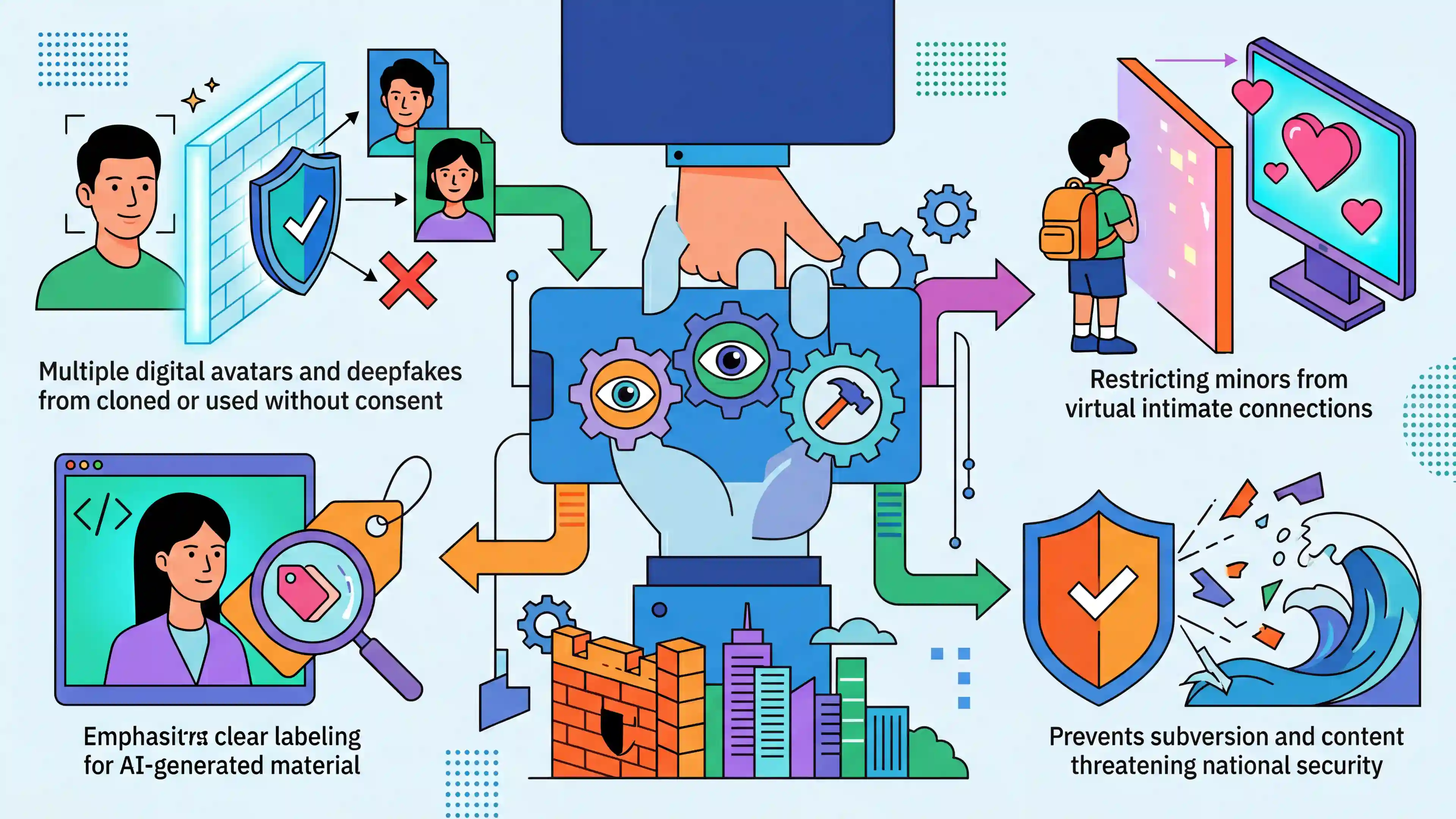
China's cyberspace regulator has proposed comprehensive draft rules to manage the booming "digital human" industry, which creates AI-driven virtual avatars and deepfakes. The regulations aim to curb ethical and social risks by banning the cloning of individuals without consent, restricting minors from accessing virtual intimate relationships, and mandating clear labeling on AI-generated content. Furthermore, the rules address internal security by forbidding digital humans from creating or spreading subversive material or content that threatens national security. These guidelines represent a strategic effort by China to balance rapid AI industry growth with strict societal and political guardrails.
Key Points
- The Cyberspace Administration of China (CAC) has introduced draft regulations to govern the rapidly expanding $600 million "digital human" industry, encompassing AI avatars and virtual companions.
- Regulations mandate clear labeling for AI-generated content and prohibit the creation of deepfakes or AI clones of individuals—including deceased relatives (grief tech)—without explicit consent.
- To safeguard youth, services providing minors with virtual intimate relationships or promoting extreme emotions and harmful habits are strictly banned.
- To mitigate political and security risks, the rules prohibit using digital humans to generate or disseminate content that endangers national security or incites subversion of state power.
- This regulatory approach reflects a governance model of balancing rapid technological innovation with robust state control over potential social, ethical, and internal security disruptions.
Important Terms
Cyberspace Administration of China (CAC)

China's primary internet regulator and censor, responsible for enforcing cybersecurity, data privacy, and content rules to align with national security and state ideology.
UPSC context
GS II (Governance) and GS III (Cyber Security). Tests knowledge of global tech governance models and digital sovereignty.
Digital Humans
AI-driven virtual avatars or figures that simulate human appearance, voice, and behavior for use in entertainment, e-commerce, and personal services.
UPSC context
GS III (Science & Technology). Relevant for topics on Artificial Intelligence, Deepfakes, and the ethics of Generative AI.
Super Brain
A Chinese AI company specializing in creating digital avatars of deceased individuals for grieving families, highlighting the ethical frontiers of the "digital human" industry.
UPSC context
GS III (Ethics). A case study for the ethical implications of AI in society, specifically regarding consent and emotional manipulation.
Asia Society Policy Institute (ASPI)
A solution-oriented US-based think tank that addresses major policy challenges in the Asia-Pacific region, focusing on security, prosperity, and sustainability.
UPSC context
GS II (International Relations). Example of Track II diplomacy and global policy analysis affecting India's neighborhood.
S. Rajaratnam School of International Studies (RSIS)
A premier Singapore-based graduate school and think tank specializing in strategic studies, security affairs, and international relations in the Asia-Pacific.
UPSC context
GS II (International Relations). Important source for strategic analysis on regional security and Indo-Pacific geopolitics.
Prelims Trap
Deepfakes and AI avatars are explicitly banned under India's Information Technology Rules, 2021.
India's IT Rules do not blanketly ban deepfakes. They only mandate intermediaries to remove impersonating or manipulated content within 24 hours after a user complaint is filed.
Static Concepts Connected
What are the primary ethical concerns surrounding Generative AI and deepfakes?
- Consent & Privacy: Unauthorized use of biometric data, voice, and likeness to create digital clones without explicit permission.
- Misinformation: Weaponization of deepfakes to spread fake news, manipulate elections, and damage personal reputations.
- Psychological Impact: Emotional dependency on AI companions and 'grief tech' exploiting vulnerable individuals mourning deceased loved ones.
How do deepfakes and AI avatars threaten a nation's internal security?
- Subversion & Radicalization: Non-state actors using AI to spread propaganda, incite violence, and subvert state power rapidly.
- Identity Fraud: Bypassing biometric security systems (e.g., facial recognition) for financial fraud or unauthorized data access.
- Trust Deficit: Eroding public trust in institutions by blurring the line between real and synthetic media.
Cross-Topic Patterns
Global AI Governance Models
China's state-control model contrasts with the EU's risk-based AI Act and India's advisory-driven approach, highlighting the global fragmentation in tech governance frameworks.
Post-mortem Privacy Rights
The rise of AI clones of deceased relatives intersects with constitutional debates on whether the Right to Privacy (Puttaswamy judgement) legally extends beyond death.

Deepfakes + post-mortem privacy + IT Rules 2021 will likely form a multi-statement prelims question on AI regulation in 2026.
Linked PYQs · 3
Linked PYQs · 3
- 2023MainsGS3
Introduce the concept of Artificial Intelligence (AI). How does Al help clinical diagnosis? Do you perceive any threat to privacy of the individual in the use of Al in healthcare?
- 2016MainsGS3
Use of Internet and social media by non-state actors for subversive activities is a major security concern. How have these been misused in the recent past? Suggest effective guidelines to curb the above threat.
- 2025MainsGS4
In the present digital age, social media has revolutionised our way of communication and interaction. However, it has raised several ethical issues and challenges. Describe the key ethical dilemmas in this regard.
