China Rejects US Stance on Tibet and Dalai Lama
Source:The Hindu ↗
Why It Matters
The Dalai Lama's advancing age and the looming succession battle represent a critical flashpoint in Sino-Indian and Sino-US relations. China's attempt to control Tibetan Buddhism's leadership impacts the geopolitical stability of the Himalayan region, the Tibetan exile community in India, and international debates on religious freedom and human rights.
Summary
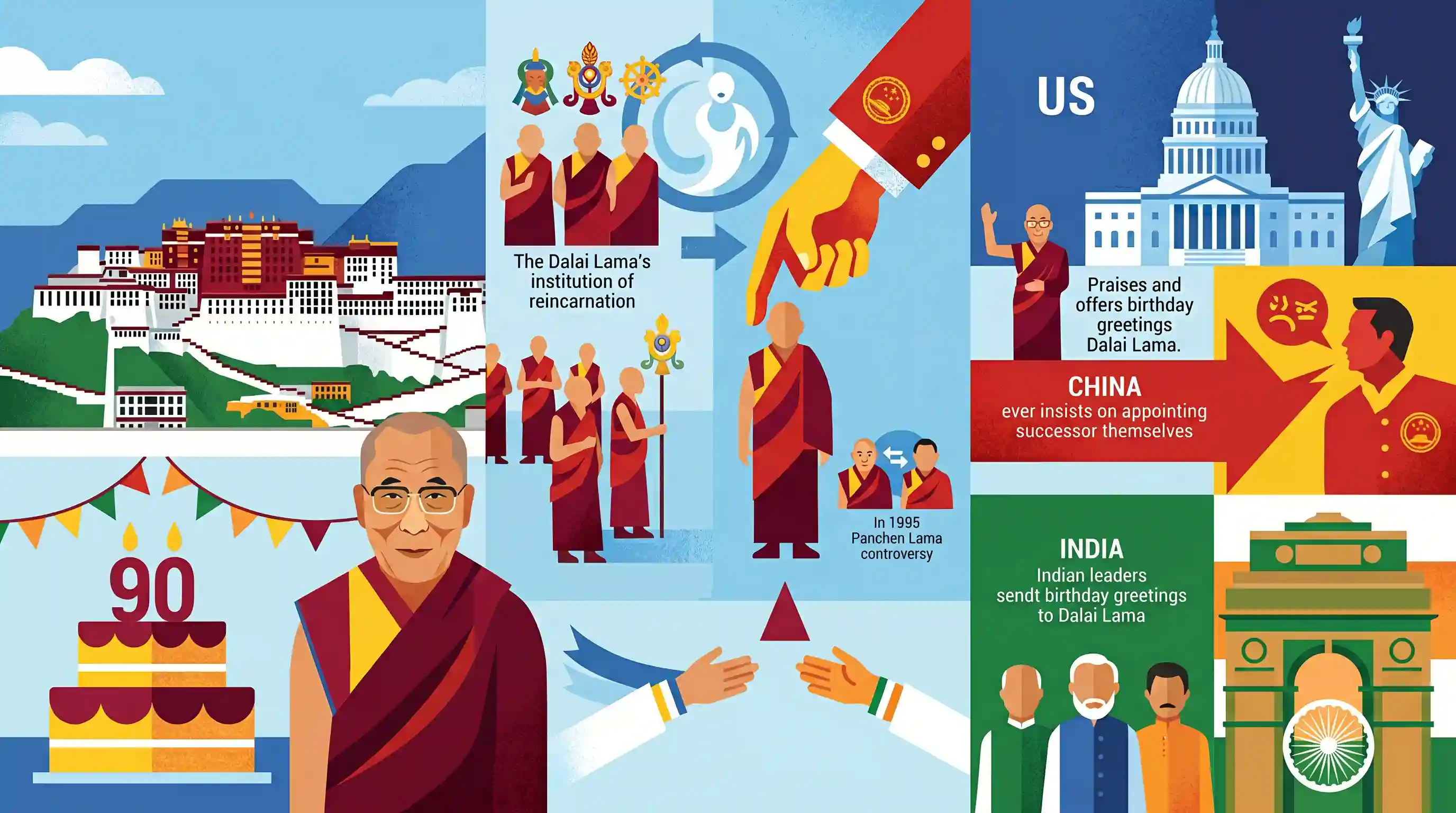
China strongly criticized the United States for praising the Dalai Lama on his 90th birthday, with the Chinese Foreign Ministry stating the US has "no position" to point fingers over Tibet. Beijing labeled the Dalai Lama a political exile involved in separatist activities. The core friction point is the Dalai Lama's succession; while he asserts his reincarnation will be managed by his own institution, China insists on appointing his successor itself, echoing the 1995 Panchen Lama controversy. The US supported Tibetans' right to choose their religious leaders, while China additionally protested Indian leaders' birthday greetings to the Dalai Lama, underlining the broader geopolitical tensions surrounding Tibet.
Key Points
- China dismissed US Secretary of State Marco Rubio's praise of the Dalai Lama on his 90th birthday, asserting the US has 'no position' to interfere in Tibet-related matters.
- Beijing reiterated its stance that the Dalai Lama is a 'political exile' engaged in separatist activities, not merely a religious figure.
- A major dispute exists over the Dalai Lama's succession: he insists a non-profit trust will manage his reincarnation, while China claims sole authority to choose his successor based on imperial precedent.
- The conflict mirrors the 1995 Panchen Lama controversy, where the Dalai Lama's chosen successor disappeared and Beijing appointed its own candidate.
- China also lodged protests against Indian PM Narendra Modi and other Indian ministers for greeting the Dalai Lama on his birthday, highlighting the issue's impact on India-China relations.
Important Terms
Dalai Lama

The spiritual leader of Tibetan Buddhism's Gelug school. Traditionally the temporal and spiritual head of Tibet, the 14th Dalai Lama, Tenzin Gyatso, has lived in exile in India since 1959.
UPSC context
GS Paper I (Art & Culture) and GS Paper II (International Relations). Tests knowledge of Tibetan Buddhism and its geopolitical significance.
Measures on the Management of Reincarnation of Living Buddhas
A 2007 Chinese law stating all reincarnations of "Living Buddhas" (Tulkus) must be approved by the Chinese government to be legal, aiming to control spiritual succession in Tibet.
UPSC context
GS Paper II (International Relations). Relates to human rights, religious freedom, and China’s domestic policies affecting neighborhood relations.
Golden Urn Process
A lottery method introduced by the Qing Dynasty (1792) to choose major Tibetan reincarnations. China cites this as historical evidence of its right to approve the next Dalai Lama.
UPSC context
GS Paper I (History/Culture). Tests historical precedents used in modern geopolitical claims over Tibetan sovereignty and religious practices.
Panchen Lama Controversy
The second-most important figure in the Gelug school. A 1995 dispute over his recognition, involving a disappeared candidate, serves as the precedent for the current Dalai Lama succession conflict.
UPSC context
GS Paper II (International Relations). Illustrates the "dual-claimant" risk in Tibet’s spiritual leadership and its impact on regional stability.
Gaden Phodrang Trust
The administrative body established by the 14th Dalai Lama in exile. He has designated this Trust as the sole authority responsible for identifying and recognizing his future reincarnation.
UPSC context
GS Paper II (International Relations). Key to understanding the institutional mechanism of the Tibetan government-in-exile (CTA) and succession diplomacy.
Dharamshala
An Indian city serving as the headquarters for the Central Tibetan Administration (government-in-exile). It is a major center for Tibetan culture and a friction point in India-China relations.
UPSC context
GS Paper II (International Relations). Important for India’s "Tibet Policy" and its role as a host to the Tibetan diaspora.
Prelims Trap
"The 'Golden Urn' method is an ancient Tibetan Buddhist ritual traditionally used by monks to select the Dalai Lama."
The Golden Urn was actually imposed by the Chinese Qing Dynasty in 1792 to control Tibetan successions. It is now weaponized by the CCP.
Static Concepts Connected
What are the primary schools of Tibetan Buddhism and the Tulku system?
- Four Major Schools: Gelug (Yellow Hat, led by the Dalai Lama), Nyingma, Kagyu, and Sakya form the core traditions of Tibetan Buddhism.
- Tulku System: The traditional Tibetan doctrine that specific high-ranking lamas (like the Dalai Lama as Avalokiteshvara) continuously reincarnate to complete their spiritual missions.
- Panchen Lama: The second-highest ranking figure in the Gelug school, traditionally playing a pivotal role in identifying the exact reincarnation of the Dalai Lama.
How does India officially manage its diplomatic stance regarding Tibet?
- Panchsheel Agreement: Under the 1954 agreement, India officially recognized Tibet as a "region of China," formally ceding extra-territorial rights inherited from the British.
- 1959 Asylum: India granted asylum to the 14th Dalai Lama in 1959, an act that heavily contributed to the outbreak of the 1962 Sino-Indian War.
- Non-recognition of CTA: India hosts the Central Tibetan Administration (CTA) in Dharamshala but officially considers it a cultural/spiritual organization, not a recognized government-in-exile.
Cross-Topic Patterns
Buddhism Diplomacy: India vs China
China's state-backed reincarnation laws (Order No. 5) directly compete with India's "Buddhist Circuit" initiatives, turning religious heritage into a geopolitical battleground for Asian soft power.
The Tibet Card in Border Disputes
Indian leaders' public greetings to the Dalai Lama are increasingly viewed as calibrated diplomatic signaling against Chinese military aggression along the Line of Actual Control (LAC).

Expect a Prelims question mapping Tibetan Buddhist schools (Gelug, Nyingma) or a Mains Q on Buddhism in Sino-Indian soft-power diplomacy.
Linked PYQs · 3
Linked PYQs · 3
- 2014MainsGS2
With respect to the South China sea, maritime territorial disputes and rising tension affirm the need for safeguarding maritime security to ensure freedom of navigation and over flight throughout the region. In this context, discuss the bilateral issues between India and China.
- 2012MainsGS2
Do you think that China's emergence as one of the largest trading partners of India has adversely affected the settlement of the outstanding border problem?
- 2020PrelimsGS1
With reference to the religious history of India, consider the following statements: 1. Sthaviravadins belong to Mahayana Buddhism. 2. Lokottaravadin sect was an offshoot of Mahasanghika sect of Buddhism. 3. The deification of Buddha by Mahasanghikas fostered the Mahayana Buddhism. Which of the statements given above is/are correct?
