China Seeks US Ties While Defending Red Lines
Source:The Hindu ↗
Why It Matters
The trajectory of US-China relations significantly dictates the global economic and geopolitical environment. As both superpowers attempt to stabilize their ties and negotiate trade deals, it directly impacts regional security in the Indo-Pacific and influences India's strategic positioning and supply-chain alternatives.
Summary
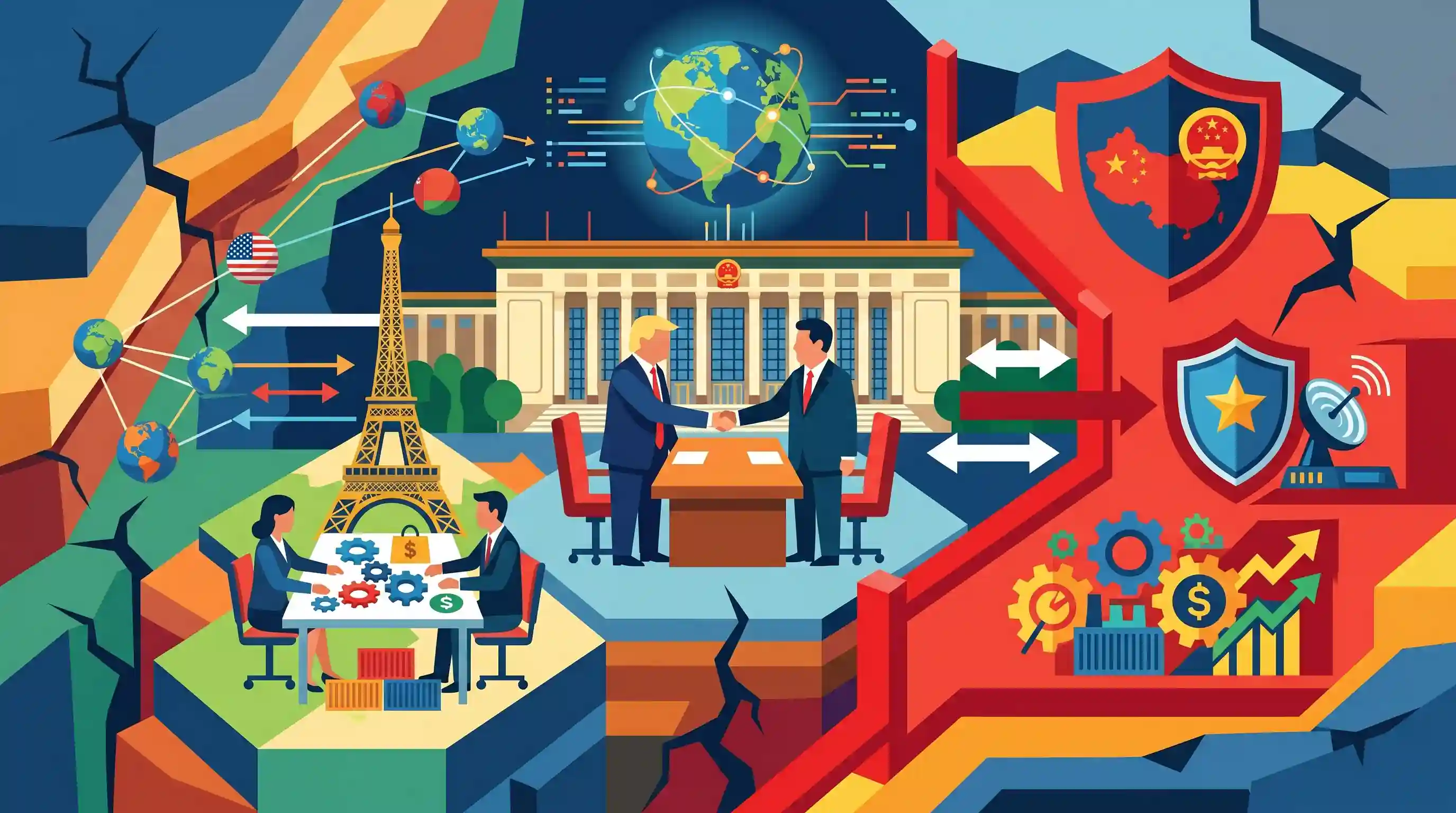
China has reaffirmed its desire to maintain open communication and peaceful coexistence with the United States while steadfastly defending its 'red lines' concerning sovereignty, security, and development. This diplomatic stance, articulated by National People's Congress spokesperson Lou Qinjian, comes ahead of a highly anticipated summit between Donald Trump and Xi Jinping in Beijing. Concurrently, top trade negotiators are scheduled to meet in Paris, reflecting ongoing efforts by both superpowers to stabilize economic and geopolitical ties despite underlying frictions.
Key Points
- China has expressed its willingness to maintain communication and peacefully coexist with the US, provided its sovereignty and security 'red lines' are respected.
- The statement was made ahead of the National People's Congress annual session, where China will outline its upcoming economic targets.
- A crucial summit between US President Donald Trump and Chinese President Xi Jinping is expected to take place in Beijing to stabilize bilateral ties.
- Top trade negotiators from both nations are preparing to meet in Paris to discuss potential business deals ahead of the leaders' summit.
Important Terms
National People's Congress (NPC)

The highest organ of state power and national legislature of the People's Republic of China, which meets annually to approve major policy, laws, and leadership appointments.
UPSC context
GS Paper II (International Relations); tests understanding of China's political structure and its impact on global geopolitics and bilateral relations.
Red Lines
In diplomacy, non-negotiable boundaries or thresholds set by a state, beyond which actions by another party are deemed unacceptable and may trigger a significant response.
UPSC context
GS Paper II (International Relations); tests knowledge of conflict management, signaling, and strategic boundaries in bilateral and multilateral diplomacy.
Head-of-State Diplomacy
Diplomatic engagement conducted directly between top national leaders (Presidents/PMs) to provide strategic guidance, break deadlocks, and finalize high-level agreements.
UPSC context
GS Paper II (International Relations); tests understanding of summit-level interactions and the role of leadership in shaping foreign policy.
Trade Diplomacy
The use of economic negotiations and trade agreements as a tool to stabilize geopolitical relations and manage strategic competition between major powers.
UPSC context
GS Paper II/III (International Relations/Economy); focuses on the intersection of global trade architecture and national security interests.
Core Interests (Hexin Liyi)
A state's most vital interests, typically including national sovereignty, territorial integrity, and regime security, which it considers non-negotiable and worth defending at all costs.
UPSC context
GS Paper II (International Relations); relevant for analyzing Indo-China relations and the 'One China' policy within broader regional stability.
Prelims Trap
"The 'Thucydides Trap' refers to a debt-trap diplomacy mechanism used by China in developing nations."
It actually refers to the geopolitical risk of conflict when a rising power threatens to displace an established power, completely distinct from predatory lending (Debt-Trap Diplomacy).
Static Concepts Connected
What is the 'China Plus One' strategy in global trade?
- Supply Chain Diversification: A business strategy to avoid investing solely in China by diversifying operations into other countries, mitigating exposure to geopolitical shocks and tariff wars.
- India's Advantage: Provides India a crucial opportunity to attract shifting Foreign Direct Investment (FDI) and boost its domestic manufacturing capacity through targeted schemes.
What constitutes China's core diplomatic 'Red Lines'?
- Taiwan Sovereignty: Strict adherence to the One-China Principle, rejecting any foreign diplomatic recognition, military support, or formal independence for Taiwan.
- Maritime Claims: Assertive and historically-based territorial claims, such as the Nine-Dash Line in the South China Sea, which Beijing treats as core non-negotiable interests.
- Internal Security: Complete rejection of external criticism or intervention regarding its internal administration, particularly in Xinjiang, Tibet, and Hong Kong.
Cross-Topic Patterns
US-China decoupling and India's PLI
As the US and China navigate trade frictions, India leverages the 'China Plus One' global supply chain shift via Production Linked Incentive (PLI) schemes to attract relocating electronics and manufacturing giants.
China's Red Lines vs Indo-Pacific strategy
China's non-negotiable red lines concerning sovereignty directly clash with the US and Quad's strategic vision of a Free and Open Indo-Pacific (FOIP) and adherence to UNCLOS in the South China Sea.

Expect a 2026 Prelims question linking 'Thucydides Trap' and 'China Plus One' supply chain shifts to India's PLI schemes and Quad strategy.
Linked PYQs · 2
Linked PYQs · 2
- 2021MainsGS2
“The USA is facing an existential threat in the form of a China, that is much more challenging than the erstwhile Soviet Union.” Explain.
- 2024MainsGS2
‘The West is fostering India as an alternative to reduce dependence on China's supply chain and as a strategic ally to counter China's political and economic dominance.’ Explain this statement with examples.
