New START Expiration and Strategic Global Nuclear Stability
Source:The Hindu ↗
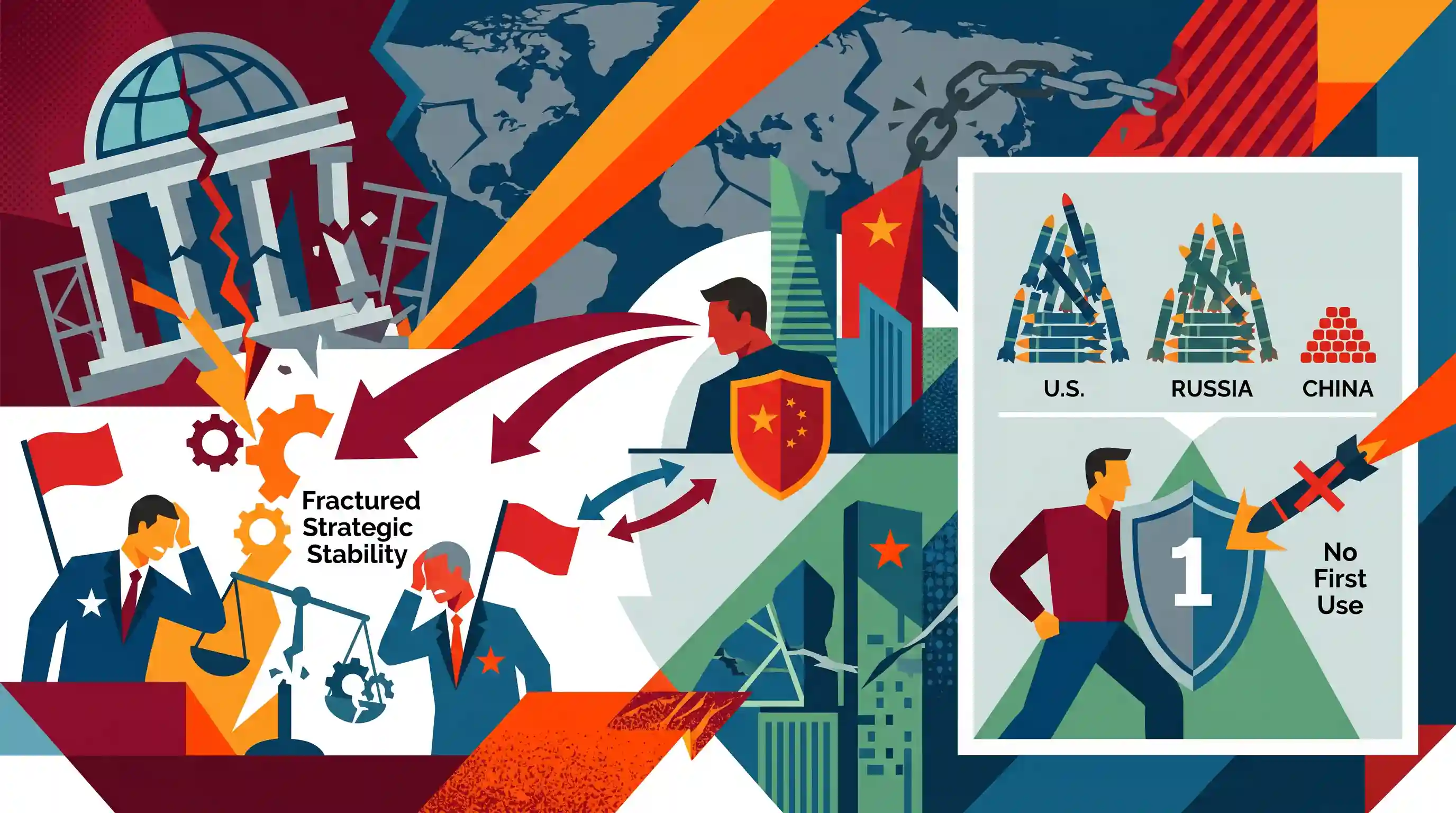
Why It Matters
The collapse of the New START treaty marks a pivotal moment in global security, potentially triggering a new nuclear arms race between major powers. For UPSC aspirants, understanding the evolving nuclear doctrines of neighboring countries like China (such as its "no first use" policy) and the broader geopolitical implications of the U.S.-Russia arms control vacuum is crucial for analyzing India's strategic environment and its own nuclear posture.
Summary
China has expressed regret over the expiration of the New START treaty between the United States and Russia, emphasizing its negative impact on global strategic stability and the international nuclear arms control regime. While urging the U.S. and Russia to resume dialogue, China reiterated its refusal to join bilateral or trilateral arms-reduction talks, citing its comparatively smaller nuclear arsenal. Beijing also reaffirmed its adherence to a defensive nuclear strategy, anchored by a strict "no first use" policy.
Key Points
- The New START treaty, a critical bilateral nuclear arms reduction pact between the U.S. and Russia, expired on February 4, 2026.
- China expressed regret over the treaty's expiration, warning that it undermines global strategic stability and the international nuclear arms control system.
- Beijing urged the United States to resume dialogue with Russia on maintaining strategic stability.
- China reiterated its refusal to join arms-reduction talks, citing that its nuclear arsenal is significantly smaller than those of the U.S. and Russia.
- China reaffirmed its defensive nuclear strategy, maintaining a strict "no first use" policy and a commitment not to threaten non-nuclear-weapon states with nuclear weapons.
Important Terms
New START Treaty

The last major nuclear arms reduction treaty between the US and Russia, limiting deployed strategic warheads to 1,550. It officially expired on February 5, 2026.
UPSC context
GS Paper 2: International Relations. Important for understanding bilateral disarmament and the breakdown of Cold War-era security architectures.
Strategic Stability
A condition in which nuclear-armed states lack incentives to initiate a first strike, typically ensured by the presence of a credible second-strike capability.
UPSC context
GS Paper 2 & 3. Tests conceptual understanding of deterrence, arms races, and global security management.
No First Use (NFU) Policy
A pledge by a nuclear power to never initiate a nuclear attack, reserving such weapons only for retaliation against a nuclear strike.
UPSC context
GS Paper 2 & 3. Key component of India and China's nuclear doctrines; central to debates on nuclear ethics.
Nuclear Arms Control Regime
The collective system of treaties (e.g., NPT), norms, and international organizations (e.g., IAEA) intended to limit the spread and development of nuclear weapons.
UPSC context
GS Paper 2: International Relations. Tests knowledge of global institutions and India's historical opposition to discriminatory treaty frameworks.
Defensive Nuclear Strategy
A strategy where a state maintains nuclear forces solely for deterrence and retaliation, typically rejecting pre-emptive strikes and offensive posturing.
UPSC context
GS Paper 3: Internal Security/Defense. Relevant to analyzing China's strategic posture and its contrast with aggressive modernization.
Prelims Trap
"The New START treaty was a trilateral arms reduction pact between the US, Russia, and China."
New START was strictly bilateral (US-Russia). China explicitly refuses to join these talks, citing its vastly smaller nuclear arsenal compared to the two superpowers.
Static Concepts Connected
What were the key provisions of the New START Treaty?
- Bilateral scope: A 2010 agreement strictly between the US and Russia to limit deployed strategic nuclear warheads, excluding other nuclear-armed states.
- Hard caps: Restricted each side to 1,550 deployed strategic warheads and 700 deployed delivery systems (ICBMs, SLBMs, heavy bombers).
- Verification regime: Allowed mutual on-site inspections and continuous data exchanges, ensuring transparency before its 2026 expiration.
How do global 'No First Use' (NFU) nuclear doctrines compare?
- India and China: Both officially maintain strict NFU policies, pledging to use nuclear weapons only in retaliation to a nuclear attack.
- Pakistan: Explicitly rejects NFU, maintaining a 'first-use' posture primarily to counter India's conventional military superiority.
- US and Russia: Neither maintains an unconditional NFU policy, reserving the right to use nuclear weapons against overwhelming non-nuclear strategic attacks.
Cross-Topic Patterns
Doctrinal alignment: India & China NFU
Despite severe border tensions, India and China are the only major nuclear powers anchoring their doctrines in strict 'No First Use', contrasting sharply with Western postures and Pakistan's first-use doctrine.
Collapse of Cold War arms architecture
New START's expiration marks the final domino, following the US withdrawal from the Anti-Ballistic Missile (ABM) Treaty in 2002 and the Intermediate-Range Nuclear Forces (INF) Treaty in 2019.

Expect a 2026 prelims multi-statement question pairing the expiration of New START/INF with NPT-recognized states vs. NFU doctrines.
Linked PYQs · 4
Linked PYQs · 4
- 2011PrelimsGS1
The "New START" treaty was in the news. What is this treaty?
- 2015PrelimsGS1
Consider the following countries: 1. China 2. France 3. India 4. Israel 5. Pakistan Which among the above are Nuclear Weapons States as recognized by the Treaty on the Non-Proliferation of Nuclear Weapons, commonly known as Nuclear Non-Proliferation Treaty (NPT)?
- 2018PrelimsGS1
What is/are the consequence/consequences of a country becoming the member of the 'Nuclear Suppliers Group'? 1. It will have access to the latest and most efficient nuclear technologies. 2. It automatically becomes a member of "The Treaty on the Non-Proliferation of Nuclear Weapons (NPT)". Which of the statements given above is/are correct?
- 2021MainsGS2
“The USA is facing an existential threat in the form of a China, that is much more challenging than the erstwhile Soviet Union.” Explain.
