Geopolitical Implications of Dalai Lama Succession Dispute
Source:Indian Express ↗
Why It Matters
The succession of the Dalai Lama is not merely a religious event but a critical geopolitical pivot point. How India handles the Tibetan government-in-exile and the reincarnation issue will profoundly impact its leverage and long-term bilateral ties with China.
Summary
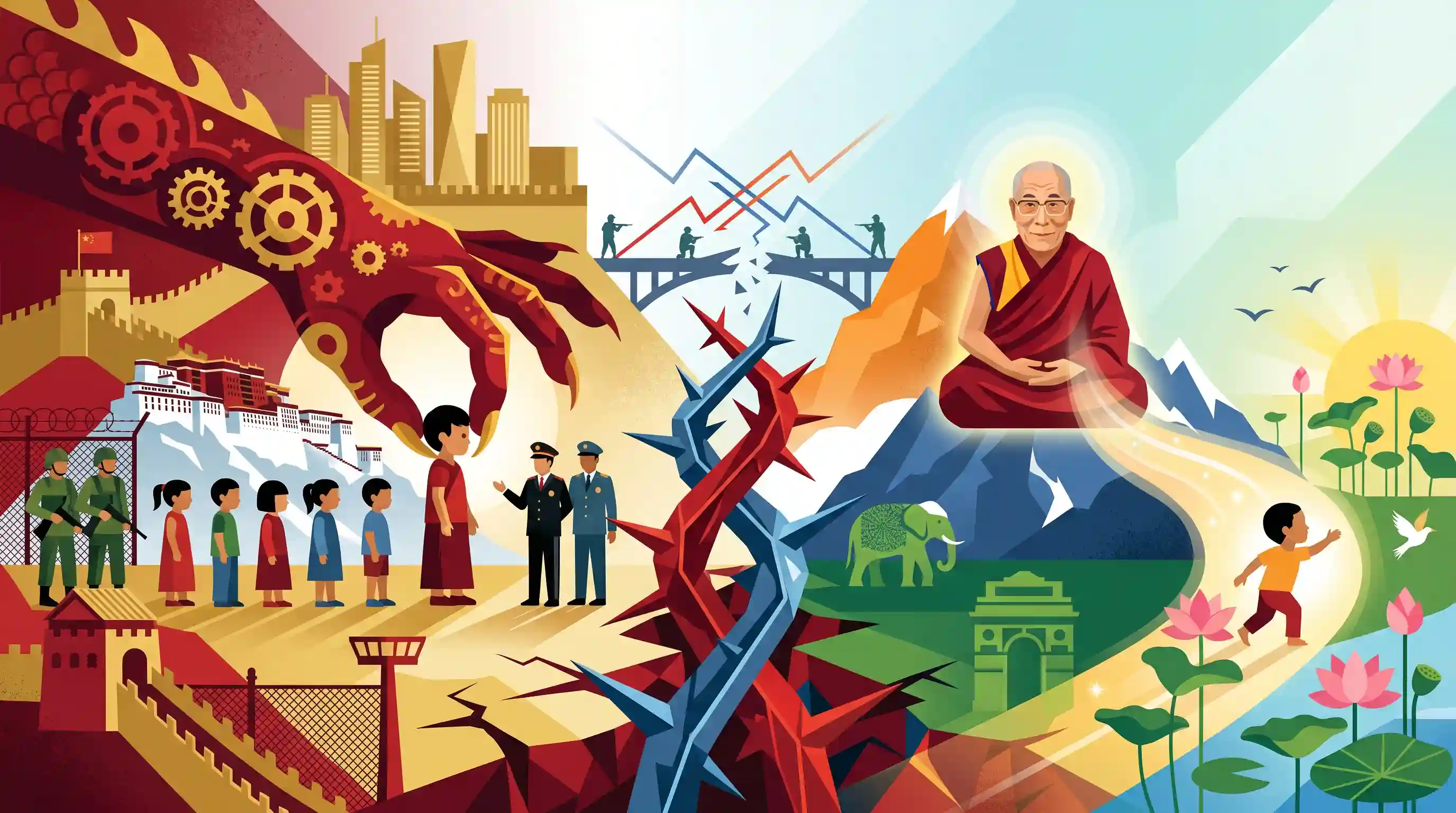
China has explicitly stated that the succession of the Dalai Lama is an internal matter and characterized it as a 'thorn' in its relations with India. While Beijing insists that the successor must be chosen according to Chinese laws and historical customs to consolidate control over Tibet, the 14th Dalai Lama and the Tibetan exile administration assert that he alone has the authority to decide his reincarnation, likely in a free country. This disagreement adds another layer of geopolitical tension to the already strained India-China bilateral relationship.
Key Points
- China considers the succession of the 14th Dalai Lama as a major internal issue, emphasizing that it must follow Chinese laws and historical rituals (like the Golden Urn).
- The Chinese envoy described the succession issue as a significant 'thorn' in bilateral relations with India.
- The Dalai Lama maintains that the decision regarding his reincarnation rests solely with him, and it will occur in a free country, countering Beijing's attempts to control the institution.
- This religious issue serves as a major geopolitical faultline, adding friction to the India-China relationship already strained by boundary disputes.
Important Terms
Dalai Lama (14th)

The 14th Dalai Lama, Tenzin Gyatso, is the preeminent spiritual leader of Tibetan Buddhism. Since 1959, he has lived in India, leading the Tibetan community and advocating for autonomy.
UPSC context
GS Paper 2 (International Relations); central to India-China geopolitical tensions and the "Tibet card."
Central Tibetan Administration (CTA)
Headquartered in Dharamsala, India, the CTA (Tibetan Government-in-Exile) manages the welfare, education, and cultural preservation of the Tibetan diaspora while advocating for Tibetan freedom.
UPSC context
GS Paper 2; tests India's diplomatic balancing between humanitarian support and official sovereignty positions.
Golden Urn System
A selection method introduced by the Qing dynasty (1793) using a lottery to identify reincarnations. China mandates its use to assert state control over the Dalai Lama's succession.
UPSC context
GS Paper 2; significant as a flashpoint for religious freedom and state sovereignty disputes.
Panchsheel Agreement
The 1954 "Agreement on Trade and Intercourse" between India and Tibet. It established five principles—like mutual non-interference—but also formally recognized Tibet as part of China.
UPSC context
GS Paper 2 (Foreign Policy); foundational for understanding the historical trajectory of India-China relations.
One China Policy
A diplomatic stance acknowledging only one Chinese government. While India historically followed this, it has recently avoided mentioning it to signal dissatisfaction with China’s border conduct.
UPSC context
GS Paper 2; tests knowledge of India's evolving response to China's territorial claims.
Tulku System
The Tibetan Buddhist belief where high lamas (Tulkus) are consciously reborn. The search for the next Dalai Lama relies on this system, currently contested by Chinese law.
UPSC context
GS Paper 1 (Culture) and Paper 2; examines religion as a tool of soft power.
Prelims Trap
"India officially recognizes the Central Tibetan Administration (CTA) as the legitimate government of Tibet."
India recognized Tibet as an integral part of China under the 1954 Panchsheel Agreement. The CTA operates from India but lacks formal diplomatic recognition.
Static Concepts Connected
What are the key elements of the 1954 Panchsheel Agreement regarding Tibet?
- Formal recognition: India officially recognized Tibet as the "Tibet Autonomous Region of China," surrendering the extra-territorial rights and privileges it inherited from British India.
- Five Principles: Mutual respect for territorial integrity, mutual non-aggression, non-interference in internal affairs, equality/mutual benefit, and peaceful co-existence.
What is the 'Tulku' concept and the 'Golden Urn' method in Tibetan Buddhism?
- Tulku tradition: The belief in Tibetan Buddhism that enlightened spiritual masters (Bodhisattvas) consciously dictate their reincarnation to continue guiding sentient beings.
- Golden Urn: An 18th-century Qing dynasty method of drawing lots to select reincarnations, now mandated by Beijing to legally and politically control the selection of high Lamas.
Cross-Topic Patterns
Buddhist Diplomacy vs State Control
India leverages its heritage via the Global Buddhist Summit and Asian Buddhist diplomacy to counter China's aggressive state-backed control over Tibetan Buddhism and regional soft power.
Succession as a Territorial Leverage
China's push to control the next Dalai Lama directly ties into its claims over Arunachal Pradesh ("South Tibet"), seeking religious legitimacy for its territorial expansions and border salami-slicing.

Expect a multi-statement Prelims question merging the 'Tulku' tradition of Tibetan Buddhism with India's 1954 Panchsheel commitments.
Linked PYQs · 2
Linked PYQs · 2
- 2014MainsGS2
With respect to the South China sea, maritime territorial disputes and rising tension affirm the need for safeguarding maritime security to ensure freedom of navigation and over flight throughout the region. In this context, discuss the bilateral issues between India and China.
- 2012MainsGS2
Do you think that China's emergence as one of the largest trading partners of India has adversely affected the settlement of the outstanding border problem?
