US China Geopolitical Rivalry and Taiwan Arms Sales Sanctions
Source:The Hindu ↗
Why It Matters
The Taiwan Strait remains a major geopolitical flashpoint with direct implications for global supply chains, particularly semiconductors, and maritime security. Escalating U.S.-China tensions over Taiwan shape the broader Indo-Pacific security architecture, influencing global alliances and great power competition, which is central to the UPSC GS2 syllabus on International Relations.
Summary
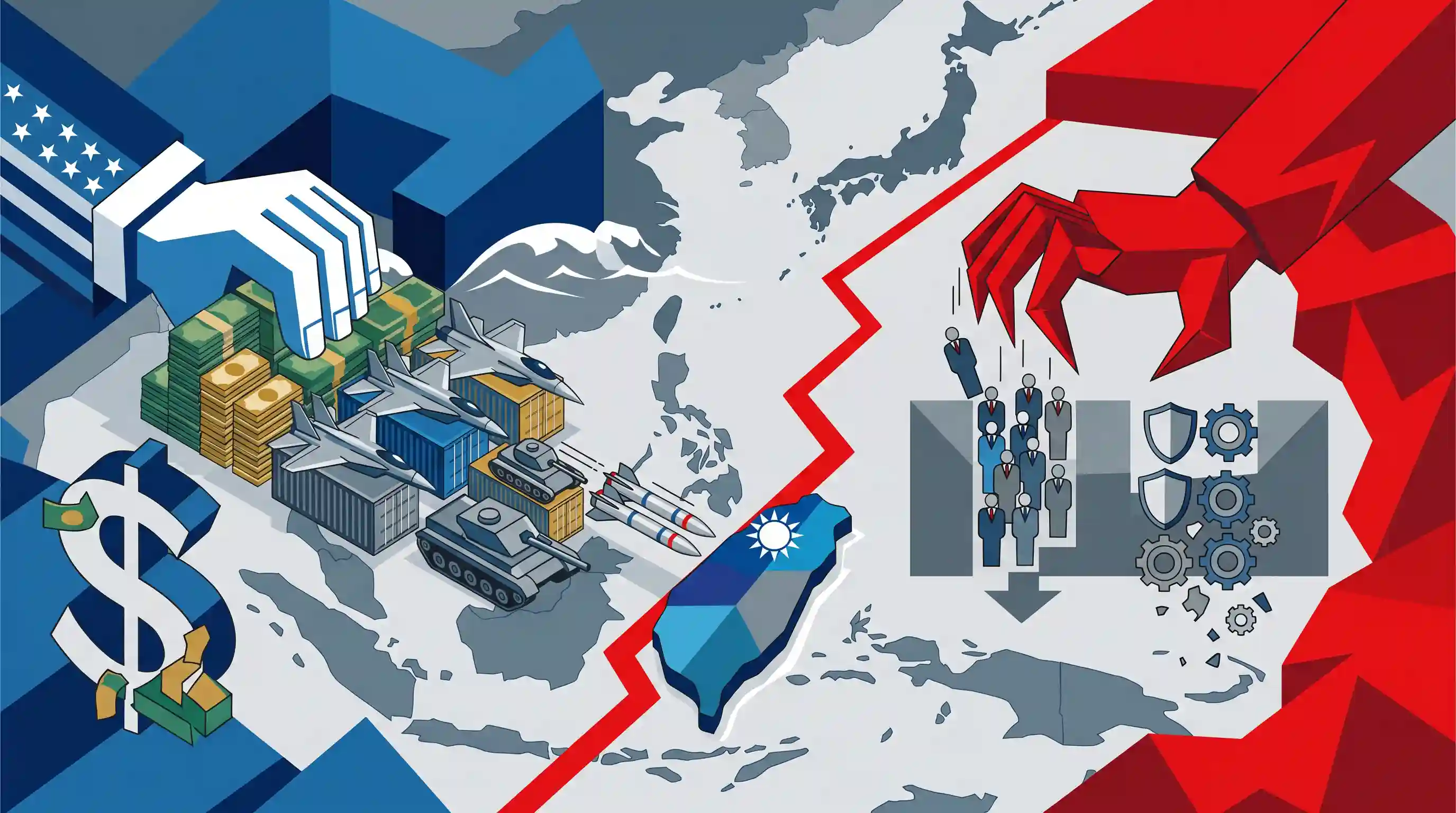
In response to a record $11.1 billion U.S. arms sales package to Taiwan approved by the Trump administration, China has imposed sanctions on 20 U.S. defense firms and 10 senior executives. Beijing labeled the arms sale a violation of the "one-China principle" and a dangerous provocation crossing a fundamental "red line." The sanctions, though largely symbolic as the defense firms lack operations in China, underscore escalating Sino-U.S. tensions. The arms package aims to bolster Taipei's defense against a potential Chinese invasion and reflects bipartisan U.S. support for Taiwan amid broader strategic competition between the two superpowers.
Key Points
- China imposed sanctions on 20 U.S. defense firms and 10 executives in retaliation for an $11.1 billion U.S. arms sales package to Taiwan approved by the Trump administration.
- Beijing condemned the move as a violation of the "one-China principle" and warned that the Taiwan issue is a "red line" in U.S.-China relations.
- The sanctions are seen as largely symbolic, as the targeted American defense contractors do not have business operations in mainland China.
- The arms package, which requires U.S. Congress approval, exceeds the $8.4 billion in arms sold to Taiwan during the Biden administration.
- The deal aims to reassure Washington\'s China hawks and bolster Taiwan\'s defenses amid fears of a potential invasion by Beijing.
Important Terms
one-China principle

Beijing's diplomatic stance that there is only one China, Taiwan is an inalienable part of it, and the People's Republic of China (PRC) is the sole legitimate government.
UPSC context
GS Paper 2 (International Relations). Crucial for understanding sovereignty disputes and China's 'core interests' in bilateral relations.
one-China policy
The U.S. diplomatic stance that acknowledges Beijing's position on Taiwan while maintaining unofficial ties with Taipei. It differs from China's 'Principle' by not explicitly recognizing Chinese sovereignty over Taiwan.
UPSC context
GS Paper 2 (International Relations). Tests the ability to distinguish between nuanced diplomatic postures in major power competition.
Taiwan Relations Act (TRA)
A 1979 U.S. law providing the legal basis for unofficial relations with Taiwan. it mandates that the U.S. provide defensive arms to ensure Taiwan's self-defense capability.
UPSC context
GS Paper 2 (International Relations). Key for analyzing the legal frameworks governing Indo-Pacific security and U.S. foreign policy.
U.S. Congress
The legislative branch of the U.S. government that authorizes and oversees arms sales to Taiwan. It often drives bipartisan support for Taiwan's security through legislation and budgetary oversight.
UPSC context
GS Paper 2 (Governance/IR). Tests understanding of how legislative bodies influence foreign policy and defense alliances.
Chinese Foreign Ministry
The executive department of the PRC responsible for foreign policy. It implements sanctions and manages 'red lines' concerning Chinese sovereignty and territorial integrity.
UPSC context
GS Paper 2 (International Relations). Tests familiarity with institutional actors in global diplomatic escalation and conflict management.
strategic ambiguity
The U.S. policy of remaining intentionally vague about whether it would militarily intervene if China attacked Taiwan, aiming to deter both Chinese aggression and a Taiwanese independence declaration.
UPSC context
GS Paper 2 (International Relations). Central to discussions on deterrence, Indo-Pacific stability, and conflict prevention strategies.
Prelims Trap
The United States officially recognizes the "One-China Principle" and has a formal mutual defense treaty with Taiwan.
The US follows the "One-China Policy" (acknowledging but not endorsing Beijing's claim over Taiwan), not Beijing's "One-China Principle" (which asserts Taiwan is an inalienable part of the PRC).
Static Concepts Connected
What constitutes the "First Island Chain" in the Indo-Pacific?
- Definition: The first major archipelago chain situated off the East Asian continental mainland.
- Key Territories: Includes the Kuril Islands, Japanese archipelago, Ryukyu Islands, Taiwan, the Philippines, and Borneo.
- Strategic Importance: Historically viewed as a geographical containment line used by the US to restrict Chinese and Soviet naval expansion into the broader Pacific Ocean.
How does the US arm Taiwan without formal diplomatic ties?
- Taiwan Relations Act: A 1979 US law mandating Washington to provide Taipei with defensive weapons to maintain its self-defense capabilities, despite ending formal diplomatic relations.
- Strategic Ambiguity: A deliberate US policy of not stating explicitly whether it would militarily intervene to defend Taiwan in the event of a Chinese attack.
- Unofficial Relations: The US maintains robust, unofficial economic, cultural, and security ties with Taipei through the American Institute in Taiwan (AIT).
Cross-Topic Patterns
Semiconductors and the "Silicon Shield"
Taiwan's dominance in advanced semiconductor manufacturing (TSMC) directly intertwines its security with global tech supply chains, making its defense critical to US economic and strategic interests.
Grey Zone Warfare in the Indo-Pacific
China's use of non-kinetic coercion, such as economic sanctions and ADIZ incursions around Taiwan, heavily mirrors its maritime militia and coast guard tactics against the Philippines.

First Island chain mapping combined with US 'Strategic Ambiguity' vs 'One-China Policy' is highly probable for 2026 Prelims.
Linked PYQs · 3
Linked PYQs · 3
- 2021MainsGS2
“The USA is facing an existential threat in the form of a China, that is much more challenging than the erstwhile Soviet Union.” Explain.
- 2020MainsGS2
What is the significance of Indo-US defence deals over Indo-Russian defence deals? Discuss with reference to stability in the Indo-Pacific region.
- 2025MainsGS2
"The reform process in the United Nations remains unresolved, because of the delicate imbalance of East and West and entanglement of the USA vs. Russo-Chinese alliance.” Examine and critically evaluate the East-West policy confrontations in this regard.
