China and Russia Announce Joint Naval Drills in the Indo-Pacific
Source:The Hindu ↗
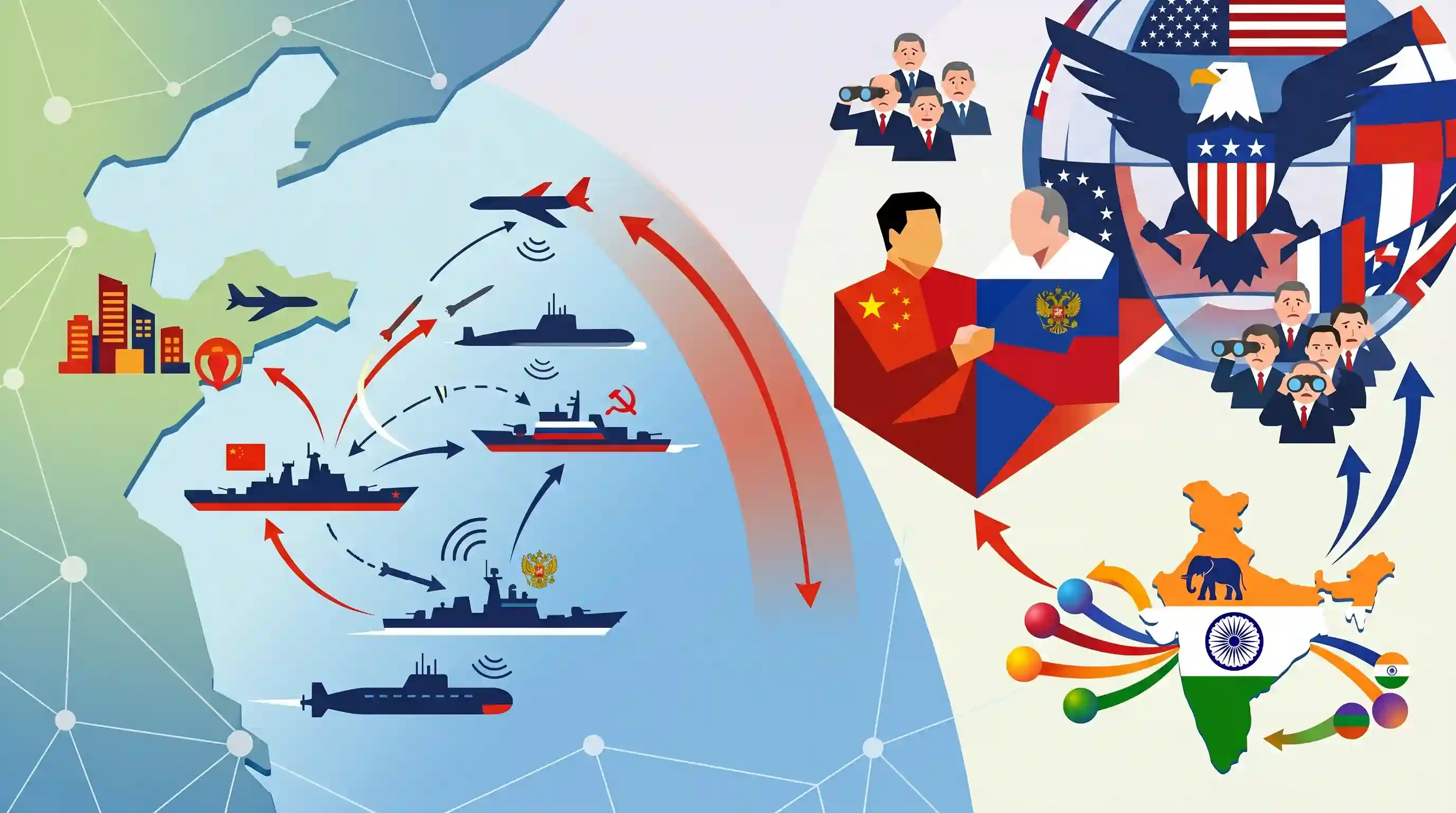
Why It Matters
The deepening of the Sino-Russian military alliance through annual exercises like 'Joint Sea-2026' indicates a hardening geopolitical division between a Western-aligned maritime framework and a revisionist Eurasian axis. For UPSC, this provides crucial context for understanding international polarizations, the USA vs. Russo-Chinese rivalry, and India's pressing challenge of maintaining strategic autonomy while balancing its traditional defense relationship with Moscow against its security cooperation with the West.
Summary
China and Russia announced their annual "Joint Sea-2026" naval exercises off the coast of Qingdao in the Yellow Sea, running from July 6 to 13, 2026. Followed by joint maritime patrols in the Pacific Ocean, the drills feature air and missile defence, surface strikes, and anti-submarine warfare. The escalating security partnership reflects a growing Moscow-Beijing axis aligned against a US-dominated global order, raising concerns among Western nations and complicating India's strategic balancing act in the Indo-Pacific.
Key Points
- Joint Sea-2026 Exercise: An annual bilateral naval drill scheduled from July 6 to 13, 2026, taking place in the Yellow Sea (separating China from the Korean peninsula) and the airspace and waters off the military port of Qingdao, China.
- Force Composition: China's Northern Theater Command has deployed two destroyers, a frigate, a submarine, a supply ship, and a rescue vessel. Russia's Pacific Fleet has sent a cruiser, a corvette, a diesel submarine, and a rescue vessel.
- Tactical Scope: The war games encompass reconnaissance, surface strikes, air and missile defence, joint rescue operations, anti-submarine warfare, and artillery exercises, culminating in a joint Pacific Ocean maritime patrol.
- Strategic Revisionist Alliance: The drills project a joint front against the US-dominated world order. This follows Vladimir Putin's May 2026 bilateral meeting with Xi Jinping, reinforcing an 'unyielding' alliance amid the ongoing Ukraine conflict.
- Strategic Dilemma for India: The deepening Russia-China military axis challenges India's balancing act—maintaining traditional defence dependencies on Russia while actively countering Chinese border and maritime assertiveness through partnerships like the Quad.
Important Terms
Joint Sea exercises

The annual bilateral naval exercises conducted by China and Russia since 2012, aimed at enhancing joint maritime combat capabilities and strategic coordination against common security challenges.
UPSC context
GS Paper II (Bilateral Groupings): Tests understanding of growing Sino-Russian defense ties and geopolitical implications for India.
Joint Sea-2026
The July 2026 iteration of the China-Russia naval exercises off Qingdao in the Yellow Sea, featuring joint air defense, maritime strikes, and subsequent Pacific Ocean patrols.
UPSC context
GS Paper II (International Relations): Tests understanding of evolving Indo-Pacific security dynamics and major power alignments.
Russian Pacific Fleet
The Russian Navy’s second-largest fleet, headquartered in Vladivostok, responsible for maritime security and projecting Russian military presence across the Asia-Pacific and Indian Oceans.
UPSC context
GS Paper II (Global Security): Tests awareness of Russia’s naval presence and its growing cooperation with China in the Indo-Pacific.
Chinese Northern Theater Command
One of China's five joint operational military commands, headquartered in Shenyang, responsible for northern border defense, the Yellow Sea, and Korean Peninsula contingencies.
UPSC context
GS Paper III (Security Challenges): Tests knowledge of China's joint military structures and command capabilities affecting East Asian security.
People's Liberation Army Navy
The maritime service branch of China’s military, currently the world’s largest navy by ship count, actively projecting power across the Indo-Pacific and Indian Oceans.
UPSC context
GS Paper III (Maritime Security): Tests understanding of China's naval expansion and threats in the Indian Ocean Region.
Prelims Trap
The Chennai-Vladivostok Eastern Maritime Corridor (VCMC) passes through the South China Sea and Suez Canal to reach the Russian Far East.
The VCMC bypasses the Suez Canal and Red Sea entirely, routing via the Malacca Strait and South China Sea to cut transit time to 15 days.
Static Concepts Connected
What is India's policy of Strategic Autonomy in contemporary international relations?
- Core Definition: Refers to a state's ability to pursue its national interests and foreign policy without being constrained by systemic alliances.
- Multi-alignment Shift: Emphasizes issue-based partnerships (multi-alignment) rather than rigid bloc-membership, cooperating with the US (Quad) while maintaining ties with Russia.
- Strategic Dilemma: Forced to balance continental threats from China with maritime security concerns in the Indian Ocean and Indo-Pacific.
What are the geographical features and strategic significance of the Yellow Sea?
- Location: A marginal sea of the Western Pacific Ocean located between mainland China to the west and the Korean Peninsula to the east.
- Silt Inflow: Named for the golden-yellow color of silt discharged by major rivers like the Yellow River (Huang He) and the Yangtze.
- Strategic Hub: Hosts Qingdao on its western coast, the vital headquarters of the PLA Navy's Northern Theater Command.
Cross-Topic Patterns
Vladivostok Corridor vs. Russia-China Axis
India's Chennai-Vladivostok shipping link aims to tap Russian Far East resources but traverses waters heavily patrolled by the Sino-Russian joint naval axis.
IPMDA and Sino-Russian Pacific patrols
The expansion of Russia-China joint patrols directly drives the Quad's deployment of the Indo-Pacific Partnership for Maritime Domain Awareness (IPMDA) technology.

Sino-Russian joint naval drills and the Vladivostok-Chennai corridor could be combined to test India's strategic balancing in GS Paper II.
Linked PYQs · 4
Linked PYQs · 4
- 2025MainsGS2
"The reform process in the United Nations remains unresolved, because of the delicate imbalance of East and West and entanglement of the USA vs. Russo-Chinese alliance.” Examine and critically evaluate the East-West policy confrontations in this regard.
- 2020MainsGS2
What is the significance of Indo-US defence deals over Indo-Russian defence deals? Discuss with reference to stability in the Indo-Pacific region.
- 2021MainsGS2
The newly tri-nation partnership AUKUS is aimed at countering China's ambitions in the Indo-Pacific region. Is it going to supersede the existing partnerships in the region? Discuss the strength and impact of AUKUS in the present scenario.
- 2014MainsGS2
With respect to the South China sea, maritime territorial disputes and rising tension affirm the need for safeguarding maritime security to ensure freedom of navigation and over flight throughout the region. In this context, discuss the bilateral issues between India and China.
