US Unilateral Sanctions on Chinese Refineries and Iran Oil Trade
Source:The Hindu ↗
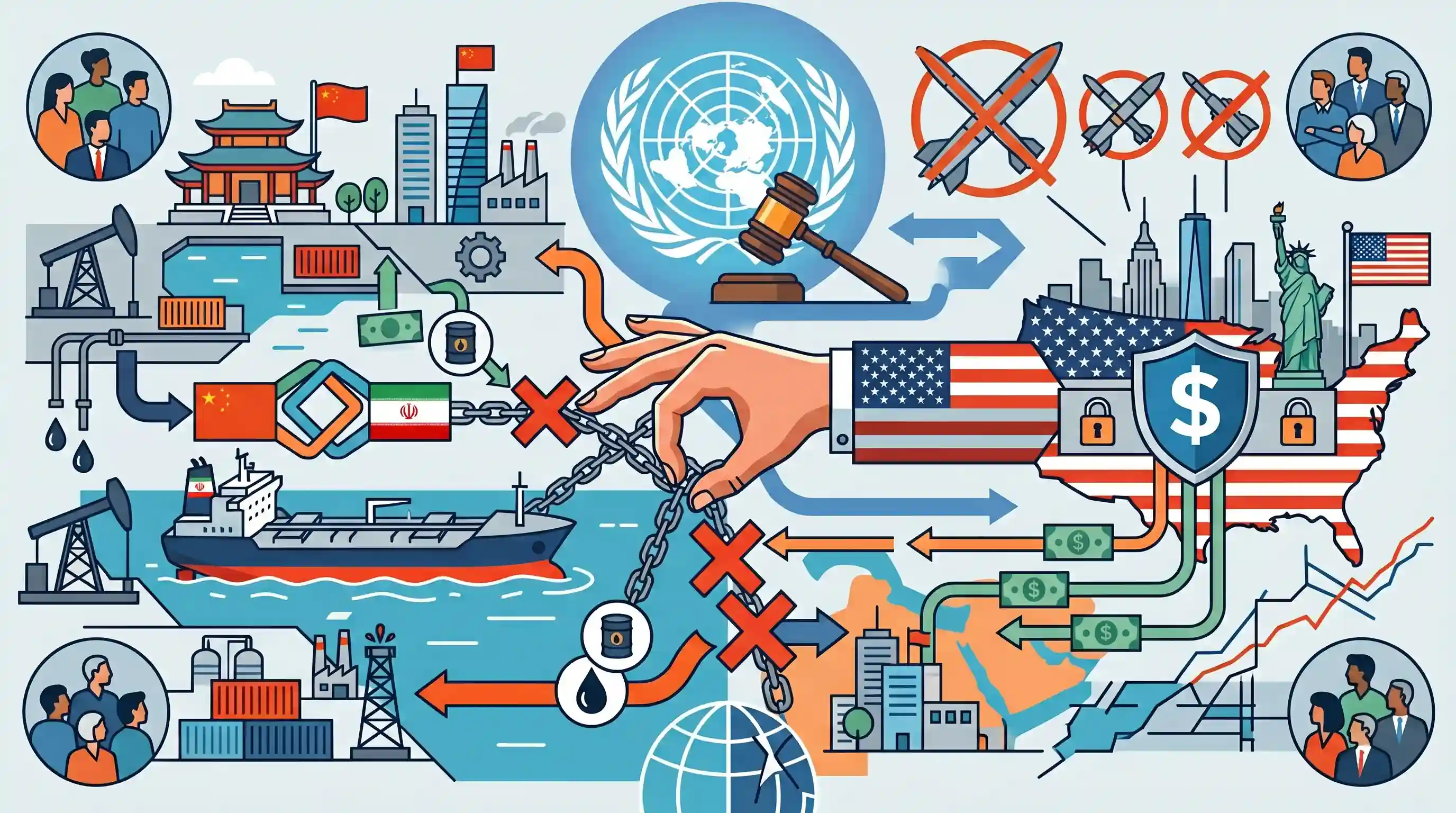
Why It Matters
This article highlights the ongoing debate between unilateral economic statecraft (US sanctions) and international sovereignty in trade. It is highly relevant for UPSC aspirants to understand the US-China geopolitical rivalry, the limitations of secondary sanctions lacking UN approval, and how these factors influence global energy supply chains and Middle Eastern diplomacy.
Summary
China has strongly condemned the United States for imposing unilateral sanctions on Chinese companies and vessels accused of facilitating the sale of Iranian petroleum. Beijing defended its trade with Tehran as legitimate under international law and rejected Washington's use of 'long-arm jurisdiction' absent a United Nations mandate. The US Treasury's move aims to cut off Tehran's revenue streams, which it claims are used to fund malign activities. The diplomatic friction underscores the ongoing geopolitical confrontation surrounding unilateral economic statecraft, international trade sovereignty, and the strategic alignment between China and Iran in the face of US pressure.
Key Points
- The US imposed unilateral sanctions on a network of maritime and petrochemical companies, including Chinese firms, for allegedly facilitating Iranian oil sales.
- China strongly rejected the US sanctions, defending its trade with Iran as legitimate, lawful, and mutually beneficial without targeting third parties.
- Beijing criticized Washington's reliance on 'long-arm jurisdiction' and unilateral sanctions that lack the mandate of the United Nations Security Council.
- The sanctions are part of ongoing US efforts to cut off revenue streams to Tehran, which Washington claims fund regional instability, while China maintains its role as the principal buyer of Iranian crude oil.
Important Terms
Unilateral Sanctions

Economic, financial, or trade penalties imposed by a single nation against another state or entity without a multilateral mandate from the United Nations.
UPSC context
GS Paper II (International Relations). Tests understanding of challenges to multilateralism and India’s stance on 'strategic autonomy.'
Long-arm Jurisdiction
The assertion of legal authority by a state over foreign entities outside its territory, often by leveraging domestic laws to penalize international actors.
UPSC context
GS Paper II (IR). Critical for analyzing extraterritoriality and friction between domestic law and international sovereignty.
Economic Statecraft
The use of economic resources—such as sanctions, trade, and aid—as instruments of foreign policy to influence other states and achieve strategic objectives.
UPSC context
GS Paper II (IR). Essential for evaluating the 'weaponization' of global finance and geoeconomic competition.
United Nations Security Council (UNSC)
The primary UN organ responsible for international peace, and the only body empowered to impose legally binding, multilateral sanctions on sovereign states.
UPSC context
GS Paper II (International Institutions). Core topic concerning global governance legitimacy and institutional reforms.
Office of Foreign Assets Control (OFAC)
An agency of the U.S. Treasury Department that administers and enforces economic and trade sanctions to support national security and foreign policy goals.
UPSC context
GS Paper II/III. Relevant for studying how the global dollar-based financial system is used as a geopolitical tool.
Strategic Alignment
The convergence of political and economic interests between nations to counter a shared rival and enhance their mutual regional or global leverage.
UPSC context
GS Paper II (IR). Key for studying shifting global power dynamics like the China-Iran-Russia axis.
Prelims Trap
Unilateral US sanctions against Iran are legally binding on all UN member states.
Only UNSC sanctions under Chapter VII are universally binding. US secondary sanctions rely on leveraging access to the US financial system, lacking an international legal mandate.
Static Concepts Connected
How do UN Security Council sanctions differ from unilateral secondary sanctions?
- UN Mandate: Issued under Chapter VII of the UN Charter; they are universally legally binding on all UN member states.
- Unilateral Sanctions: Imposed by individual states (e.g., USA); they lack an international legal mandate but are enforced via domestic economic leverage.
- Secondary Sanctions: Extraterritorial application ('long-arm jurisdiction') penalizing third-party nations or firms for dealing with a sanctioned entity, often leveraging global dependence on the US dollar.
Cross-Topic Patterns
Secondary Sanctions & Strategic Autonomy
India's 2019 halt of Iranian oil imports to avoid US financial exclusion contrasts with its defiance regarding Russian S-400 purchases, highlighting nuanced diplomatic balancing and strategic autonomy.
De-dollarization and Alternate Payment Systems
US reliance on 'long-arm jurisdiction' and secondary sanctions accelerates Sino-Russian and Sino-Iranian efforts to bypass the petrodollar using alternative financial systems like China's CIPS.

Expect a multi-statement question contrasting UNSC Chapter VII legally binding sanctions with unilateral 'long-arm' tools like CAATSA.
Linked PYQs · 4
Linked PYQs · 4
- 2025MainsGS2
"Energy security constitutes the dominant kingpin of India's foreign policy, and is linked with India's overarching influence in Middle Eastern countries.” How would you integrate energy security with India's foreign policy trajectories in the coming years?
- 2021MainsGS2
“The USA is facing an existential threat in the form of a China, that is much more challenging than the erstwhile Soviet Union.” Explain.
- 2025MainsGS2
"The reform process in the United Nations remains unresolved, because of the delicate imbalance of East and West and entanglement of the USA vs. Russo-Chinese alliance.” Examine and critically evaluate the East-West policy confrontations in this regard.
- 2024PrelimsGS1
Consider the following statements : Statement-I : Sumed pipeline is a strategic route for Persian Gulf oil and natural gas shipments to Europe. Statement-II : Sumed pipeline connects the Red Sea with the Mediterranean Sea. Which one of the following is correct in respect of the above statements?
