China Protests Indian Ministers Greetings to Dalai Lama
Source:The Hindu ↗
Why It Matters
This article highlights enduring bilateral frictions between India and China centered on the Tibet issue and the Dalai Lama's succession. It also points to the alarming security implications for India regarding the deepening China-Pakistan defense relationship, making it highly relevant for IR and internal security topics.
Summary
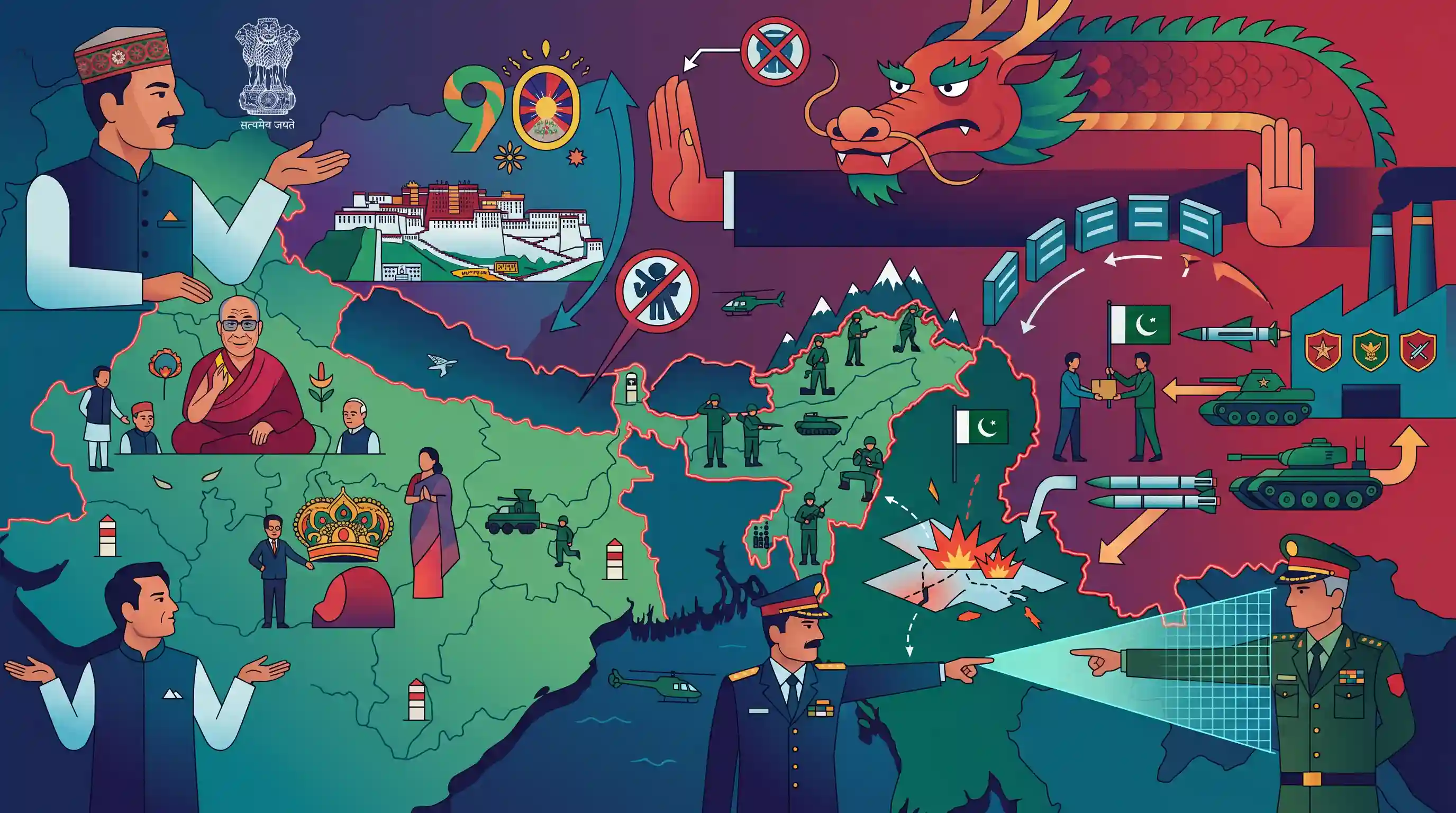
China formally protested to India over Prime Minister Narendra Modi's birthday greetings to the 14th Dalai Lama on his 90th birthday and the attendance of Indian ministers at celebrations in Dharamshala. Beijing criticized these actions as interference in its internal affairs concerning Tibet. Additionally, China objected to Union Minister Kiren Rijiju’s comments supporting the Dalai Lama's exclusive right to choose his successor, prompting India's MEA to clarify it holds "no position" on the religious matter. Furthermore, the Chinese foreign ministry defended its defence cooperation with Pakistan after Indian Deputy Chief of Army Staff Lt. Gen. Rahul R. Singh alleged that China tested its military hardware in a "live lab" during the recent Operation Sindoor conflict in May 2025.
Key Points
- China issued a formal protest over PM Narendra Modi's birthday greetings to the 14th Dalai Lama and the attendance of Indian ministers at his 90th birthday celebrations in Dharamshala.
- Beijing reiterated its view of the Dalai Lama as a separatist, urging India to respect its stance on Tibet (Xizang) and refrain from interfering in China's internal affairs.
- Union Minister Kiren Rijiju's remarks supporting the Dalai Lama's exclusive right to decide his succession drew Chinese objections, though India's MEA clarified it takes "no position" on religious beliefs.
- Chinese spokesperson Mao Ning defended the China-Pakistan defence cooperation after Indian Deputy Chief of Army Staff Lt. Gen. Rahul R. Singh claimed China used Pakistan as a "live lab" to test military hardware during Operation Sindoor in May 2025.
- The developments underscore India's diplomatic balancing act—hosting the Dalai Lama as an "honoured guest" while dealing with dual geopolitical friction regarding Tibet and the China-Pakistan military axis.
Important Terms
Operation Sindoor

A May 2025 Indian counter-terror operation against infrastructure in Pakistan. It is cited as a significant instance where China allegedly used Pakistan as a 'live lab' to test military hardware.
UPSC context
GS II & III (IR/Security). Tests knowledge of the China-Pakistan nexus and multi-domain warfare in South Asia.
14th Dalai Lama
The spiritual leader of Tibet, Tenzin Gyatso, resident in India since 1959. His status and 90th birthday celebrations remain a major flashpoint in India-China diplomatic relations.
UPSC context
GS II (IR). Central to the Tibet issue, border disputes, and India's 'One China' policy stance.
Gaden Phodrang Trust
The official office of the Dalai Lama, designated as the sole authority for identifying his successor. This excludes any role for the Chinese government in the reincarnation process.
UPSC context
GS II (IR). Relevant for understanding the religious-geopolitical struggle over Tibetan leadership succession.
Ministry of External Affairs (MEA)
India's government ministry responsible for foreign relations. It manages the diplomatic fallout from China's protests regarding Tibet while upholding India's sovereign right to host spiritual leaders.
UPSC context
GS II (Polity/IR). Tests understanding of India's institutional foreign policy framework and diplomatic communication.
China-Pakistan Military Nexus
The strategic and technological collaboration between Beijing and Islamabad, characterized by shared military hardware, intelligence, and the use of Pakistan to challenge India's regional influence.
UPSC context
GS III (Security). Crucial for analyzing the two-front threat and regional defense dynamics.
Chinese Ministry of Foreign Affairs (MFA)
The executive department of the Chinese government that issues formal protests (demarches) to India, viewing Indian official engagement with the Dalai Lama as interference in internal affairs.
UPSC context
GS II (IR). Significant for studying the diplomatic tactics and 'wolf warrior' rhetoric of India's neighbors.
Prelims Trap
India does not recognize Tibet as part of China and formally supports the Dalai Lama's sole right to choose his successor.
India officially recognized the Tibet Autonomous Region as part of China in 2003. Furthermore, the MEA explicitly maintains "no position" on the religious matter of the Dalai Lama's succession.
Static Concepts Connected
How has India's official diplomatic stance on the status of Tibet evolved?
- 1954 Panchsheel: The Sino-Indian agreement first referred to Tibet as the 'Tibet region of China', implicitly acknowledging Chinese control.
- 2003 Joint Declaration: India formally and explicitly recognized the Tibet Autonomous Region (TAR) as part of the territory of the People's Republic of China.
- Current Status: India hosts the Dalai Lama as an 'honoured guest' but officially prohibits Tibetans from engaging in anti-China political activities on Indian soil.
What defines the evolving China-Pakistan military interoperability threat?
- Hardware Parity: Pakistan's integration of advanced Chinese platforms like J-10C fighters establishes equipment commonality, complicating India's conventional air defense strategy.
- Space Integration: Use of China's BeiDou satellite navigation system by Pakistani forces reduces reliance on Western GPS, enabling independent, uninterrupted precision-strike capabilities.
- Two-Front Doctrine: The relationship has shifted from diplomatic shielding at the UN to direct technological enablement, heightening the risk of a coordinated two-front war.
Cross-Topic Patterns
BeiDou Navigation vs India's NavIC
Pakistan's use of Chinese BeiDou systems during military skirmishes bridges IR with Space Tech, highlighting the strategic urgency for India to fully operationalize and secure its own NavIC system for military use.
Buddhism Soft-Power vs Absolute Sovereignty
India leverages Buddhism as a soft-power tool in Asia, yet must carefully balance this against China's strict 'internal affairs' boundary regarding Tibetan autonomy and the reincarnation of the Dalai Lama.

India's Tibet policy duality (2003 recognition vs CTA) alongside the China-Pak military 'live lab' threat is a prime 2026 GS-2/GS-3 focus.
Linked PYQs · 4
Linked PYQs · 4
- 2014MainsGS2
With respect to the South China sea, maritime territorial disputes and rising tension affirm the need for safeguarding maritime security to ensure freedom of navigation and over flight throughout the region. In this context, discuss the bilateral issues between India and China.
- 2012MainsGS2
Do you think that China's emergence as one of the largest trading partners of India has adversely affected the settlement of the outstanding border problem?
- 2014MainsGS3
China and Pakistan have entered into an agreement for development of an economic corridor. What threat does this pose for India's security? Critically examine.
- 2024MainsGS3
India has a long and troubled border with China and Pakistan fraught with contentious issues. Examine the conflicting issues and security challenges along the border. Also give out the development being undertaken in these areas under the Border Area Development Programme (BADP) and Border Infrastructure and Management (BIM) Scheme.
