Trilateral Expansion of CPEC into Afghanistan
Source:The Hindu ↗
Why It Matters
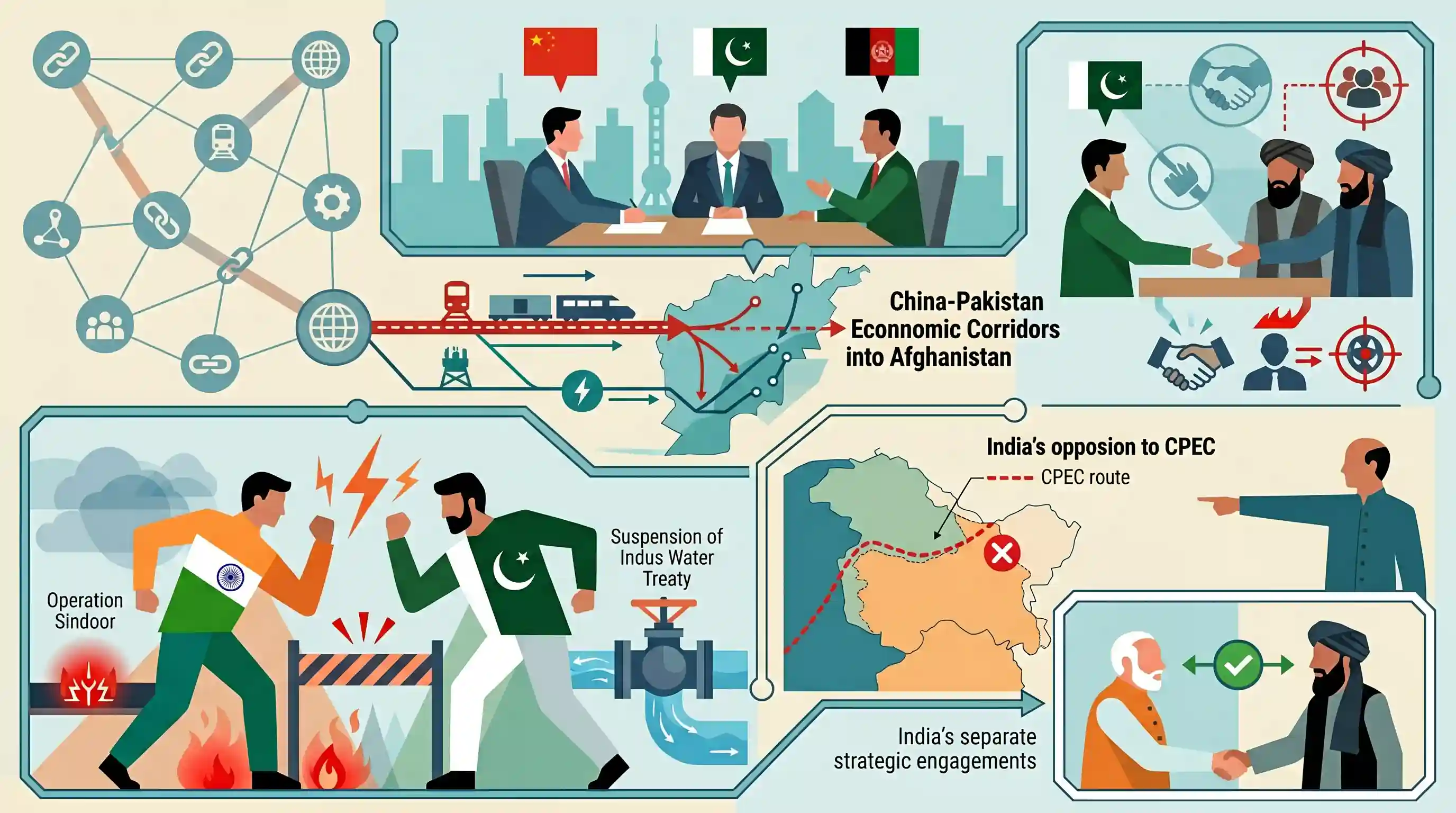
The expansion of CPEC into Afghanistan directly impacts India's strategic calculations in its neighborhood. It connects overlapping themes of cross-border terrorism, sovereignty concerns in PoK, the relevance of the Indus Water Treaty, and the evolving geopolitical alignments involving China, Pakistan, and the Taliban.
Summary
During a trilateral dialogue in Beijing, the foreign ministers of China, Pakistan, and Afghanistan agreed to expand the China-Pakistan Economic Corridor (CPEC) into Afghan territory, deepening Afghanistan's integration into the Belt and Road Initiative (BRI). The talks also addressed counter-terrorism cooperation, with Pakistan pressing Kabul to act against groups like the TTP and BLA. This development takes place amidst severe India-Pakistan tensions—highlighted by India's recent 'Operation Sindoor' and suspension of the Indus Water Treaty—and India's continued opposition to CPEC's violation of its sovereignty in PoK. Concurrently, India has been pursuing its own strategic engagements with the Taliban administration.
Key Points
- China, Pakistan, and Afghanistan have formally agreed to extend the China-Pakistan Economic Corridor (CPEC) into Afghanistan, integrating it into the broader Belt and Road Initiative (BRI).
- The trilateral meeting in Beijing also focused on regional security, with Pakistan urging the Afghan Taliban to crack down on militant groups like the TTP and BLA operating from Afghan soil.
- The geopolitical backdrop includes India's recent 'Operation Sindoor' targeting terror launchpads in PoK and New Delhi's decision to keep the 1960 Indus Water Treaty in abeyance.
- India maintains firm opposition to CPEC due to its routing through Pakistan-occupied Kashmir (PoK), even as New Delhi gradually warms diplomatic channels with the Taliban administration in Kabul.
Important Terms
China-Pakistan Economic Corridor (CPEC)

A $60+ billion infrastructure project connecting China's Xinjiang to Pakistan's Gwadar port; a flagship component of the BRI passing through Pakistan-occupied Kashmir (PoK).
UPSC context
GS-II/International Relations; critical for questions on regional connectivity, China’s influence, and India’s territorial integrity concerns in PoK.
Belt and Road Initiative (BRI)
China's global strategy for infrastructure development and international cooperation, aimed at enhancing connectivity between China and the rest of Eurasia, Africa, and beyond.
UPSC context
GS-II/Global Groupings; relevant for India’s strategic response to Chinese economic diplomacy and regional infrastructure projects.
Indus Water Treaty (IWT)
A 1960 water-sharing agreement between India and Pakistan mediated by the World Bank; recently faced unprecedented strain due to India's concerns over state-sponsored terrorism.
UPSC context
GS-II/Bilateral Relations; tests knowledge of hydro-diplomacy, treaty legalities, and the 'water as a weapon' strategic discourse.
Tehreek-e-Taliban Pakistan (TTP)
A militant umbrella organization targeting the Pakistani state; its presence in Afghanistan is a major point of contention between Islamabad and the Taliban.
UPSC context
GS-III/Security Challenges; essential for understanding the Af-Pak security dynamic and its implications for regional stability.
Balochistan Liberation Army (BLA)
A separatist group in Balochistan province that opposes CPEC and Chinese investment, frequently targeting Chinese nationals and infrastructure projects.
UPSC context
GS-III/Security Challenges; relevant for analyzing internal security threats in the neighborhood and the vulnerability of Chinese investments.
Taliban (Afghanistan)
The de facto governing body of Afghanistan since 2021; currently navigating a complex 'triangular' relationship between Chinese investment, Pakistani security demands, and Indian humanitarian engagement.
UPSC context
GS-II/India and its Neighborhood; tests India's pragmatic foreign policy shifts and the impact of the 2021 regime change.
Prelims Trap
India has formally abrogated and withdrawn from the 1960 Indus Water Treaty.
India has placed treaty mechanisms in 'abeyance' (suspension) to pressure Pakistan, but it has not formally withdrawn from or legally abrogated the World Bank-brokered treaty.
Static Concepts Connected
What are the core water-sharing provisions of the Indus Water Treaty (1960)?
- Eastern Rivers: India has absolute control and unrestricted use over the Ravi, Beas, and Sutlej rivers.
- Western Rivers: Pakistan is allocated the Indus, Jhelum, and Chenab, but India is permitted limited agricultural use and non-consumptive (run-of-the-river) hydroelectric projects.
- Institutional Broker: The treaty was brokered by the World Bank, which maintains a role in dispute resolution mechanisms like appointing Neutral Experts.
Why does India officially oppose China's Belt and Road Initiative (BRI)?
- Sovereignty violation: The flagship China-Pakistan Economic Corridor (CPEC) passes through Gilgit-Baltistan in Pakistan-occupied Kashmir (PoK), directly violating India's territorial integrity.
- Opaque financing: India cites a lack of transparency, ecological standards, and the creation of unsustainable debt burdens for host nations (debt-trap diplomacy).
- Strategic encirclement: India is wary of the dual-use nature of BRI infrastructure (like ports and highways) that enhances China's military encirclement capabilities.
Cross-Topic Patterns
CPEC extension & Afghan critical minerals
China's push to extend CPEC into Kabul is deeply linked to securing Afghanistan's vast, untapped reserves of lithium and copper, essential for Chinese clean-energy manufacturing.
Hydro-diplomacy as coercive statecraft
Placing the Indus Water Treaty in abeyance alongside border strikes reflects India's modern doctrine of multi-domain deterrence, linking transboundary water rights directly to state-sponsored terrorism.
Ideological isolation vs Strategic Realism
India's measured engagement with the Taliban, despite China's heavy infrastructural footprint, highlights a shift from ideological isolationism to 'strategic realism' to secure regional security interests.

Expect a 2026 multi-statement prelims question linking CPEC's geographical routing, Afghanistan's BRI entry, and Indus Water Treaty mechanisms.
Linked PYQs · 4
Linked PYQs · 4
- 2018MainsGS3
The China-Pakistan Economic Corridor (CPEC) is viewed as a cardinal subset of China's larger 'One Belt One Road' initiative. Give a brief description of CPEC and enumerate the reasons why India has distanced itself from the same.
- 2014MainsGS3
China and Pakistan have entered into an agreement for development of an economic corridor. What threat does this pose for India's security? Critically examine.
- 2012MainsGS2
The situation today is far different to that prevalent fifty years back when the Indus Water Treaty was signed." Highlight the complexity of the current challenges on both sides of the border in this regard. Do you think that a review of the Treaty is in India's best interests?
- 2011MainsGS2
Critically examine the security and strategic implications of the so-called 'string of pearls' theory for India.
