China Diplomatic Bid in Iran Conflict and US Skepticism
Source:The Hindu ↗
Why It Matters
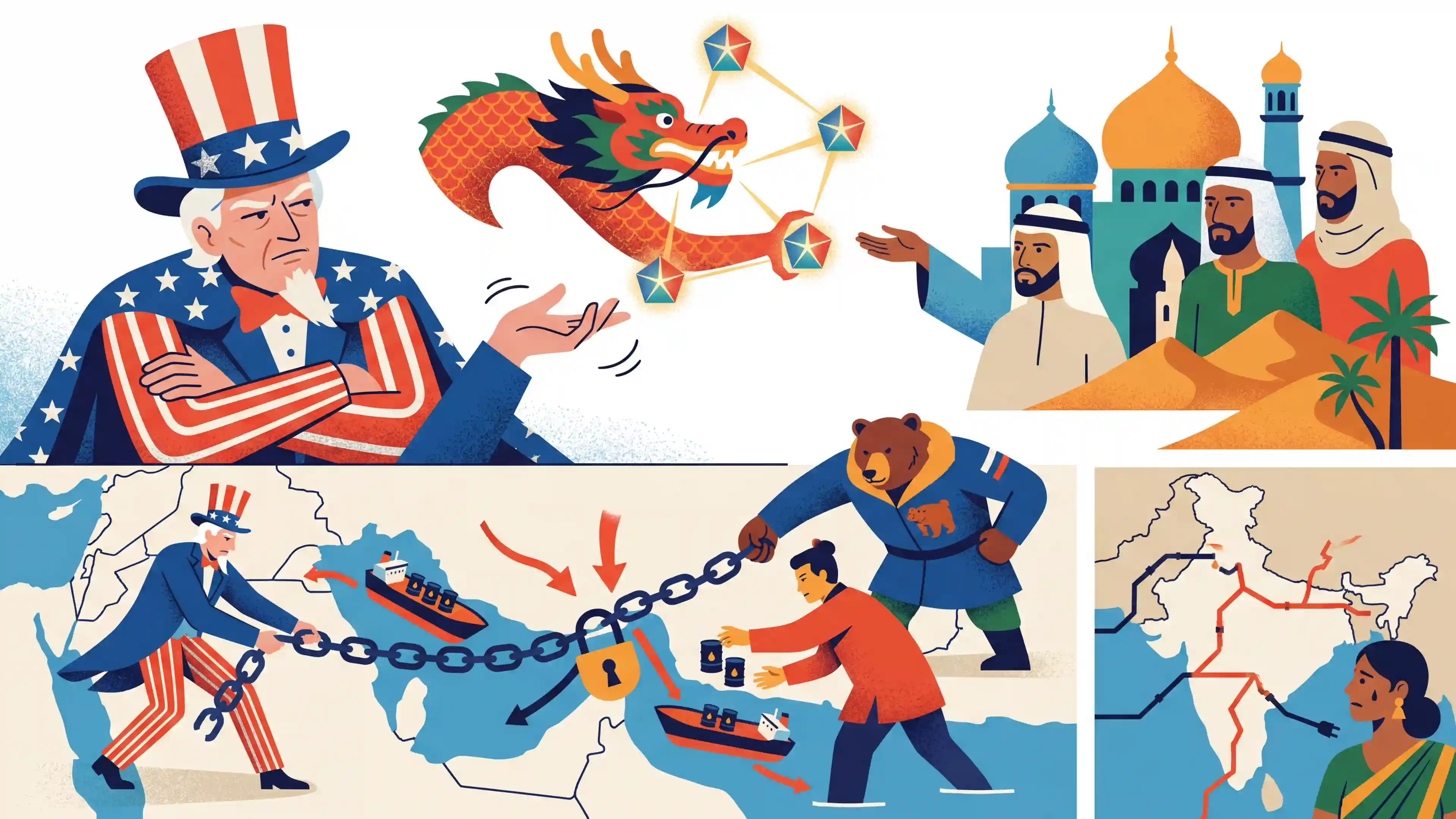
The article highlights the shifting multipolar dynamics in the Middle East (West Asia) as China increasingly asserts a diplomatic role, challenging the traditional US hegemony. Understanding these shifts is crucial for UPSC aspirants, as control over maritime chokepoints like the Strait of Hormuz directly affects global supply chains and India's vital energy security framework.
Summary
China is attempting to expand its diplomatic influence in the Middle East amidst the ongoing Iran conflict by introducing a five-point peace proposal and rallying regional support. However, the United States remains highly skeptical, dismissing Beijing's initiatives as 'performative' and lacking substantive commitment. The closure of the Strait of Hormuz introduces complex geopolitical dynamics, threatening the energy security and shipping lanes of major oil importers like China, while highlighting the contrasting strategic interests of the US, China, and Russia in the region.
Key Points
- China has proposed a five-point peace plan to address the ongoing Iran crisis, seeking support from Pakistan and Gulf nations.
- The United States views China's diplomatic moves as 'performative' messaging rather than genuine mediation, citing past superficial efforts in Ukraine.
- The ongoing conflict poses significant energy security risks, as China relies on Iran for oil and fears economic damage from shipping disruptions in the Strait of Hormuz.
- Strategic competition is playing out at the UN, where China opposed a Bahrain-backed, US-supported proposal to authorize force to reopen the Strait of Hormuz.
Important Terms
China’s Five-Point Proposal (Middle East)

A 2026 joint framework by China and Pakistan calling for an immediate ceasefire, peace talks, protection of non-military targets, secure shipping lanes, and adherence to the UN Charter.
UPSC context
GS Paper 2 (International Relations); tests understanding of China's expanding diplomatic role and its 'alternative' peace-making frameworks in West Asia.
Strait of Hormuz
A narrow, strategically vital waterway connecting the Persian Gulf to the Gulf of Oman, through which approximately 20% of the world's petroleum and LNG supplies transit.
UPSC context
GS Paper 1 (Geography) and Paper 2 (IR); critical for analyzing global energy supply chains and India's maritime security interests.
Global Security Initiative (GSI)
A Chinese foreign policy framework advocating for 'indivisible security,' sovereignty, and peaceful dispute resolution, positioned as a non-interventionist alternative to Western-led security architectures.
UPSC context
GS Paper 2 (IR); relevant for studying China's geopolitical strategy and its attempts to reshape the global security order.
Energy Security
The uninterrupted availability of energy sources at an affordable price, encompassing physical supply stability and economic accessibility in the face of geopolitical disruptions.
UPSC context
GS Paper 3 (Economy/Infrastructure); vital for India’s strategic planning, diversification of oil imports, and management of current account deficits.
Strategic Chokepoint
A narrow geographical passage, like a strait or canal, that can be easily blocked to significantly disrupt international trade and military movement.
UPSC context
GS Paper 1 and 2; a core concept in maritime geopolitics and the 'Revenge of Geography' in international relations.
West Asia
The subregion of Asia encompassing the Middle East, which is a focal point for India’s 'Link West' policy, energy imports, and large expatriate workforce.
UPSC context
GS Paper 2 (IR); essential for analyzing India's regional interests and the impact of great power competition on regional stability.
Prelims Trap
"The Strait of Hormuz is bordered by Iran to the north and the United Arab Emirates to the south."
The Strait is bordered by Iran to the north and Oman (specifically the Musandam Peninsula exclave) to the south, not the UAE. Map-based questions frequently exploit this geographical nuance.
Static Concepts Connected
What are the critical maritime chokepoints for energy transit in West Asia?
- Strait of Hormuz: Connects the Persian Gulf to the Gulf of Oman and Arabian Sea. Crucially, it is bordered by Iran and Oman, facilitating 20% of global oil consumption.
- Bab el-Mandeb: Connects the Red Sea to the Gulf of Aden and the Indian Ocean. Bordered by Yemen on the Arabian Peninsula, and Djibouti and Eritrea in Africa.
- Suez Canal: An artificial sea-level waterway in Egypt connecting the Mediterranean Sea to the Red Sea, separating the African continent from Asia.
How does the United Nations Security Council authorize the use of force?
- Chapter VII resolutions: The UNSC can authorize military action, blockades, or sanctions to restore international peace and security under Chapter VII of the UN Charter.
- P5 Veto Power: Substantive resolutions require nine affirmative votes. Any of the five permanent members (P5) can block the resolution by exercising their veto power, even if the majority agrees.
Cross-Topic Patterns
China's mediation vs India's West Asia calculus
China's transition from an economic partner to a diplomatic mediator in West Asia challenges India’s traditional multi-alignment strategy and connectivity projects like the India-Middle East-Europe Economic Corridor (IMEC).
Maritime chokepoints and imported inflation
Disruptions in the Strait of Hormuz directly impact GS3 macroeconomics. As 20% of global oil transits here, blockades spike crude prices, worsening India's current account deficit and driving imported inflation.

Expect a 2026 Prelims question mapping West Asian chokepoints (Hormuz/Bab el-Mandeb) alongside China's diplomatic footprint in the region.
Linked PYQs · 5
Linked PYQs · 5
- 2025MainsGS2
"The reform process in the United Nations remains unresolved, because of the delicate imbalance of East and West and entanglement of the USA vs. Russo-Chinese alliance.” Examine and critically evaluate the East-West policy confrontations in this regard.
- 2021MainsGS2
“The USA is facing an existential threat in the form of a China, that is much more challenging than the erstwhile Soviet Union.” Explain.
- 2025MainsGS2
"Energy security constitutes the dominant kingpin of India's foreign policy, and is linked with India's overarching influence in Middle Eastern countries.” How would you integrate energy security with India's foreign policy trajectories in the coming years?
- 2017MainsGS2
The question of India's Energy Security constitutes the most important part of India's economic progress. Analyze India's energy policy cooperation with West Asian countries.
- 2024MainsGS2
‘The West is fostering India as an alternative to reduce dependence on China's supply chain and as a strategic ally to counter China's political and economic dominance.’ Explain this statement with examples.
