China Displays Military Might at World War Two Commemoration
Source:The Hindu ↗
Why It Matters
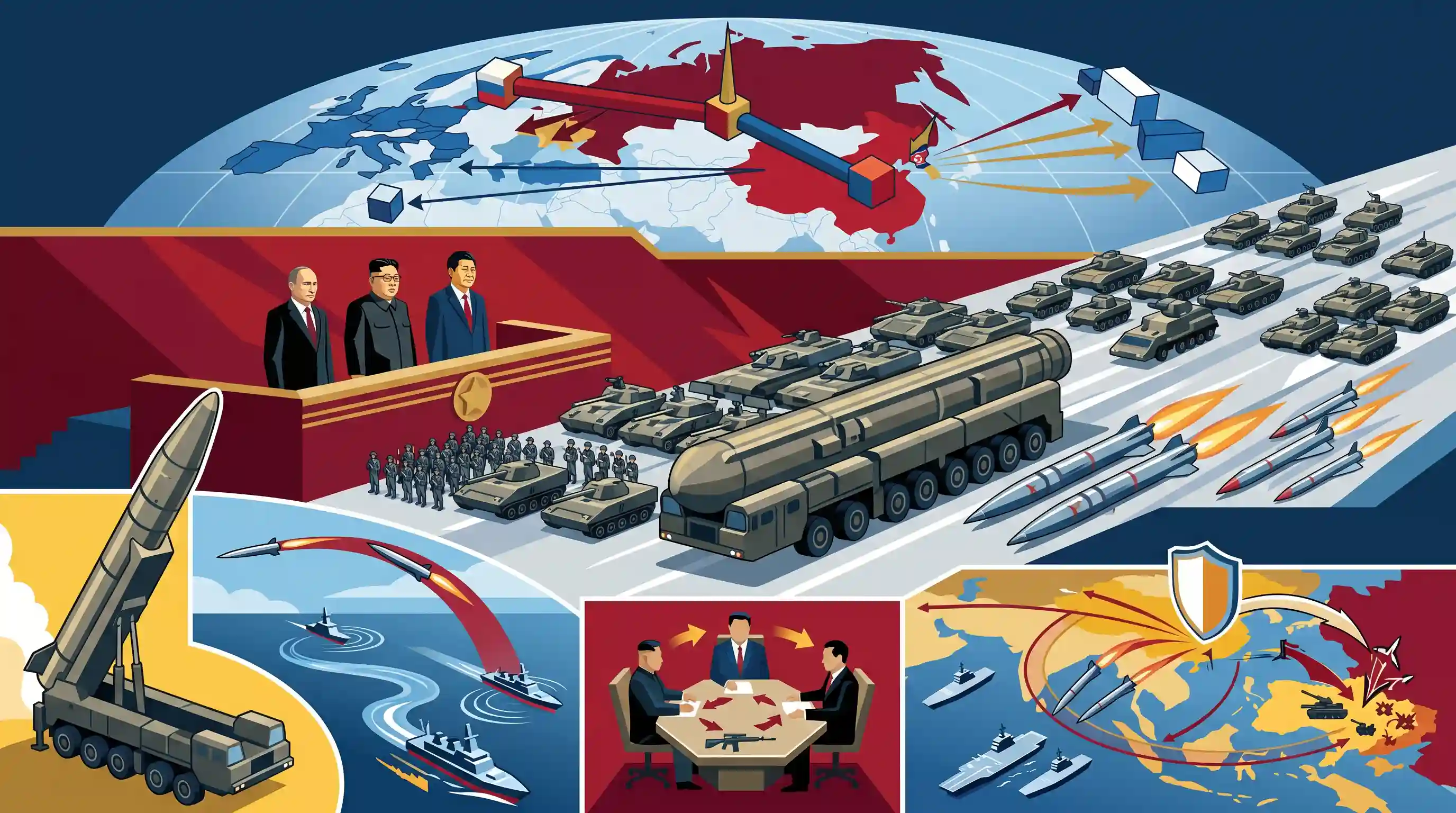
The event signifies a hardening of global alliances into opposing blocs, with the China-Russia-North Korea nexus challenging the existing US-led world order. For India, China's growing military prowess—particularly in hypersonic weapons and naval deterrence—alters the security architecture in the Indo-Pacific, necessitating continuous recalibration of its strategic and defense priorities.
Summary
China's Victory Day military parade on September 3, 2025, served as a potent display of its modern military capabilities and shifting global geopolitical alignments. With key leaders like Vladimir Putin and Kim Jong-un in attendance, the event underscored a deepening strategic axis between Beijing, Moscow, and Pyongyang, contrasting with US and Western interests. The unveiling of advanced weaponry, including the DF-61 ICBM and new hypersonic anti-ship missiles, highlighted China's focus on maritime dominance and deterrence in the Indo-Pacific. Furthermore, bilateral meetings acknowledging North Korean military support for Russia in the Ukraine conflict emphasized the practical implications of this growing trilateral partnership on global security.
Key Points
- China held a massive military parade on September 3, 2025, to mark the 80th anniversary of its victory against Japanese aggression in World War II.
- The prominent presence of Russian President Vladimir Putin and North Korean leader Kim Jong-un alongside Xi Jinping highlighted a consolidating strategic alignment against Western powers.
- China showcased major advancements in its military modernization, unveiling the DF-61 ICBM, JL-3 submarine-launched missiles, and new long-range hypersonic anti-ship missiles (YJ-15 to YJ-20).
- Putin and Kim Jong-un held bilateral talks on the sidelines, with Putin praising North Korean troops for aiding in repelling a Ukrainian incursion in Russia's Kursk region.
- The display of new hypersonic and naval interceptor capabilities signals China's enhanced anti-access/area denial (A2/AD) posture in the Indo-Pacific, directly impacting geopolitical stability concerning Taiwan and the South China Sea.
Important Terms
Russia-North Korea Comprehensive Strategic Partnership Treaty

A 2024 security pact between Moscow and Pyongyang featuring a mutual defense clause. It mandates immediate military assistance if either nation is attacked, formalizing a strategic alliance against Western-led pressure.
UPSC context
GS Paper II (International Relations). Crucial for analyzing shifting power dynamics in the Indo-Pacific and the emergence of non-Western security blocs.
DF-61 ICBM
China’s next-generation, road-mobile heavy intercontinental ballistic missile (ICBM) unveiled in 2025. It is designed to carry multiple independently targetable reentry vehicles (MIRVs) or hypersonic glide vehicles to evade missile defenses.
UPSC context
GS Paper III (Internal Security/Defense). Tests knowledge of global nuclear deterrence and advanced military technology impacting India's neighborhood.
JL-3 (Julang-3) SLBM
A third-generation submarine-launched ballistic missile (SLBM) with an estimated range of 9,000–12,000 km. It enables China to strike distant targets from protected coastal waters, securing a credible second-strike capability.
UPSC context
GS Paper III (Defense). Essential for understanding the sea-based leg of the nuclear triad and maritime strategic stability.
YJ-21 Hypersonic Missile
China's advanced hypersonic anti-ship ballistic missile, nicknamed the 'carrier killer.' It can be launched from ships or aircraft and travels at hypersonic speeds to penetrate sophisticated naval air defenses.
UPSC context
GS Paper II (Indo-Pacific Security). Relevant to discussions on 'Anti-Access/Area Denial' (A2/AD) strategies and maritime security challenges.
Nuclear Triad
A strategic military structure consisting of three components: land-based ICBMs, submarine-launched missiles (SLBMs), and strategic bombers. This ensures nuclear survivability and a guaranteed retaliatory strike capability.
UPSC context
GS Paper III (Security). Tests conceptual understanding of strategic deterrence and the modernization of global nuclear postures.
Prelims Trap
"Hypersonic glide vehicles follow a predictable ballistic trajectory similar to traditional ICBMs."
Hypersonic missiles maneuver mid-flight at lower atmospheric altitudes, whereas traditional ballistic missiles follow a predictable parabolic arc in space, making HGVs exceptionally difficult to intercept.
Static Concepts Connected
What constitutes an Anti-Access/Area Denial (A2/AD) strategy?
- Anti-Access (A2): Long-range capabilities designed to prevent an advancing adversary from entering a broader theater of operations (e.g., long-range anti-ship ballistic missiles).
- Area Denial (AD): Shorter-range capabilities aimed at limiting an adversary's freedom of action within the contested theater (e.g., coastal submarines, dense air-defense systems).
- Strategic intent: Primarily employed by regional powers to deter or delay intervention by a superior global naval power, raising the costs of conflict.
How do hypersonic missiles differ from traditional ballistic missiles?
- Speed & Trajectory: While both can exceed Mach 5, traditional ICBMs follow a highly predictable arching, parabolic trajectory into the exosphere before re-entering.
- Maneuverability: Hypersonic glide vehicles (HGVs) travel lower in the atmosphere and can dynamically alter their flight path mid-course to evade detection.
- Interception difficulty: Due to their unpredictable flight paths and lower operational altitude, existing conventional terrestrial radars and missile defense systems struggle to track them.
Cross-Topic Patterns
A2/AD & Indo-Pacific Quad
China's enhanced naval denial capabilities directly challenge the Free and Open Indo-Pacific doctrine, elevating the military necessity of the AUKUS pact and Quad naval exercises.
Nuclear Triad & Second-Strike deterrence
The JL-3 submarine-launched missiles boost China's survivable second-strike capability, altering global nuclear deterrence calculus and mirroring debates around India's own Arihant-class SSBN deployments.

Expect a 2026 Prelims question linking hypersonic A2/AD missile technology to the strategic China-Russia-North Korea axis.
Linked PYQs · 3
Linked PYQs · 3
- 2025MainsGS2
"The reform process in the United Nations remains unresolved, because of the delicate imbalance of East and West and entanglement of the USA vs. Russo-Chinese alliance.” Examine and critically evaluate the East-West policy confrontations in this regard.
- 2021MainsGS2
The newly tri-nation partnership AUKUS is aimed at countering China's ambitions in the Indo-Pacific region. Is it going to supersede the existing partnerships in the region? Discuss the strength and impact of AUKUS in the present scenario.
- 2020MainsGS2
What is the significance of Indo-US defence deals over Indo-Russian defence deals? Discuss with reference to stability in the Indo-Pacific region.
