China 2026 Economic Growth Target and Global Trade Impact
Source:The Hindu ↗
Why It Matters
China's economic slowdown and trade wars have a profound impact on global supply chains and inflation. For India, this presents both challenges and strategic opportunities (e.g., China Plus One strategy) in manufacturing and trade, heavily relevant for GS2 (IR) and GS3 (Economy).
Summary
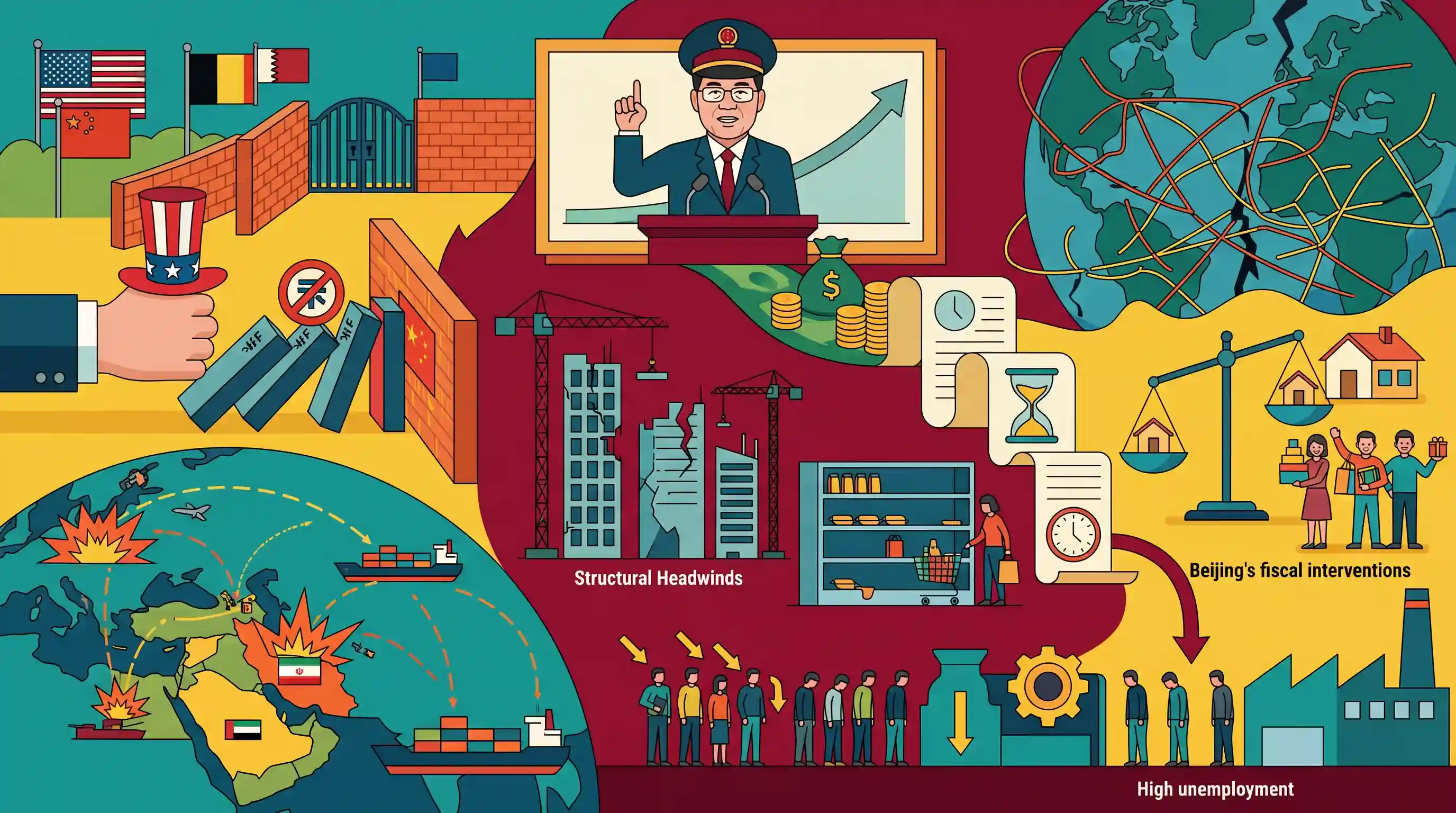
China's Premier Li Qiang announced a modest economic growth target of 4.5% to 5% for 2026 at the National People's Congress, reflecting caution amid rising domestic and global pressures. The Chinese economy faces structural headwinds including a prolonged property sector slump, weak domestic consumption, and high unemployment. Compounding these are external risks, notably potential trade tariffs from the U.S. and supply chain disruptions resulting from the U.S.-Iran conflict. To stimulate growth and pivot towards domestic consumption, Beijing plans significant fiscal interventions, including ultra-long special treasury bonds. The economic slowdown and changing geopolitical landscape highlight the vulnerability of global supply chains to bilateral conflicts and protectionist policies.
Key Points
- China lowered its 2026 economic growth target to 4.5-5% at the National People's Congress, citing global uncertainties and domestic challenges.
- External economic pressures include looming trade tariffs from the U.S. under Donald Trump and global supply chain disruptions caused by a U.S.-Iran war.
- Domestic economic headwinds consist of sluggish internal consumption, a property market crisis, and high urban unemployment.
- To counter these trends, Beijing announced fiscal stimulus including 250 billion yuan in ultra-long special treasury bonds to boost consumer goods trade-ins.
- China targets creating over 12 million new urban jobs, maintaining an urban unemployment rate around 5.5%, and keeping CPI inflation at 2%.
Important Terms
National People's Congress (NPC)

China's supreme state power organ and legislature. It meets annually to approve national goals, budgets, and laws, serving as the primary venue for announcing major economic shifts and policies.
UPSC context
GS-II (International Relations); essential for understanding the governance and policy-making processes of a major global power and Indian neighbor.
Ultra-long special treasury bonds
Sovereign debt with 20-50 year maturities issued for specific strategic projects rather than general deficits. These provide long-term fiscal support for infrastructure and national security initiatives.
UPSC context
GS-III (Economy); relevant for studying fiscal stimulus tools and state-led economic recovery strategies in large economies.
Protectionism
Government policies, such as tariffs and quotas, that restrict international trade to protect domestic industries. It is a key driver of current global trade tensions and the "de-globalization" trend.
UPSC context
GS-III (Economy); critical for evaluating the impact of global trade wars and protectionist trends on Indian exports.
Global Supply Chain Disruptions
Interruptions in the worldwide production and distribution network due to geopolitical conflicts or trade barriers. This vulnerability forces nations to seek more resilient and diversified sourcing strategies.
UPSC context
GS-III (Economy/Infrastructure); vital for analyzing global trade vulnerabilities and India's potential as an alternative manufacturing hub.
Structural Headwinds
Persistent, long-term economic challenges—like high debt or property slumps—that impede growth. Unlike cyclical dips, these require deep policy reforms to transition to a new growth model.
UPSC context
GS-III (Economy); key for understanding deep economic crises and the transition from investment-led to consumption-led growth models.
Prelims Trap
China's deflationary cycle heavily benefits Indian MSMEs by lowering the cost of imported raw materials and capital goods.
While cheap imports seem beneficial, "exporting deflation" means China dumps cheap finished goods globally, threatening the survival and competitiveness of Indian MSMEs.
Static Concepts Connected
What is "Dumping" and how are Anti-Dumping Duties applied under the WTO?
- Dumping: The practice of a country exporting a product at a price lower than its normal value in its own domestic market.
- Anti-Dumping Duty (ADD): A customs duty applied to imports to rectify the market distortion caused by dumping and protect domestic industries.
- WTO Rules: WTO agreements allow ADDs only if the importing nation demonstrates that the dumping causes "material injury" to its competing domestic industry.
What characterizes "Special Treasury Bonds" in macroeconomic management?
- Specific Purpose: Unlike regular bonds covering general fiscal deficits, they are issued to fund specific strategic projects, structural adjustments, or crisis recovery.
- Budgetary Treatment: In many jurisdictions, they are treated as off-budget items, meaning they do not directly inflate the headline fiscal deficit figure.
- Ultra-Long Maturity: They often feature 10 to 50-year maturities, aligning debt repayment with the long-term economic returns of infrastructure or structural upgrades.
Cross-Topic Patterns
China's slowdown + India's PLI strategy
As MNCs de-risk from China amid trade wars and slowdowns, India leverages Production-Linked Incentive (PLI) schemes to capture shifting global supply chains.
Chinese deflation + Global trade remedies
China's weak domestic consumption forces surplus manufacturing abroad, prompting nations like India to heavily rely on anti-dumping duties and neo-mercantilist protections.

Expect a 2026 Mains question linking China's structural economic slowdown to 'exported deflation' and India's trade protection strategies.
Linked PYQs · 4
Linked PYQs · 4
- 2024MainsGS2
‘The West is fostering India as an alternative to reduce dependence on China's supply chain and as a strategic ally to counter China's political and economic dominance.’ Explain this statement with examples.
- 2025MainsGS3
What are the challenges before the Indian economy when the world is moving away from free trade and multilateralism to protectionism and bilateralism? How can these challenges be met?
- 2018MainsGS2
What are the key areas of reform if the WTO has to survive in the present context of "Trade War', especially keeping in mind the interest of India?
- 2021MainsGS2
“The USA is facing an existential threat in the form of a China, that is much more challenging than the erstwhile Soviet Union.” Explain.
