India AI Adoption and China Open Source Leadership in Tech Report
Source:Indian Express ↗
Why It Matters
The global race for AI supremacy directly impacts India's economic growth and strategic autonomy. Recognizing India's core strengths—rapid digital adoption facilitated by DPI and human capital—alongside the strategic implications of the US-China open-source versus proprietary tech rivalry is crucial for formulating forward-looking science, technology, and foreign policies.
Summary
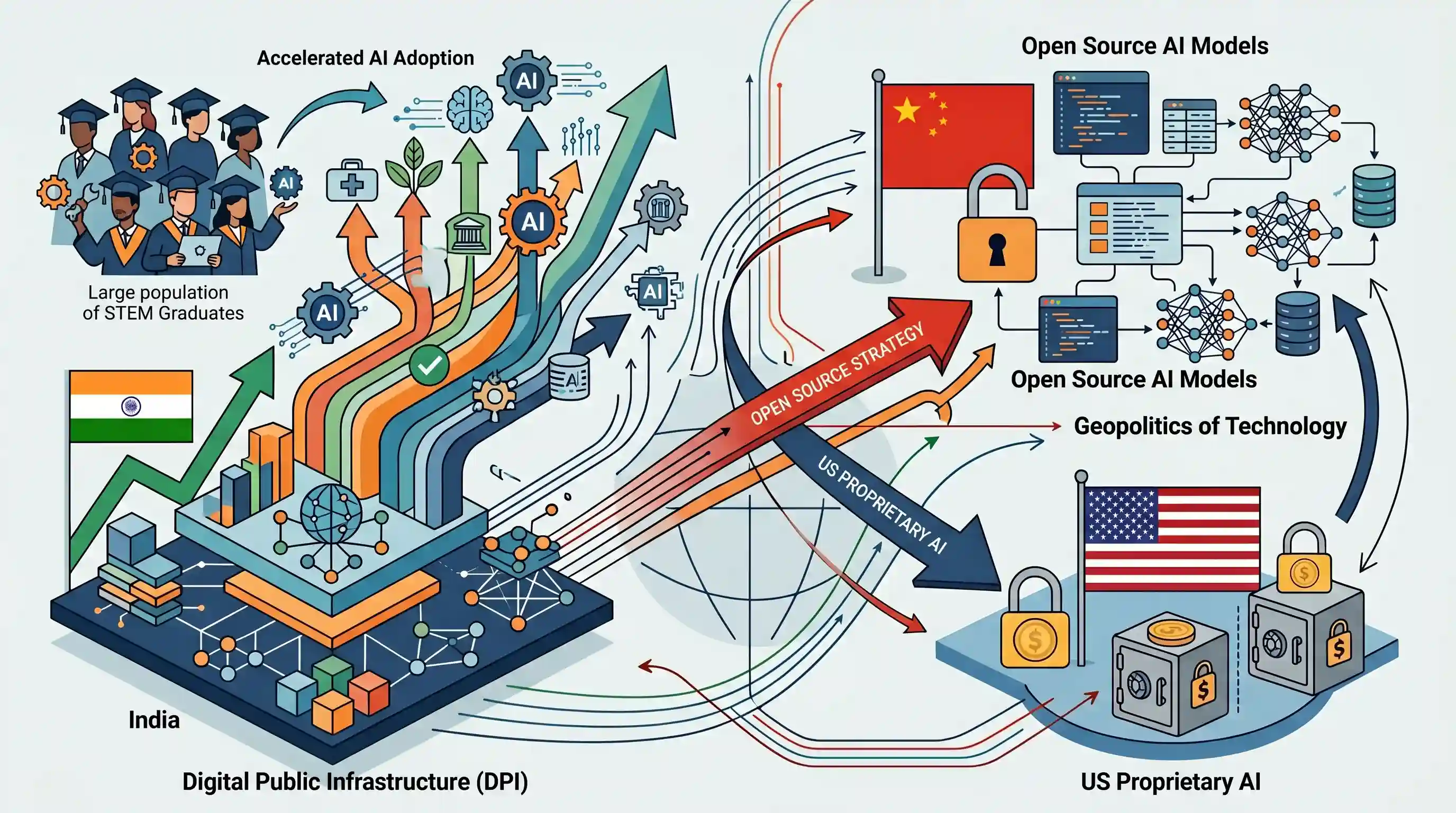
Renowned technology analyst Mary Meeker's report highlights a shifting global AI landscape, placing significant focus on India's accelerated adoption of artificial intelligence and China's growing dominance in developing open-source AI models. The report underscores India's unique advantage, which stems from its robust Digital Public Infrastructure (DPI) and a strong demographic dividend of STEM graduates driving rapid AI integration across sectors. Concurrently, it draws attention to China's competitive edge in the global tech rivalry through leading open-source models. This open-source strategy poses both geopolitical and technological challenges to the US's largely proprietary approach to AI development, reshaping the global dynamics of technological supremacy.
Key Points
- Venture capitalist Mary Meeker's report highlights India's accelerated rate of Artificial Intelligence (AI) adoption, driven by its large pool of STEM talent, demographic dividend, and widespread digital penetration.
- India's robust Digital Public Infrastructure (DPI) serves as a critical foundational layer, enabling large-scale, rapid integration of AI solutions across public and private sectors.
- China is gaining a significant competitive edge in the global technology race by taking the lead in developing and releasing high-performing open-source AI models.
- The US-China tech rivalry is shifting, with the US focusing heavily on proprietary foundational models while China leverages open-source AI to expand its technological influence and global soft power.
Important Terms
Digital Public Infrastructure (DPI)

Shared digital systems (like Aadhaar, UPI, DigiLocker) built on open standards that enable societal-scale service delivery, fostering innovation, financial inclusion, and secure data exchange.
UPSC context
GS Paper III (Economy/S&T); vital for India's digital transformation, G20 'India Stack' diplomacy, and financial inclusion strategies.
Open Source Technology
Software or AI models (e.g., China's DeepSeek) whose source code or weights are publicly accessible for modification and distribution, promoting collaborative innovation and transparency.
UPSC context
GS Paper III (S&T); tests understanding of tech sovereignty, "Atmanirbhar Bharat," and global technological competition (US vs. China).
Demographic Dividend
The economic growth potential resulting from shifts in a population's age structure, specifically when the working-age population (15-64 years) outnumbers the dependent population.
UPSC context
GS Paper I (Population) and GS Paper III (Economy); critical for analyzing India’s growth trajectory and employment challenges.
STEM
An interdisciplinary educational approach focusing on Science, Technology, Engineering, and Mathematics, essential for building a skilled workforce in modern high-tech economies.
UPSC context
GS Paper II (Education) and Paper III (S&T); relates to human capital development and India's global competitive advantage in tech.
Artificial Intelligence (AI)
Systems capable of performing tasks requiring human intelligence, such as reasoning and learning; increasingly used as a foundational layer for the global digital economy.
UPSC context
GS Paper III (S&T); central to discussions on emerging technologies, ethics, and the National Strategy for AI.
Prelims Trap
"The United States leads the global development and distribution of open-source foundational AI models."
Aspirants often default to the US for all tech leadership, but China is actively championing open-source AI to build soft power while the US focuses heavily on proprietary models.
Static Concepts Connected
What are the three core foundational layers of India's Digital Public Infrastructure (DPI)?
- Identity Layer: Systems like Aadhaar provide a verifiable, foundational digital identity that enables the targeted delivery of public and private services.
- Payments Layer: Interoperable, real-time payment networks like the Unified Payments Interface (UPI) facilitate frictionless, large-scale financial inclusion.
- Data Empowerment Layer: Frameworks like DEPA enable secure, consent-driven sharing of personal data, exemplified by the Account Aggregator system.
How do Open Source and Proprietary software models structurally differ?
- Source Code Access: Open-source code is publicly accessible for inspection, modification, and redistribution, whereas proprietary code is legally restricted and guarded.
- Innovation Model: Open-source relies on decentralized, community-driven development, while proprietary software relies on centralized corporate R&D investments.
- Geopolitical Utility: Open-source technologies are increasingly used by nations (like China in AI) to set global standards and project technological soft power.
Cross-Topic Patterns
DPI Diplomacy + Sovereign AI
India is packaging its DPI (India Stack) with AI capabilities to export as soft power to the Global South, directly competing with China's digital infrastructure under the BRI.
The 'Splinternet' and AI decoupling
The US-China divergence in AI models mirrors their decoupling in semiconductors and 5G, accelerating the division of global technology standards into isolated geopolitical ecosystems.

Expect a Prelims question comparing open-source vs proprietary AI models in the context of India's DPI and the IndiaAI Mission.
Linked PYQs · 3
Linked PYQs · 3
- 2022PrelimsGS1
Consider the following : 1. Aarogya Setu 2. CoWIN 3. DigiLocker 4. DIKSHA Which of the above are built on top of open-source digital platforms?
- 2023MainsGS3
Introduce the concept of Artificial Intelligence (AI). How does Al help clinical diagnosis? Do you perceive any threat to privacy of the individual in the use of Al in healthcare?
- 2023MainsGS3
What is the status of digitalization in the Indian economy? Examine the problems faced in this regard and suggest improvements.
