भारत-चीन सीधी उड़ानों की बहाली और द्विपक्षीय संबंध
स्रोत:इंडियन एक्सप्रेस ↗
क्यों मायने रखता है
The article provides a nuanced assessment of the current state of India-China relations, helping aspirants understand the difference between tactical diplomatic breakthroughs (like resuming flights or local disengagements) and the persistent structural disputes that complicate long-term stability.
सारांश
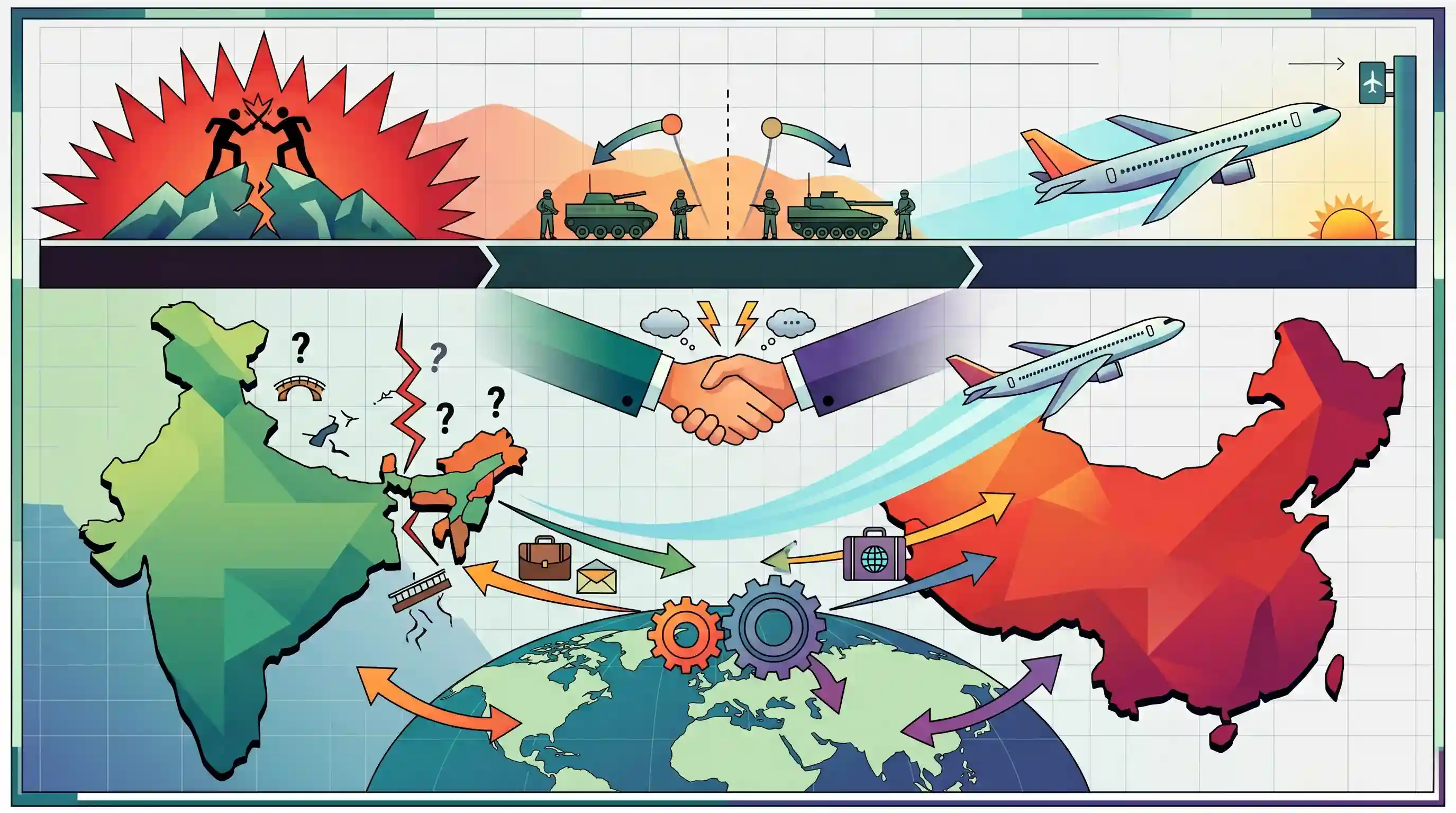
The article analyzes the recent resumption of direct passenger flights between India and China, a significant step marking a tactical thaw after years of strained relations triggered by the 2020 Galwan Valley clash. Coming on the heels of military disengagement at friction points like Depsang and Demchok, the restart of flights serves as a practical confidence-building measure that facilitates business travel and diplomatic engagement. However, the author cautions that despite these positive developments, India-China ties will remain fundamentally fragile. A severe trust deficit, unresolved border demarcations along the Line of Actual Control (LAC), and broader geopolitical competition ensure that the structural challenges defining the bilateral relationship are far from settled.
मुख्य बिंदु
- Direct flights between India and China have resumed after being suspended since the COVID-19 pandemic and the 2020 Galwan Valley clashes.
- The resumption of flights follows recent disengagement agreements at key friction points like Depsang and Demchok, signaling a tactical thaw in bilateral relations.
- Despite these confidence-building measures (CBMs), the overall bilateral relationship remains fragile due to a deep-seated trust deficit and unresolved structural border issues.
- Resuming direct connectivity is a pragmatic step to facilitate essential business, diplomatic, and people-to-people exchanges, which are necessary for managing the relationship.
- Long-term stability will require moving beyond tactical disengagement to address the broader geopolitical rivalry and secure the Line of Actual Control (LAC).
महत्वपूर्ण शब्द
वास्तविक नियंत्रण रेखा (LAC)

The 3,488 km de facto border separating Indian-controlled territory from Chinese-controlled territory, divided into Western (Ladakh), Middle, and Eastern (Arunachal/Sikkim) sectors.
UPSC context
GS II/III: Border Management; tests knowledge of territorial disputes and perceptions of sovereignty.
People's Liberation Army (PLA)
The unified military force of the People's Republic of China and the armed wing of the Chinese Communist Party (CCP), overseen by the Central Military Commission.
UPSC context
GS II: International Relations; essential for analyzing regional security and India-China bilateral friction.
Indian Armed Forces
The professional military services of India—Army, Navy, and Air Force—tasked with defending national sovereignty and territorial integrity under the Ministry of Defence.
UPSC context
GS III: Internal Security; tests understanding of mandates for external defense and border guarding.
Confidence-Building Measures (CBMs)
Bilateral diplomatic or military actions intended to reduce suspicion, prevent accidental conflict, and build trust in a strained relationship.
UPSC context
GS II: Diplomacy and International Relations; key for maintaining "peace and tranquility" at borders.
Galwan Valley Clash
A deadly June 2020 military confrontation in eastern Ladakh between Indian and Chinese troops, marking a significant deterioration in bilateral ties.
UPSC context
GS II/III: Friction points; a watershed event affecting neighborhood relations and border protocols.
Military Disengagement
A 2024 military agreement where both sides withdrew troops from specific friction points to restore the pre-April 2020 status quo in Ladakh.
UPSC context
GS II: Bilateral agreements; tests understanding of conflict resolution and border stabilization processes.
प्रारंभिक ट्रैप
"Depsang Plains are located south of the Galwan Valley in Eastern Ladakh."
UPSC frequently tests map-based North-to-South arrangements. Depsang Plains are located in the extreme north (near Daulat Beg Oldie), well north of Galwan.
संबंधित अवधारणाएँ
पूर्वी लद्दाख में प्रमुख घर्षण बिंदुओं का उत्तर-से-दक्षिण क्रम क्या है?
- देपसांग मैदान: The northernmost friction point, crucial for Indian access to the strategic Daulat Beg Oldie (DBO) airstrip.
- Galwan Valley: डेपसांग के दक्षिण में स्थित, यह नदी घाटी 2020 की घातक सैन्य झड़पों का स्थल थी।
- पैंगोंग त्सो: A central sector high-altitude lake featuring the disputed "Finger" areas 1 through 8.
- Demchok: The southernmost among the major active friction points in the Eastern Ladakh sector.
What are the foundational bilateral agreements managing the India-China border?
- 1993 Agreement: वास्तविक नियंत्रण रेखा (LAC) पर सामान्य शांति और स्थिरता बनाए रखने पर केंद्रित एक आधारभूत समझौता।
- 1996 का समझौता: Introduced specific military Confidence Building Measures (CBMs), including limitations on troop sizes and a ban on firearms within 2km of the LAC.
- 2013 BDCA: Formalized Border Personnel Meetings (BPMs) and established hotlines to prevent face-offs from escalating into conflicts.
अंतर-विषय पैटर्न
Bilateral Thaw vs Economic De-risking
उड़ानों की सामरिक बहाली भारत की दीर्घकालिक आर्थिक रणनीति (जैसे PLI योजनाएं और प्रेस नोट 3 FDI निगरानी) के साथ मेल खाती है, ताकि चीनी आयात से आपूर्ति श्रृंखलाओं को संरचनात्मक रूप से जोखिम मुक्त (de-risk) किया जा सके।
द्विपक्षीय सामान्यीकरण के साथ-साथ क्वाड निवारण
चीन के साथ भारत की स्थानीय सीमा पर तनाव में सुधार, क्वाड (Quad) में इसकी बढ़ती सैन्य अंतर-संचालनीयता (interoperability) के समानांतर जारी है, जो इंडो-पैसिफिक में एक क्लासिक बहु-संरेखित (multi-aligned) दृष्टिकोण को प्रदर्शित करता है।

Expect a 2026 Mains GS2 question analyzing the 'economy vs security' dilemma in India-China ties amid tactical thaws and deep distrust.
संबद्ध PYQ · 3
संबद्ध PYQ · 3
- 2014MainsGS2
With respect to the South China sea, maritime territorial disputes and rising tension affirm the need for safeguarding maritime security to ensure freedom of navigation and over flight throughout the region. In this context, discuss the bilateral issues between India and China.
- 2012MainsGS2
Do you think that China's emergence as one of the largest trading partners of India has adversely affected the settlement of the outstanding border problem?
- 2024MainsGS3
India has a long and troubled border with China and Pakistan fraught with contentious issues. Examine the conflicting issues and security challenges along the border. Also give out the development being undertaken in these areas under the Border Area Development Programme (BADP) and Border Infrastructure and Management (BIM) Scheme.
