India and Japan Enhance Strategic and Defence Collaboration
Source:Indian Express ↗
Why It Matters
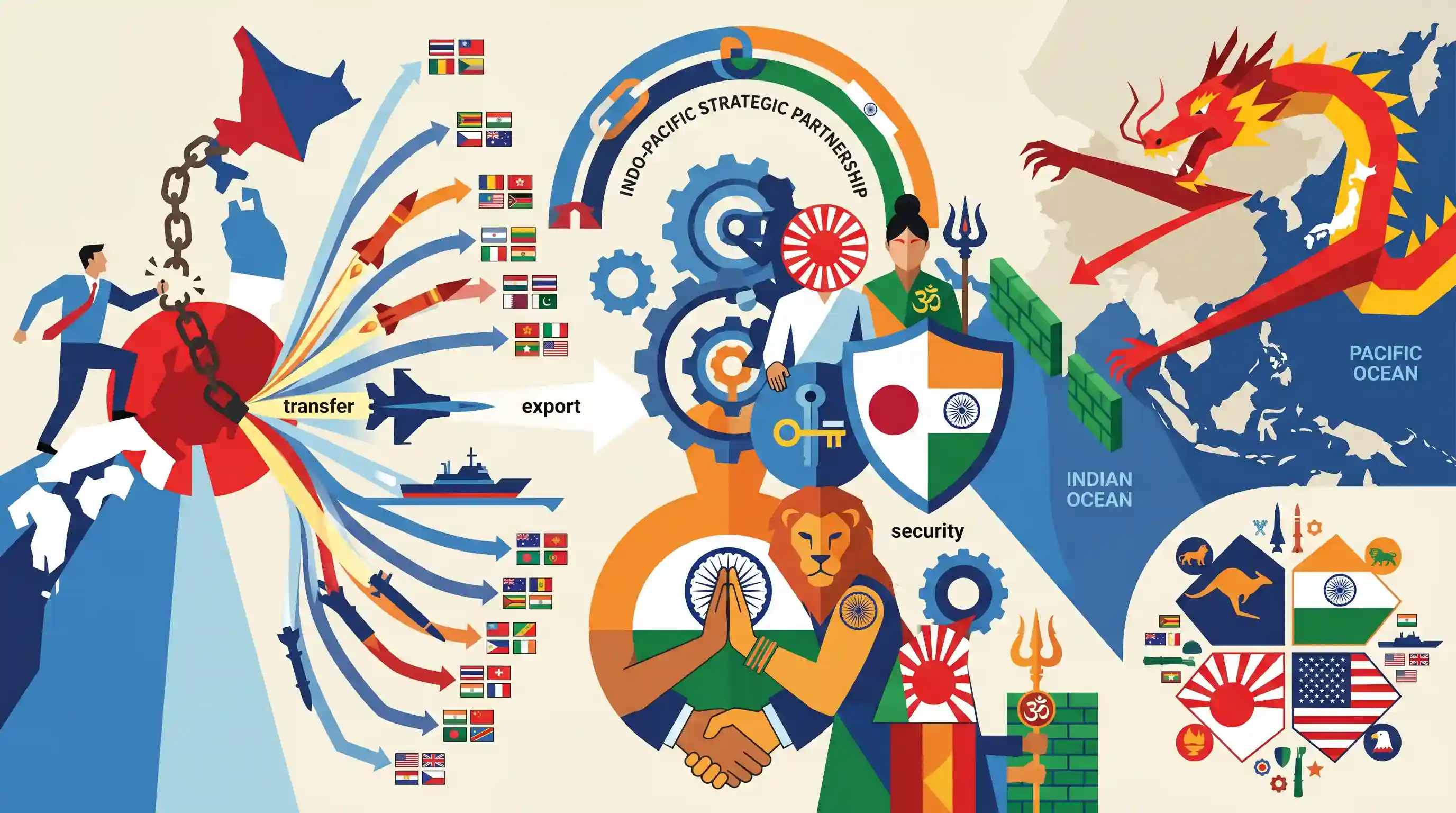
Japan's departure from strict pacifism alters the security architecture of the Indo-Pacific. A deeper India-Japan defence partnership, including military-industrial collaboration, is crucial for balancing China's regional hegemony and strengthening minilaterals like the Quad.
Summary
Japan has significantly relaxed its decades-old, post-World War II restrictions on arms exports, allowing it to sell lethal weapons to 17 allied nations. India welcomed this strategic policy shift, specifically the "Review of the Three Principles on Transfer of Defence Equipment and Technology", to deepen defence and security cooperation under the India-Japan Joint Declaration on Security Cooperation. The strengthening of bilateral defence ties and technological collaboration comes as both nations seek to counter China's growing assertiveness in the Indo-Pacific region, complementing their multilateral engagements in groupings like the Quad.
Key Points
- Japan has relaxed its post-WWII arms export restrictions, allowing the sale of lethal weapons to 17 countries with which it has defence agreements.
- The move marks a major departure from Japan's traditional pacifist defence policy, which previously restricted arms exports to five non-lethal categories.
- India welcomed Japan's "Review of the Three Principles on Transfer of Defence Equipment and Technology", committing to deepened practical defence cooperation.
- The deepening of the India-Japan Special Strategic and Global Partnership is largely driven by mutual concerns over a belligerent China in the Indo-Pacific region.
- Both nations aim to promote technological and industrial collaboration in critical national security sectors, reinforcing bilateral ties and multilateral efforts like the Quad.
Important Terms
Three Principles on Transfer of Defence Equipment and Technology

Japan's revised 2026 guidelines governing arms exports, permitting the transfer of lethal equipment to 17 trusted partners (including India) while prohibiting sales to conflict zones and ensuring strict end-use monitoring.
UPSC context
GS Paper II: Bilateral Relations. Crucial for understanding Japan's departure from post-WWII pacifism and its impact on India's defense procurement.
Joint Declaration on Security Cooperation between India and Japan
A 2008 foundational framework updated in 2024 and 2026 to expand India-Japan cooperation in maritime security, space, and cyberspace against evolving regional security threats.
UPSC context
GS Paper II: Bilateral Agreements. Tests knowledge of institutional frameworks that guide India's 'Special Strategic and Global Partnership' with Japan.
Quad (Quadrilateral Security Dialogue)
An informal strategic forum of India, Japan, the US, and Australia committed to a 'Free and Open Indo-Pacific' and counterbalancing China's regional assertiveness.
UPSC context
GS Paper II: Regional/Global Groupings. Core topic for questions on Indo-Pacific geopolitics and maritime security architecture.
Free and Open Indo-Pacific (FOIP)
A diplomatic vision shared by India and Japan to ensure a rules-based order, freedom of navigation, and territorial integrity in the region, primarily as a counter-narrative to Chinese expansionism.
UPSC context
GS Paper II: International Relations. A key strategic concept often tested in the context of maritime domain awareness and regional stability.
Special Strategic and Global Partnership
The elevated diplomatic status of India-Japan relations established in 2014, covering deep cooperation in defense, technology, infrastructure (e.g., Bullet Train), and energy.
UPSC context
GS Paper II: Bilateral Relations. Essential terminology for describing the depth of India's engagement with its closest Asian ally.
Prelims Trap
"Japan recently amended Article 9 of its Constitution to allow the export of lethal weapons to partner nations."
Japan has relaxed its statutory "Three Principles on Transfer of Defence Equipment," but has not officially amended the pacifist Article 9 of its Constitution.
Static Concepts Connected
What are the key pillars of India-Japan bilateral defence cooperation?
- Logistics Pact (ACSA): The Acquisition and Cross-Servicing Agreement (ACSA) enables reciprocal provision of supplies and services between their armed forces.
- Joint Exercises: Dharma Guardian (Army), JIMEX (Navy), and Veer Guardian/Shinyuu Maitri (Air Force) ensure sustained tactical interoperability.
- 2+2 Ministerial Dialogue: A formalized dialogue framework between the Foreign and Defence ministers of both nations to align Indo-Pacific security strategies.
What defines Japan's post-WWII defense posture and its recent strategic shifts?
- Article 9: The famous pacifist clause in Japan's Constitution that formally renounces war as a sovereign right and bans the use of force to settle international disputes.
- Three Principles: Originally a strict ban on arms exports, these guidelines were recently revised to permit the transfer of defense technology and lethal weapons to 17 allied nations.
Cross-Topic Patterns
Logistics pacts + Quad security architecture
India’s ACSA with Japan mirrors LEMOA with the US and MLSA with Australia, creating an interlocking, interoperable military logistics web across all four Quad nations to secure the Indo-Pacific.
Defense indigenization + Tech transfer diversification
Japan's entry into lethal arms exports alters the global defense-industrial base, allowing India to diversify its high-tech defense imports and joint-production away from Russia and towards reliable Indo-Pacific allies.

Expect a multi-statement prelims question in 2026 linking Japan's 'Three Principles' revision to India-Japan ACSA and Quad logistics.
Linked PYQs · 4
Linked PYQs · 4
- 2019MainsGS2
‘The time has come for India and Japan to build a strong contemporary relationship, one involving global and strategic partnership that will have a great significance for Asia and the world as a whole.’ Comment.
- 2020MainsGS2
Quadrilateral Security Dialogue (Quad)' is transforming itself into a trade bloc from a military alliance, in present times - Discuss.
- 2020MainsGS2
What is the significance of Indo-US defence deals over Indo-Russian defence deals? Discuss with reference to stability in the Indo-Pacific region.
- 2024MainsGS2
‘The West is fostering India as an alternative to reduce dependence on China's supply chain and as a strategic ally to counter China's political and economic dominance.’ Explain this statement with examples.
