China imposes export controls on Japanese entities amid tensions
Source:The Hindu ↗
Why It Matters
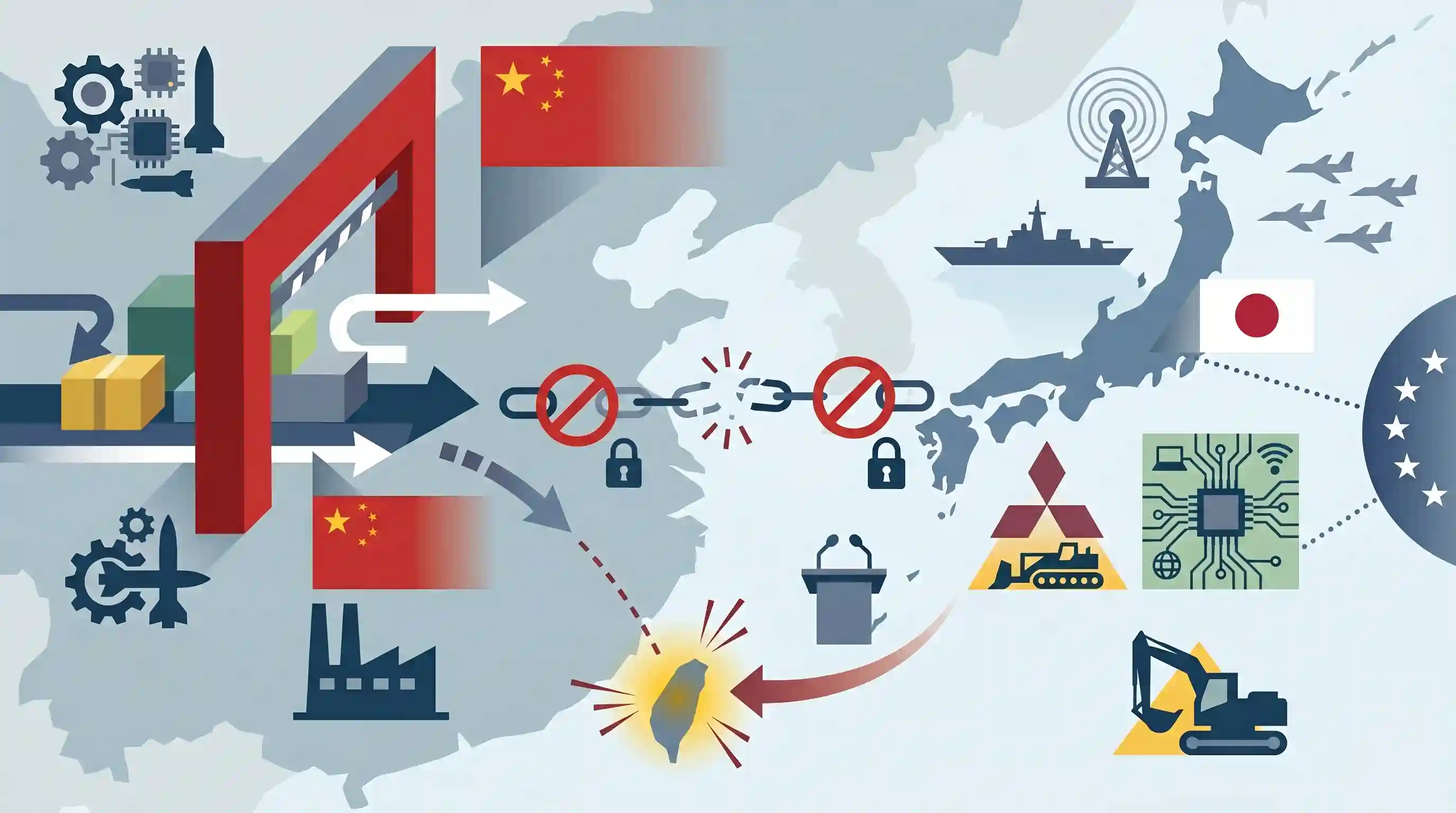
The increasing weaponization of trade and dual-use technology supply chains is a critical aspect of modern geopolitical conflicts. For India, which relies heavily on global supply chains and views Japan as a key strategic partner in the Indo-Pacific (Quad), China's coercive economic measures present both strategic challenges and opportunities to position itself as a reliable alternative supply chain hub.
Summary
China has imposed stringent export controls on 40 major Japanese entities—including prominent conglomerates like Mitsubishi, Fujitsu, and Komatsu—restricting their access to Chinese-made dual-use technologies. Beijing attributes these measures to concerns over Japan's 'remilitarization' and potential military applications of such goods. The sanctions arrive amidst heightened geopolitical friction in the Indo-Pacific, notably sparked by Japanese Prime Minister Sanae Takaichi's remarks regarding potential intervention in a Taiwan conflict and Japan's strategic military deployments. This weaponization of supply chains further complicates the regional security dynamic involving China, Japan, and Western allies.
Key Points
- China restricted exports of dual-use goods to 40 Japanese entities, citing concerns over Japan's alleged remilitarization.
- Twenty entities, including Mitsubishi Corp, face a total ban on receiving Chinese dual-use items, while twenty others like Fujitsu and Komatsu face stringent licensing and risk assessment requirements.
- The sanctions follow escalating tensions triggered by Japanese Prime Minister Sanae Takaichi's statements suggesting potential Japanese intervention in the event of a Chinese attack on Taiwan.
- The geopolitical friction is compounded by Japan's strategic military deployments, such as placing a Type-12 missile launcher on Minamitorishima, and its maritime border talks with the Philippines.
- The incident underscores the growing trend of weaponizing supply chains and trade mechanisms for geopolitical leverage in the Indo-Pacific.
Important Terms
Dual-use Technology

Goods, software, or technology designed for civilian use that can also be repurposed for military or lethal applications, such as advanced semiconductors or precision machinery.
UPSC context
GS-3 (Security) and GS-2 (IR); tests knowledge of technology governance and non-proliferation regimes like the Wassenaar Arrangement.
Economic Statecraft
The use of economic instruments—such as trade restrictions, sanctions, and investment—by a state to achieve strategic foreign policy objectives and influence other nations.
UPSC context
GS-2 (International Relations); explores the impact of weaponized supply chains on global diplomacy and regional security.
Export Controls
Regulatory measures used by governments to restrict or monitor the export of sensitive goods, technologies, or software to protect national security interests.
UPSC context
GS-2 (Bilateral Relations); relevant for understanding trade friction, global security standards, and strategic trade management.
Ministry of Commerce (MOFCOM), China
China’s executive agency responsible for foreign trade, investment, and market regulation; it implements the country’s dual-use export catalogues and trade sanctions.
UPSC context
GS-2 (International Relations); focuses on institutional actors driving China’s economic diplomacy and its trade-based geopolitical strategy.
Supply Chain Resilience
The ability of a global supply network to withstand and recover from disruptions, often achieved through diversifying sources to reduce over-dependency on a single nation.
UPSC context
GS-3 (Economy/Security); relates to the Supply Chain Resilience Initiative (SCRI) involving India, Japan, and Australia.
Mitsubishi Corporation
A major Japanese general trading company (sogo shosha) whose diverse industrial divisions were targeted by Chinese export controls over alleged defense ties.
UPSC context
GS-2 (Bilateral Relations); illustrates how private conglomerates are affected by geopolitical trade conflicts in the Indo-Pacific.
Prelims Trap
"China's export controls on dual-use goods are governed by its membership in the Wassenaar Arrangement."
China is NOT a participating state in the Wassenaar Arrangement. Its recent dual-use export controls are acts of unilateral economic statecraft, not multilateral compliance.
Static Concepts Connected
What are the four major multilateral export control regimes?
- Wassenaar Arrangement: Controls conventional arms and dual-use goods and technologies. India joined in 2017, but China is not a member.
- Nuclear Suppliers Group: Aims to prevent nuclear proliferation by controlling the export of materials, equipment, and technology. India is NOT a member.
- MTCR: Restricts the proliferation of missiles, complete rocket systems, and UAVs capable of delivering WMDs. India is a member.
- Australia Group: A multilateral export control regime aiming to ensure that exports do not contribute to the development of chemical or biological weapons. India is a member.
What is the Supply Chain Resilience Initiative (SCRI)?
- Core Members: A trilateral initiative launched by India, Japan, and Australia in 2021 to build sustainable and reliable supply chains in the Indo-Pacific.
- Primary Objective: To reduce dependency on a single nation (like China) and mitigate disruptions caused by geopolitical tensions or global crises.
- Key Pillars: Focuses on sharing best practices, promoting foreign direct investment, and organizing buyer-seller matching events to diversify trade.
Cross-Topic Patterns
Economic Statecraft & Critical Minerals
China's dual-use export curbs mirror its previous restrictions on critical minerals like Gallium and Germanium, tying high-tech supply chain dependencies directly to Indo-Pacific geopolitical security.
Article 9 & Japan's Remilitarization
Japan's strategic deployments on Minamitorishima and shifting defense posture mark a departure from its pacifist Constitution (Article 9), fundamentally altering Quad and US-alliance security dynamics.

Expect a paired question linking minilateral supply chain groupings (SCRI, IPEF) with multilateral dual-use export controls (Wassenaar).
Linked PYQs · 2
Linked PYQs · 2
- 2024MainsGS2
‘The West is fostering India as an alternative to reduce dependence on China's supply chain and as a strategic ally to counter China's political and economic dominance.’ Explain this statement with examples.
- 2019MainsGS2
‘The time has come for India and Japan to build a strong contemporary relationship, one involving global and strategic partnership that will have a great significance for Asia and the world as a whole.’ Comment.
