China global governance initiative and Indian strategy
Source:Indian Express ↗
Why It Matters
The article provides an essential critique of China's long-term diplomatic strategy (GGI) and directly relates to Mains GS2 syllabus areas of global governance, international institutions, and India-China geopolitical contestation. Its actionable recommendations on reforming India's foreign-policy and national security architecture (NITI Aayog, MEA, and NSCS) to achieve 'anticipatory statecraft' make it highly valuable for questions on administrative and strategic reforms.
Summary
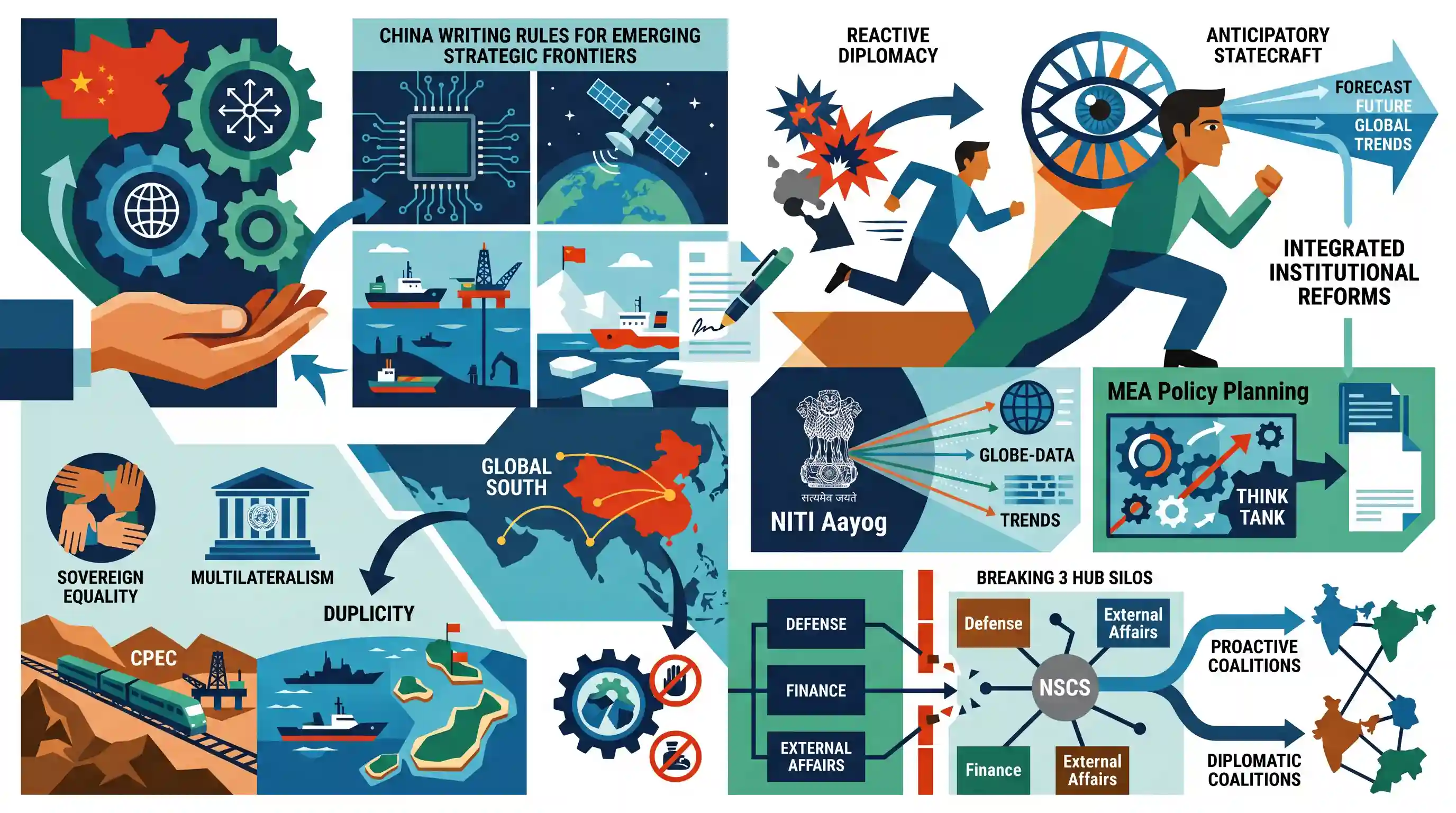
In this article, former UN diplomat Syed Akbaruddin analyzes China's newly proposed Global Governance Initiative (GGI) and its associated White Paper, 'More Just and Equitable Global Governance'. He warns that China is proactively seeking to write the rules for emerging strategic frontiers, including AI, outer space, deep seas, and polar regions, by leveraging real grievances of the Global South. While China's official positions on sovereign equality and multilateralism overlap with India's, its actual geopolitical actions—such as CPEC, unilateral South China Sea claims, and mineral export curbs—reveal deep-seated duplicity. To counter this, India must abandon post-facto reactive diplomacy in favor of 'anticipatory statecraft.' Akbaruddin urges key domestic institutional reforms, including widening NITI Aayog's mandate to scan external shifts, strengthening the MEA's Policy Planning division, and using the National Security Council Secretariat (NSCS) to break ministerial silos and build proactive, early-stage diplomatic coalitions.
Key Points
- China's newly released White Paper, 'More Just and Equitable Global Governance,' and the Global Governance Initiative (GGI) proposed by President Xi Jinping at the September 2025 SCO summit, present China's bid to draft the rules for tomorrow's global order.
- The GGI consolidates China's previous pillars (GDI, GSI, GCI, and BRI) into a singular, sweeping claim to global governance, targeting critical emerging domains: artificial intelligence (AI), cyberspace, outer space, deep seas, polar regions, climate, public health, trade, and financial architecture.
- China's framework gains traction in the Global South (with 43 'Friends of GGI' nations) by exploiting legitimate grievances, such as delayed UN Security Council reforms, IMF/World Bank quota lag, climate finance delays, weakened WTO dispute mechanisms, and unilateral sanctions.
- Despite rhetoric echoing India's views on multilateralism and sovereign equality, China's actions exhibit stark duplicity: violating sovereignty through the CPEC in Pakistan-occupied Kashmir (PoK), ignoring international law in the South China Sea, opposing a multipolar Asia, and weaponizing critical mineral export controls.
- India must transition from 'reactive diplomacy' to 'anticipatory statecraft' by identifying global governance shifts early, rather than negotiating within constraints already set by other powers.
- To institutionalize anticipatory statecraft, the author proposes: widening NITI Aayog's mandate to map external shifts; strengthening the MEA's Policy Planning and Research Division; and utilizing the National Security Council Secretariat (NSCS) to coordinate emerging strategic domains across disparate ministries.
Important Terms
Global Governance Initiative (GGI)

A strategic framework proposed by China in 2025 to reform global governance, emphasizing sovereign equality and a UN-centered system to write future rules in emerging frontiers.
UPSC context
GS Paper II (International Relations). Tests understanding of China's revisionist global strategies and their implications for India's foreign policy.
Global Development Initiative (GDI)
A Chinese initiative launched in 2021 aiming to redirect global focus toward development deficits and poverty alleviation, aligning with the UN SDGs to expand Beijing's influence.
UPSC context
GS Paper II (Bilateral Groupings & Agreements). Evaluates China's soft power diplomacy and development-assistance models affecting India's neighborhood.
Global Security Initiative (GSI)
A diplomatic initiative proposed by China in 2022 emphasizing "indivisible security" and peaceful dialogue to counter Western security alliances and promote a Beijing-aligned security architecture.
UPSC context
GS Paper II (Security Challenges & Geopolitics). Analyzes emerging global security frameworks and their impact on India's strategic partnerships.
Global Civilization Initiative (GCI)
A Chinese diplomatic initiative launched in 2023 promoting cultural diversity and mutual respect while challenging Western "universal values" such as democracy and human rights.
UPSC context
GS Paper II (Effect of Policies on India). Explores how alternative normative discourses shape international relations in the Global South.
More Just and Equitable Global Governance (White Paper)
A Chinese government policy document released in June 2026 detailing its vision for a reformed, UN-centered international order using its major global initiatives.
UPSC context
GS Paper II (Effect of Policies on India). Tests the ability to analyze official Chinese policy postures against its actual unilateral actions.
National Security Council Secretariat (NSCS)
The permanent administrative executive arm of India's National Security Council, headed by the NSA, responsible for coordinating intelligence, defense, and diplomatic inputs.
UPSC context
GS Paper III (Internal Security). Assesses institutional mechanisms and administrative reforms for long-term, proactive national security planning.
NITI Aayog
India's apex public policy think tank established in 2015 to replace the Planning Commission, focusing on cooperative federalism, strategic policy design, and monitoring.
UPSC context
GS Paper III (Indian Economy & Planning). Tests understanding of institutional mechanisms for cooperative federalism and bottom-up strategic planning.
Shanghai Cooperation Organisation (SCO)
A permanent Eurasian political, economic, and security alliance founded in 2001, comprising major powers like China, Russia, and India, focusing on regional stability and counter-terrorism.
UPSC context
GS Paper II (Bilateral & Regional Groupings). Assesses India's engagement with Eurasian powers and the strategic continental-maritime balance.
Prelims Trap
India participates in the 'Friends of GDI' or 'Friends of GGI' groupings to champion Global South institutional reforms.
While India champions Global South reforms, it strictly avoids China's unilateral strategic umbrellas (BRI, GDI, GSI, GGI) due to sovereignty violations (e.g., CPEC) and geopolitical duplicity.
Static Concepts Connected
What is the IMF Quota System and why does the Global South demand its reform?
- Quota Determination: Each member is assigned a quota based on economic size, determining voting power, financial commitments, and access to emergency financing.
- Representation Deficit: Western nations retain disproportionate voting shares and veto power, while dynamic emerging economies like India remain underrepresented relative to GDP.
- Strategic Fallout: The failure of successive IMF quota reviews to realign voting power pushes developing nations toward China-backed parallel financial institutions.
What are the governance challenges in emerging global commons like Deep Seas and Space?
- Deep-Sea Commons: Governed by UNCLOS/ISA, but lacks clear consensus on equitable mining benefit-sharing, leading to unilateral resource claims by technologically advanced nations.
- Outer Space Treaty: The 1967 Treaty prohibits weaponization but lacks binding rules on space debris, commercial congestion, and active military-use satellite constellations.
- Cyber and AI Regulation: Absence of a unified global treaty leads to fragmented regional rules, allowing dominant powers to unilaterally set technical standards.
Cross-Topic Patterns
Global Commons + Maritime Security
China's polar and deep-sea normative push under GGI directly challenges India's strategic footprint and scientific sovereignty in the Indian Ocean and Antarctic regions.
Multilateral Gridlock + Alternate Alignments
Delayed reforms in the UNSC and Bretton Woods institutions drive Global South swing states toward China's alternative frameworks, weakening traditional Western-led multilateralism.

Mains 2026 may ask India to evaluate 'anticipatory statecraft' as a tool to counter China's rule-making in AI and deep-sea commons.
Linked PYQs · 3
Linked PYQs · 3
- 2024MainsGS2
‘The West is fostering India as an alternative to reduce dependence on China's supply chain and as a strategic ally to counter China's political and economic dominance.’ Explain this statement with examples.
- 2014MainsGS2
With respect to the South China sea, maritime territorial disputes and rising tension affirm the need for safeguarding maritime security to ensure freedom of navigation and over flight throughout the region. In this context, discuss the bilateral issues between India and China.
- 2025MainsGS2
"The reform process in the United Nations remains unresolved, because of the delicate imbalance of East and West and entanglement of the USA vs. Russo-Chinese alliance.” Examine and critically evaluate the East-West policy confrontations in this regard.
