China Diplomacy and United Nations Security Council Dynamics
Source:The Hindu ↗
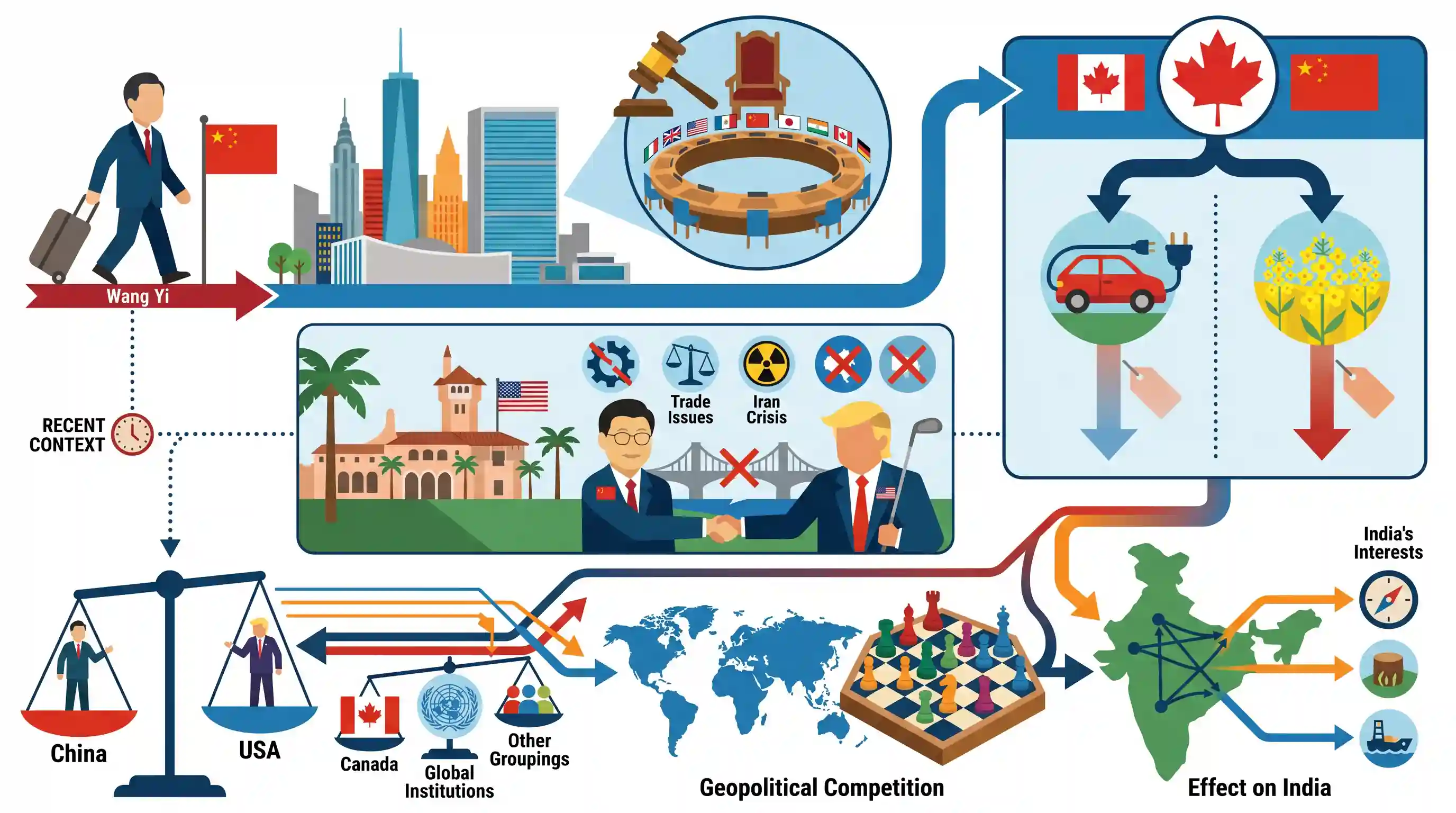
Why It Matters
Understanding the diplomatic maneuvering between China, the US, and Canada is crucial for UPSC aspirants, as it impacts global trade dynamics (like EV tariffs), multilateral institutions (UNSC), and broader geopolitical stability. The changing US-China dynamic directly influences India's strategic calculations in the Indo-Pacific and its trade policies.
Summary
Chinese Foreign Minister Wang Yi is undertaking a diplomatic tour in North America, scheduled to chair a UN Security Council meeting in New York and visit Canada for bilateral talks. The visit to Canada comes on the heels of an interim trade agreement reducing tariffs on Chinese electric vehicles and Canadian canola. These diplomatic efforts follow a recent Mar-a-Lago summit between Xi Jinping and Donald Trump, which ended without breakthroughs on key trade issues and international conflicts such as the Iran crisis. The ongoing diplomatic engagements highlight China's efforts to balance its complex relationships with North American nations amidst broader geopolitical competition.
Key Points
- Chinese Foreign Minister Wang Yi is traveling to New York to chair a UN Security Council meeting, exercising China's presidency of the UNSC.
- Wang will also visit Canada to meet Foreign Minister Melanie Joly, following a recent interim trade deal that reduced tariffs on Chinese EVs and Canadian canola.
- The diplomatic push follows a recent summit between US President Donald Trump and Chinese President Xi Jinping at Mar-a-Lago, which failed to produce breakthroughs on trade or the Iran conflict.
- Xi Jinping is scheduled to make another visit to the United States in the fall, indicating ongoing high-level dialogue despite unresolved US-China geopolitical and economic tensions.
Important Terms
China-Canada interim trade deal

A 2026 agreement where Canada reduced tariffs on Chinese electric vehicles to 6.1% in exchange for China lifting restrictions on Canadian canola and seafood exports.
UPSC context
GS Paper II: Bilateral relations. Illustrates trade diplomacy, tariff de-escalation, and balancing economic interests with strategic competition.
United Nations Security Council (UNSC)
One of the six principal organs of the UN, responsible for maintaining international peace and security, with the power to issue binding resolutions.
UPSC context
GS Paper II: International Institutions. Core to understanding global governance, the veto power of P5 nations, and institutional reform debates.
Rotating Presidency (UNSC)
The monthly leadership of the UNSC that alternates among its 15 members; the President presides over meetings and sets the Council's agenda.
UPSC context
GS Paper II: Important International institutions. Relevant for analyzing how nations leverage institutional roles to influence global diplomatic discourse.
Multilateralism
The practice of coordinating national policies in groups of three or more states; often highlighted by China as a counter to unilateralism.
UPSC context
GS Paper II: Global groupings and agreements. Fundamental for analyzing international cooperation versus power-bloc politics in a multipolar world.
Prelims Trap
"The UN Security Council presidency rotates annually among the five permanent members."
The presidency rotates on a monthly basis, not annually, and includes all 15 members (both permanent and non-permanent) following the English alphabetical order of their names.
Static Concepts Connected
What is an Early Harvest Scheme (Interim Trade Agreement)?
- Limited Scope: A preliminary agreement between nations to liberalize tariffs on a select list of goods or services before concluding a full Free Trade Agreement (FTA).
- Trust Building: Used as a confidence-building measure to demonstrate tangible economic benefits, resolve easier barriers, and de-escalate trade tensions.
- WTO Compliance: Under WTO Article XXIV, such interim pacts must eventually lead to a comprehensive agreement covering "substantially all trade" within a reasonable timeframe.
How does the presidency of the UN Security Council function?
- Monthly Rotation: The presidency is held by each of the members in turn for one calendar month.
- Alphabetical Order: The order of rotation follows the English alphabetical order of the names of the Member States.
- Inclusive Rotation: It rotates among all 15 members of the Security Council, which includes both the 5 permanent and 10 non-permanent members.
Cross-Topic Patterns
Agri-commodities as trade-war leverage
Agricultural exports like Canadian canola or US soybeans are frequently targeted in trade disputes because farming sectors hold outsized domestic political influence and are economically vulnerable to sudden tariff spikes.
Green tech protectionism vs climate goals
Western tariffs on Chinese EVs reveal a growing conflict between achieving rapid global decarbonization through cheaper imports and protecting domestic clean-energy manufacturing from state-subsidized competition.

Early Harvest Schemes and WTO Article XXIV compliance, alongside EV protectionism, form a high-probability economy question.
Linked PYQs · 4
Linked PYQs · 4
- 2024MainsGS2
‘Terrorism has become a significant threat to global peace and security.’ Evaluate the effectiveness of the United Nations Security Council's Counter Terrorism Committee (CTC) and its associated bodies in addressing and mitigating this threat at the international level.
- 2021MainsGS2
“The USA is facing an existential threat in the form of a China, that is much more challenging than the erstwhile Soviet Union.” Explain.
- 2025MainsGS2
"The reform process in the United Nations remains unresolved, because of the delicate imbalance of East and West and entanglement of the USA vs. Russo-Chinese alliance.” Examine and critically evaluate the East-West policy confrontations in this regard.
- 2025MainsGS3
What are the challenges before the Indian economy when the world is moving away from free trade and multilateralism to protectionism and bilateralism? How can these challenges be met?
