China and US tariff suspension extension in trade truce
Source:The Hindu ↗
Why It Matters
The US-China tariff war and their retaliatory measures severely impact global supply chains, international trade rules, and geopolitical stability. For India, these shifting dynamics pose challenges of protectionism but also present strategic opportunities in manufacturing (China Plus One) and agricultural exports. The handling of rare earths and dual-use technology underscores critical vulnerabilities in global strategic supply chains that India must navigate.
Summary
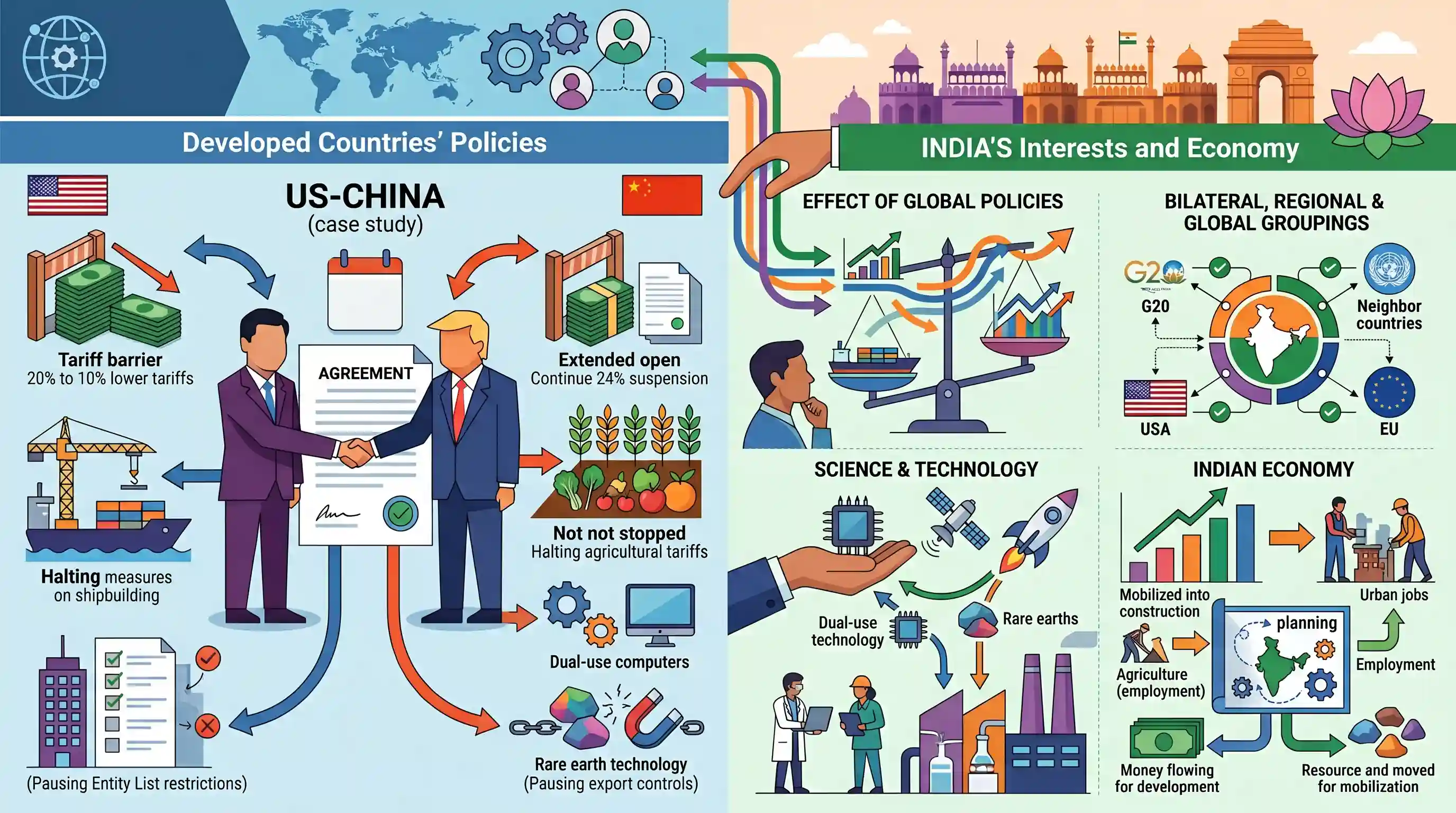
China and the United States have agreed to formalize a trade truce by extending the suspension of additional bilateral tariffs and export control measures for one year. Brokered by Chinese President Xi Jinping and US President Donald Trump, the agreement involves China continuing its 24% tariff suspension on US goods, while the US lowers its tariffs on Chinese imports from 20% to 10%. The de-escalation spans critical strategic and economic sectors, with China halting retaliatory agricultural tariffs and pausing export controls on dual-use items and rare earths technology. Concurrently, the US has suspended targeted measures against China's shipbuilding industry and paused certain 'Entity List' restrictions.
Key Points
- China extended the suspension of an additional 24% tariff on US goods for one year, while keeping a 10% tariff, effective November 10, 2025.
- The US reciprocated by cutting its additional tariffs on Chinese imports from 20% to 10%.
- China suspended retaliatory tariffs on critical US agricultural products, which were initially imposed in response to US actions over the fentanyl crisis.
- China halted export control restrictions on dual-use items targeting US defense and aerospace firms, as well as restrictions on rare earths technology exports.
- The US agreed to temporarily suspend 'Entity List' restrictions on affiliates of blacklisted foreign companies and halted measures targeting China's shipbuilding industry.
Important Terms
Entity List

A trade restriction list published by the US Department of Commerce identifying foreign entities (companies, research institutes) that require special licenses for the export or transfer of sensitive US technologies.
UPSC context
GS Paper II (Global Politics) and III (Technology/Security); tests understanding of non-tariff barriers and tech-diplomacy affecting global supply chains.
Dual-use items
Goods, software, or technology that can be utilized for both legitimate civilian/commercial purposes and military/proliferation applications (e.g., high-end semiconductors, chemical precursors, or drones).
UPSC context
GS Paper III (S&T and Internal Security); essential for questions on export control regimes like the Wassenaar Arrangement and SCOMET list.
Rare Earth Elements (REEs)
A group of 17 chemically similar metallic elements (e.g., Neodymium, Dysprosium) essential for manufacturing high-tech devices, electric vehicle motors, wind turbines, and advanced defense systems.
UPSC context
GS Paper III (Economy/Resources); critical for India’s National Critical Minerals Mission and strategic autonomy in green energy and defense.
Retaliatory Tariffs
Import taxes imposed by a country specifically to counter or "punish" previous trade barriers or tariffs enacted by a trading partner, often used as leverage in trade negotiations.
UPSC context
GS Paper III (Indian Economy); relates to trade wars, WTO norms, and their impact on Indian exports and domestic inflation.
State Council (China)
The chief administrative authority of the People's Republic of China, chaired by the Premier; it is responsible for implementing national laws and managing the country's various ministries.
UPSC context
GS Paper II (Comparison of the Indian Constitutional scheme with other countries); tests knowledge of major global executive structures.
Prelims Trap
"The US-China bilateral tariff suspensions are legally binding measures enforced through the WTO Dispute Settlement Mechanism."
This is a bilateral, ad-hoc political truce bypassing the WTO framework. Aspirants often wrongly assume all major tariff reductions operate under WTO mandates.
Static Concepts Connected
What are "Dual-Use Items" and which global regimes govern their trade?
- Definition: Goods, software, and technology with both civilian and military applications (e.g., aerospace tech, specialized chemicals, lasers).
- Wassenaar Arrangement: The Wassenaar Arrangement specifically oversees conventional arms and dual-use goods/technologies to prevent destabilizing military buildups.
- India's Status: India is a member of Wassenaar, the Missile Technology Control Regime (MTCR), and the Australia Group, but not the NSG.
Why are Rare Earth Elements (REEs) strategically critical in global trade?
- Composition: A set of 17 metallic elements (15 lanthanides plus scandium and yttrium) essential for modern manufacturing.
- Strategic Applications: Crucial for defense systems, consumer electronics, and green technologies like electric vehicles (EVs) and wind turbines.
- Chinese Monopoly: China dominates global extraction and processing, giving it immense geopolitical leverage and the ability to dictate global supply.
Cross-Topic Patterns
Supply chain weaponization & trade wars
The use of rare earths and the 'Entity List' links directly to the weaponization of supply chains, shifting global trade from efficiency-driven models to security-driven 'friend-shoring' and decoupling.
Decline of WTO multilateralism
Major economies resorting to bilateral truces and retaliatory tariffs highlights the paralysis of the WTO's appellate body and the shift towards unilateral protectionism outside global frameworks.

Expect a 2026 mains question on how US-China decoupling/truces impact India's export competitiveness and strategic critical minerals.
Linked PYQs · 4
Linked PYQs · 4
- 2018MainsGS2
What are the key areas of reform if the WTO has to survive in the present context of "Trade War', especially keeping in mind the interest of India?
- 2012PrelimsGS1
Recently, there has been a concern over the short supply of a group of elements called 'rare earth metals'. Why? 1. China, which is the largest producer of these elements, has imposed some restrictions on their export. 2. Other than China, Australia, Canada and Chile, these elements are not found in any country. 3. Rare earth metals are essential for the manufacture of various kinds of electronic items and there is a growing demand for these elements. Which of the statements given above is/are correct?
- 2025MainsGS3
What are the challenges before the Indian economy when the world is moving away from free trade and multilateralism to protectionism and bilateralism? How can these challenges be met?
- 2021MainsGS2
“The USA is facing an existential threat in the form of a China, that is much more challenging than the erstwhile Soviet Union.” Explain.
