Beijing Air Pollution Mitigation Model Offers Lessons for Delhi
Source:Indian Express ↗
Why It Matters
Urban air pollution is a persistent crisis in Indian metropolises, heavily featured in UPSC GS3 (Environment and Pollution) and GS1 (Urbanization). Analyzing successful international models like Beijing provides essential case studies and policy alternatives for aspirants discussing mitigation strategies, vehicular emissions, and regional governance for environmental management.
Summary
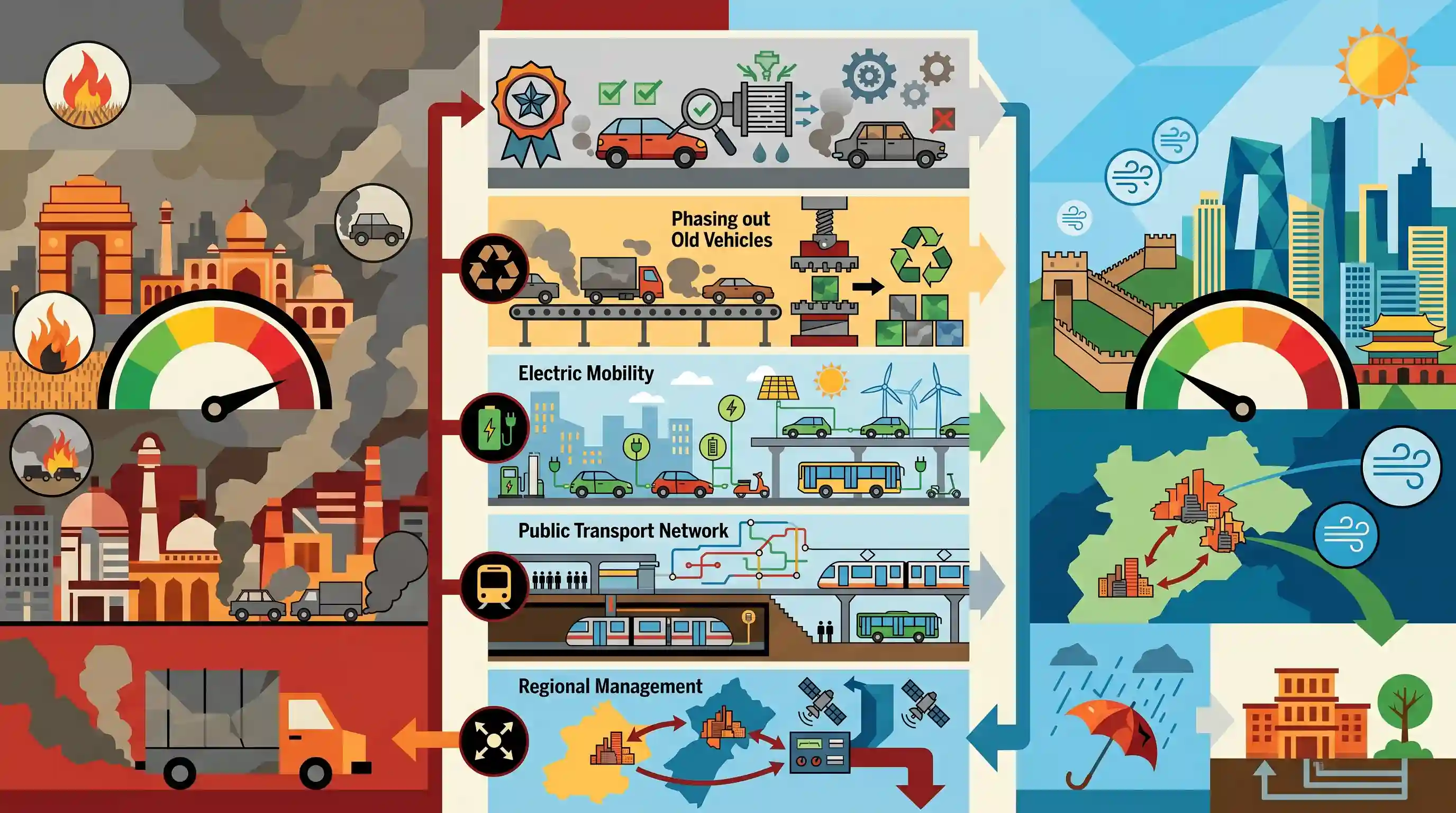
As Delhi grapples with hazardous air quality, China has showcased Beijing's successful, multi-pronged strategy to combat urban air pollution. Through a series of measures highlighted by a Chinese embassy spokesperson, Beijing achieved drastic reductions in pollution by implementing stringent vehicle emission standards (China 6NI), phasing out millions of older vehicles, and aggressively promoting electric mobility and expansive public transport networks. Crucially, China adopted a regional air quality management approach by coordinating emission cuts across the Beijing-Tianjin-Hebei region. This comparison offers critical policy lessons for India's National Capital Region on the need for structural, long-term interventions over reactive measures.
Key Points
- Amidst Delhi's toxic air quality crisis, China highlighted Beijing's successful anti-pollution model, noting a stark contrast in AQI levels between the two capital cities.
- Beijing implemented rigorous vehicular emission controls by adopting China 6NI standards (equivalent to Euro 6), phasing out 3 million high-emission older vehicles, and curbing car growth through odd-even rules and license-plate lotteries.
- China heavily invested in public infrastructure by building the world's largest subway and bus networks, significantly shifting urban mobility towards electric vehicles (EVs) for daily commuting and logistics.
- Beijing’s success is largely attributed to a coordinated regional approach, integrating emissions cuts and pollution prevention across the Beijing-Tianjin-Hebei metropolitan corridor.
- The comparative analysis underscores the necessity for Delhi and NCR to move beyond ad-hoc measures and adopt sustained, structural, and regionally coordinated environmental policies.
Important Terms
China 6 (VI) Emission Standards

Stringent vehicle emission norms in China, categorized into 6a and the more rigorous 6b. They mandate advanced particulate filters and real-world driving emission (RDE) testing to achieve 'soot-free' vehicle fleets.
UPSC context
GS3: Environment. Relevant for comparative analysis of global pollution mitigation strategies and automotive industry regulations.
Jing-Jin-Ji Region
A mega-urban cluster (Beijing-Tianjin-Hebei) serving as China's primary model for regional air quality management, utilizing unified command, industrial relocation, and cross-boundary emission coordination to reduce regional haze.
UPSC context
GS3: Environment & Disaster Management. Tests understanding of regional coordination and cooperative federalism in managing transboundary air pollution.
Graded Response Action Plan (GRAP)
An emergency framework for Delhi-NCR that mandates specific restrictive actions—such as construction bans or vehicle curbs—triggered automatically as air quality crosses predefined levels (Moderate to Severe+).
UPSC context
GS3: Environmental Pollution. Essential for questions on urban governance, reactive vs. structural measures, and judicial activism (MC Mehta case).
National Clean Air Programme (NCAP)
India's long-term national framework aimed at achieving a 20–30% reduction in particulate matter concentrations by 2024 (base year 2017) across 131 'non-attainment' cities through city-specific action plans.
UPSC context
GS3: Environmental Policy. A core scheme for mains questions regarding India's pollution targets and multi-sectoral strategies.
Bharat Stage VI (BS-VI)
India’s current vehicle emission norms (implemented 2020), equivalent to Euro 6. It mandates a five-fold reduction in fuel sulphur content (to 10 ppm) and includes On-Board Diagnostics (OBD) for real-time monitoring.
UPSC context
GS3: Technology & Environment. Often tested in Prelims/Mains regarding fuel quality and technological leapfrogging in India.
Air Quality Index (AQI)
A standardized numerical scale (0–500) used to communicate the health impact of daily air pollution by monitoring eight key pollutants, including PM2.5, PM10, Nitrogen Dioxide, and Ozone.
UPSC context
GS3: Pollution. Fundamental metric for environmental monitoring; frequently appears in both Prelims and Mains context.
Prelims Trap
The jurisdiction of the Commission for Air Quality Management (CAQM) is strictly limited to the National Capital Region.
False. CAQM's jurisdiction extends beyond the NCR to adjoining areas in Punjab, Haryana, Rajasthan, and UP where sources of air pollution impact the NCR.
Static Concepts Connected
What are the statutory powers and jurisdiction of the CAQM?
- Statutory Body: Created via the CAQM in NCR and Adjoining Areas Act, 2021, granting it statutory backing and replacing the 22-year-old EPCA.
- Airshed Jurisdiction: Covers the National Capital Region and adjoining districts in Punjab, Haryana, Rajasthan, and UP that impact NCR's air quality.
- Overriding Powers: In case of a conflict, CAQM orders supersede those of the Central Pollution Control Board (CPCB) and State Pollution Control Boards.
How do BS-VI vehicular emission standards differ from BS-IV?
- Direct Leapfrog: India skipped BS-V entirely, leapfrogging directly from BS-IV to BS-VI emission standards nationwide in April 2020.
- Sulfur Reduction: Sulfur content in both petrol and diesel is drastically reduced from 50 ppm (BS-IV) to just 10 ppm (BS-VI).
- Technology Mandate: BS-VI mandates On-Board Diagnostics (OBD) and Diesel Particulate Filters (DPF) to continuously monitor and curb tailpipe emissions.
Cross-Topic Patterns
Airshed Management & Cooperative Federalism
Environmental challenges like the Delhi/NCR smog bypass state borders, making the regional "airshed approach" a prime test of cooperative federalism and inter-state dispute resolution mechanisms.
EV Transition & Critical Mineral Security
Beijing’s EV success relies heavily on China's dominance in battery supply chains; India's EV push to curb pollution must simultaneously address its lithium and cobalt import vulnerabilities.

Expect a Mains question evaluating the 'airshed approach' of India's CAQM against international benchmarks like Beijing's regional model.
Linked PYQs · 4
Linked PYQs · 4
- 2022PrelimsGS1
In the context of WHO Air Quality Guidelines, consider the following statements: 1. The 24-hour mean of PM2.5 should not exceed 15 µg/m³ and annual mean of PM2.5 should not exceed 5 µg/m³. 2. In a year, the highest levels of ozone pollution occur during the periods of inclement weather. 3. PM10 can penetrate the lung barrier and enter the bloodstream. 4. Excessive ozone in the air can trigger asthma. Which of the statements given above are correct?
- 2016PrelimsGS1
In the cities of our country, which among the following atmospheric gases are normally considered in calculating the value of Air Quality Index? 1. Carbon dioxide 2. Carbon monoxide 3. Nitrogen dioxide 4. Sulfur dioxide 5. Methane Select the correct answer using the code given below.
- 2025PrelimsGS1
Artificial way of causing rainfall to reduce air pollution makes use of
- 2023MainsGS3
The adoption of electric vehicles is rapidly growing worldwide. How do electric vehicles contribute to reducing carbon emissions and what are the key benefits they offer compared to traditional combustion engine vehicles?
