China Technical Military Support to Pakistan in War with India
Source:The Hindu ↗
Why It Matters
The formal confirmation of direct Chinese military assistance to Pakistan during an active conflict with India transitions the 'two-front war' from a theoretical threat matrix to a proven operational reality. This underscores the strategic necessity for India to rapidly accelerate its defense indigenization (Atmanirbhar Bharat) and build robust multi-domain deterrence against adversaries heavily backed by integrated Chinese hardware and personnel.
Summary
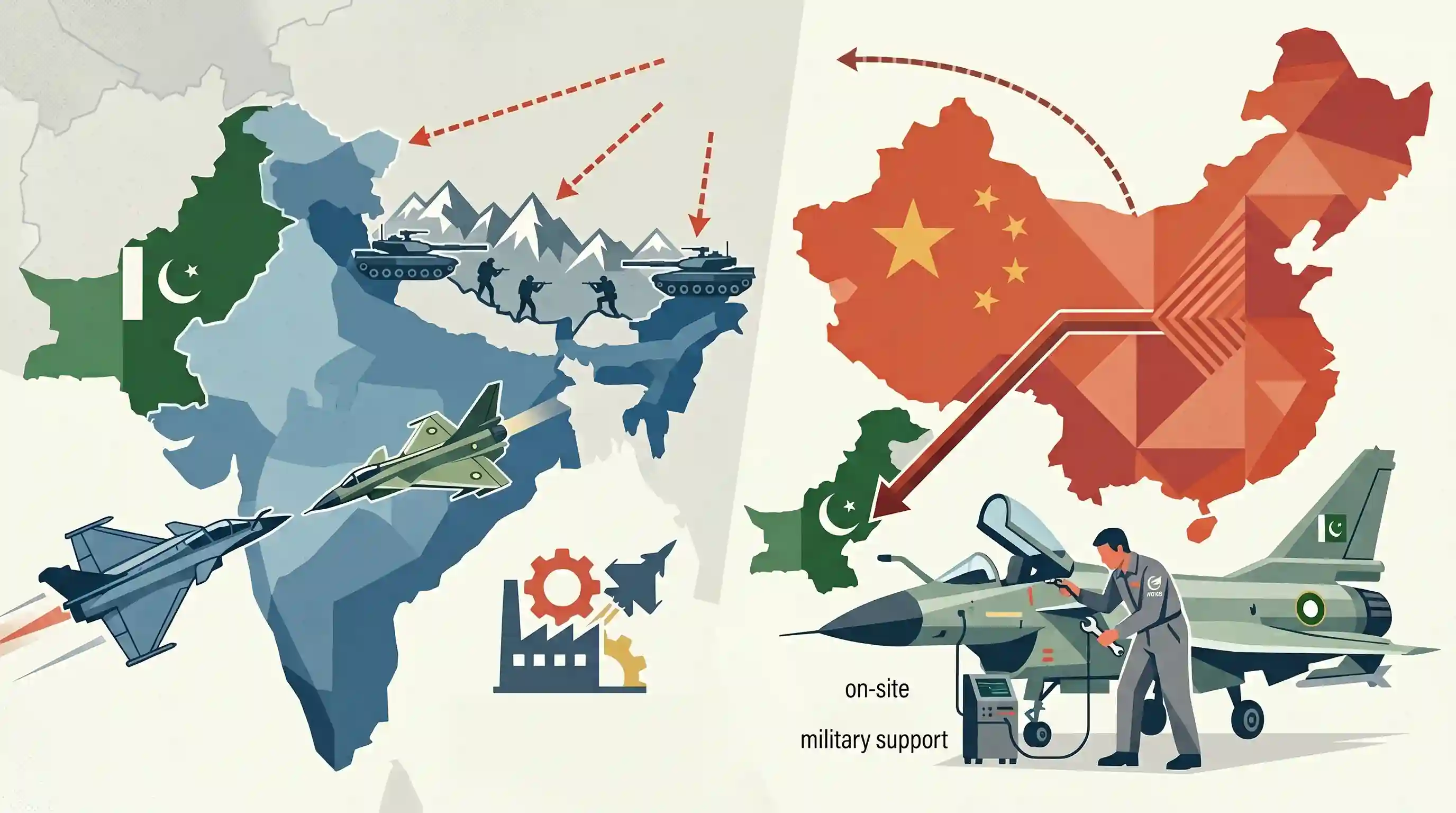
China's state media has for the first time explicitly confirmed that Beijing provided on-site technical military support to Pakistan during its 2025 war with India. An aviation engineer from China's AVIC Chengdu Aircraft Design and Research Institute revealed in a CCTV interview that he and his team were stationed at a Pakistani airbase during the conflict to ensure the optimal combat performance of Pakistan's Chinese-supplied J-10CE fighter jets. This unprecedented public admission substantiates India's claims that it fought a complex, multi-front battle against a collusive threat, wherein China provided vital operational support to Pakistan that went well beyond standard intelligence sharing or generic arms supplies.
Key Points
- China publicly confirmed for the first time that it provided on-site technical assistance to Pakistan during the 2025 India-Pakistan conflict (Operation Sindoor).
- An engineer from China's AVIC Chengdu Aircraft Design and Research Institute revealed on CCTV that a Chinese technical team was stationed at a Pakistani base to ensure the J-10CE fighter jets operated at peak combat potential.
- The admission validates India's longstanding assertions that it faced a collusive, multi-front military threat involving active support from China and Türkiye.
- This highlights the depth of the China-Pakistan defense nexus, proving it extends beyond arms sales and intelligence sharing into direct operational support during wartime.
Important Terms
Operation Sindoor

India's May 2025 military campaign involving precision strikes against terror infrastructure in Pakistan-occupied Jammu and Kashmir (PoJK) and Pakistan, following a major terror attack in Pahalgam.
UPSC context
GS-III: Security Challenges; tests understanding of India's proactive defense doctrines and surgical/precision strike capabilities against cross-border terrorism.
Aviation Industry Corporation of China (AVIC)
A Chinese state-owned aerospace conglomerate that manufactures advanced military hardware and provides technical personnel for on-site support to allied nations like Pakistan.
UPSC context
GS-II/III: IR and Security; tests awareness of the military-industrial nexus between China and Pakistan and its impact on regional security.
Chengdu Aircraft Design and Research Institute (CADI)
A specialized research and design arm of AVIC responsible for developing China's premier fighter jets, including the J-10C and J-20 stealth aircraft.
UPSC context
GS-III: Security/Science & Tech; tests knowledge of foreign entities driving technological competition in India's neighborhood.
J-10CE Fighter Jet
A 4.5-generation multirole fighter jet exported by China to Pakistan, featuring AESA radar and compatibility with long-range PL-15 air-to-air missiles.
UPSC context
GS-III: Defense Hardware; tests understanding of the air combat balance and technological shifts in the South Asian theater.
Collusive Threat
The strategic scenario where India faces simultaneous military hostility from China and Pakistan, characterized by intelligence sharing, joint production, and operational coordination.
UPSC context
GS-III: Security; central concept in India's defense planning regarding the combined military challenge from two neighbors.
CCTV (China Central Television)
China's primary state broadcaster, which serves as a tool for strategic communication and official confirmation of state military and technical involvement abroad.
UPSC context
GS-III: Information Warfare; tests awareness of how state media is used for strategic narrative building and signaling in international conflicts.
Prelims Trap
"China's military assistance to Pakistan during the 2025 conflict was limited to intelligence sharing and accelerated arms resupply."
China's unprecedented admission explicitly confirms it provided active, on-site technical support for J-10CE jets during active hostilities, marking a shift to direct operational collaboration.
Static Concepts Connected
What is the IAF's mandated squadron strength for a two-front war?
- Sanctioned Strength: The Indian Air Force is mandated by the Cabinet Committee on Security to maintain 42 fighter squadrons to simultaneously tackle a collusive threat from China and Pakistan.
- Current Deficit: The phasing out of legacy aircraft (like the MiG-21s) and delayed inductions have depleted actual strength to around 31 squadrons, exacerbating vulnerability to two-front scenarios.
How do regional satellite navigation systems impact strategic autonomy?
- BeiDou Integration: Pakistan utilizes China's BeiDou satellite network for precision strikes, ISR, and battlefield awareness, embedding its military deeply within Beijing's strategic technology ecosystem.
- NavIC's Role: India relies on NavIC (IRNSS), which provides an encrypted Restricted Service (RS) for authorized users, ensuring self-reliance in military positioning, navigation, and timing during conflicts.
Cross-Topic Patterns
Collusive Threat + Space Security
Pakistan's deep integration with China's BeiDou satellite navigation network highlights the critical overlap between conventional air deterrence and the emerging domains of space-based military infrastructure.
Arms dependency + Defense Indigenization
Pakistan sourcing 80% of its arms from China creates a unified tech-ecosystem threat, amplifying the urgency for India's indigenous defense projects like the Tejas Mk2 and AMCA.

Expect a 2026 Mains question analyzing the 'Collusive Threat' transition from theoretical doctrine to operational reality in border areas.
Linked PYQs · 3
Linked PYQs · 3
- 2024MainsGS3
India has a long and troubled border with China and Pakistan fraught with contentious issues. Examine the conflicting issues and security challenges along the border. Also give out the development being undertaken in these areas under the Border Area Development Programme (BADP) and Border Infrastructure and Management (BIM) Scheme.
- 2014MainsGS3
China and Pakistan have entered into an agreement for development of an economic corridor. What threat does this pose for India's security? Critically examine.
- 2020MainsGS3
Analyze internal security threats and transborder crimes along Myanmar, Bangladesh and Pakistan borders including Line of Control (LoC). Also discuss the role played by various security forces in this regard.
