Students protest school mergers across Madhya Pradesh districts
Source:indiatomorrow ↗
Why It Matters
This issue highlights the critical tension in public policy between consolidating resources for better educational infrastructure (efficiency) and ensuring foundational accessibility (equity). For MPPSC aspirants, it serves as a live case study on the geographical and social challenges of implementing centralized schemes in tribal and rural topographies, directly relating to the Right to Education Act and state governance.
Summary
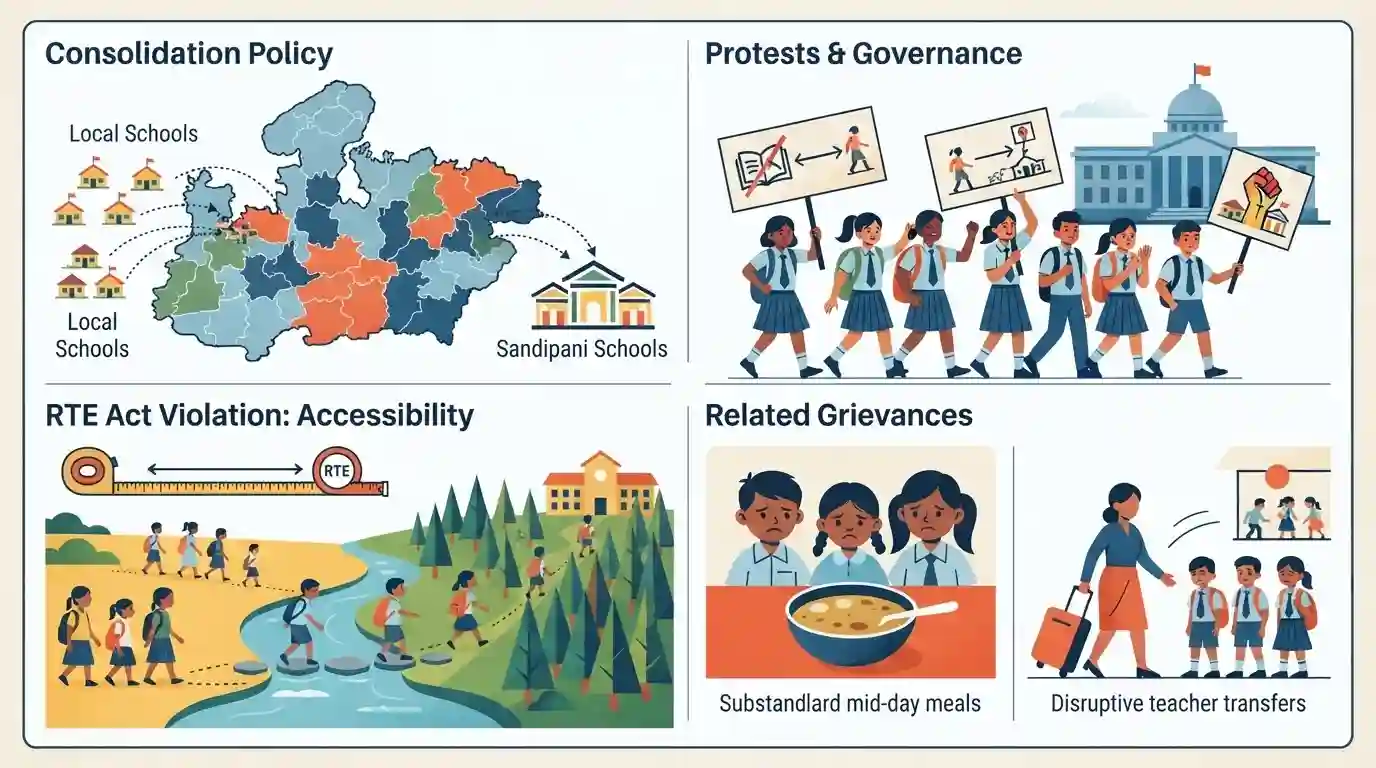
Students across 11 districts in Madhya Pradesh are actively protesting against the state government's decision to merge nearby smaller schools into larger, consolidated 'Sandipani' schools. The primary grievance is that the school mergers significantly increase travel distances for students, directly contravening the Right to Education (RTE) Act’s accessibility norms. Children from rural and tribal areas, such as Dindori and Katni, report having to navigate dense forests and waterlogged paths to reach their newly assigned schools. Although the state aims to centralize resources and improve infrastructure in line with schemes like PM SHRI, local communities argue that the lack of safe, accessible transport will trigger higher dropout rates. The protests have also brought attention to other educational grievances, including substandard mid-day meals and disruptive teacher transfers.
Key Points
- School children and parents across 11 districts in Madhya Pradesh are protesting the state government's decision to merge smaller village schools into larger, centralized 'Sandipani' schools.
- The mergers are forcing students to commute longer distances, violating the Right to Education (RTE) Act guidelines that mandate primary schools within 1 km and upper primary schools within 3 km of habitations.
- Students in rural and tribal districts (like Katni and Dindori) face hazardous routes through dense forests and waterlogged areas, leading to fears of increased dropout rates, especially among girls.
- While the government justifies the move as a way to improve infrastructure and consolidate resources similar to the PM SHRI scheme, the lack of last-mile accessibility poses significant barriers.
- Protests also highlighted other systemic issues such as poor mid-day meal quality and arbitrary teacher transfers.
Important Terms
Right to Education (RTE) Act

A 2009 law ensuring free and compulsory education for children aged 6-14 in India. It mandates accessible 'neighborhood schools', a provision cited by protesting students over the increased travel distances caused by school mergers.
UPSC context
MPPSC GS Paper 2 (Social Justice). Tests understanding of fundamental rights (Article 21A), educational accessibility, and statutory compliance in policy implementation.
Sandipani Schools
A Madhya Pradesh state initiative rebranding 'CM Rise' schools. It aims to integrate modern educational infrastructure, like smart classrooms, with traditional Indian cultural values and gurukul-inspired holistic development.
UPSC context
MPPSC GS Paper 2 (State Education Policies). Crucial for evaluating state-specific governance reforms, infrastructure consolidation efforts, and their on-ground reception.
PM SHRI Scheme
The Pradhan Mantri Schools for Rising India is a centrally sponsored scheme launched to upgrade over 14,500 existing government schools into model institutions aligned with the National Education Policy (NEP) 2020.
UPSC context
MPPSC GS Paper 2 (Government Policies). Evaluates awareness of Centre-state educational initiatives, NEP 2020 rollout, and public school infrastructure development.
PM POSHAN Scheme
Formerly the Mid-Day Meal Scheme, this centrally sponsored initiative guarantees a daily hot, cooked nutritional meal to children in government and government-aided schools from pre-primary up to Class VIII.
UPSC context
MPPSC GS Paper 2 (Welfare Schemes/Health). Tests knowledge of child nutrition interventions, the National Food Security Act, and dropout prevention strategies.
Prelims Trap
Sandipani Vidyalayas are a Centrally Sponsored Scheme aimed specifically at tribal education in Madhya Pradesh.
Sandipani Vidyalaya is the new name for the State Government's 'CM Rise' schools. It is a state-funded consolidation initiative, not a central scheme like PM SHRI.
Static Concepts Connected
What are the neighborhood school distance norms under the RTE Act, 2009?
- Primary Schools: The state must establish primary schools (Classes I-V) within a 1 km walking distance of the neighborhood habitation.
- Upper Primary Schools: Upper primary schools (Classes VI-VIII) must be established within a 3 km walking distance from the neighborhood.
- Difficult Terrain Exceptions: If distance norms cannot be met due to difficult terrain or sparse populations, the state must provide free transportation or residential facilities.
What is the PM SHRI Scheme often cited in school consolidation policies?
- Scheme Nature: Pradhan Mantri Schools for Rising India is a Centrally Sponsored Scheme to upgrade 14,500 existing government schools.
- NEP Showcase: These schools act as exemplar institutions to showcase all components and the core spirit of the National Education Policy (NEP) 2020.
- Green Infrastructure: They are designed as 'Green Schools' incorporating solar panels, LED lighting, nutrition gardens, and water conservation systems.
Cross-Topic Patterns
Education Access vs Tribal Topography
Forested and waterlogged terrain in districts like Dindori creates physical barriers to centralized education, directly linking geographic topography to vulnerable group dropout rates, especially among girls.
CM Rise (Sandipani) vs EMRS
While EMRS provides necessary residential solutions for tribal students, the daily commute requirement of consolidated Sandipani schools exposes deep gaps in rural transport infrastructure and RTE compliance.

Expect a multi-statement question testing RTE Act neighborhood distance limits alongside the objectives of MP’s Sandipani (CM Rise) schools.
Linked PYQs · 4
Linked PYQs · 4
- 2024MPPSC_PRELIMSGS1
The Samagra Shiksha Abhiyan has emerged from the amalgamation of which of the following schemes ?
- 2025MPPSC_PRELIMSGS1
What percentage of the Madhya Pradesh government's total expenditure budget was allocated to education in 2023-24?
- 2025MPPSC_PRELIMSGS1
How many total major and medium Integrated Tribal Development Projects are in existence in Madhya Pradesh in 2023-24?
- 2018MPPSC_PRELIMSGS1
Which district of Madhya Pradesh has highest percentage of tribal population?
