Supreme Court Stance Against Internet Bans for Minors
Source:Indian Express ↗
આ શા માટે મહત્વનું છે
This development addresses the intersection of digital rights, fundamental freedoms under Article 21, and child welfare, offering crucial insights for governance and judicial approaches to modern technological challenges.
સારાંશ
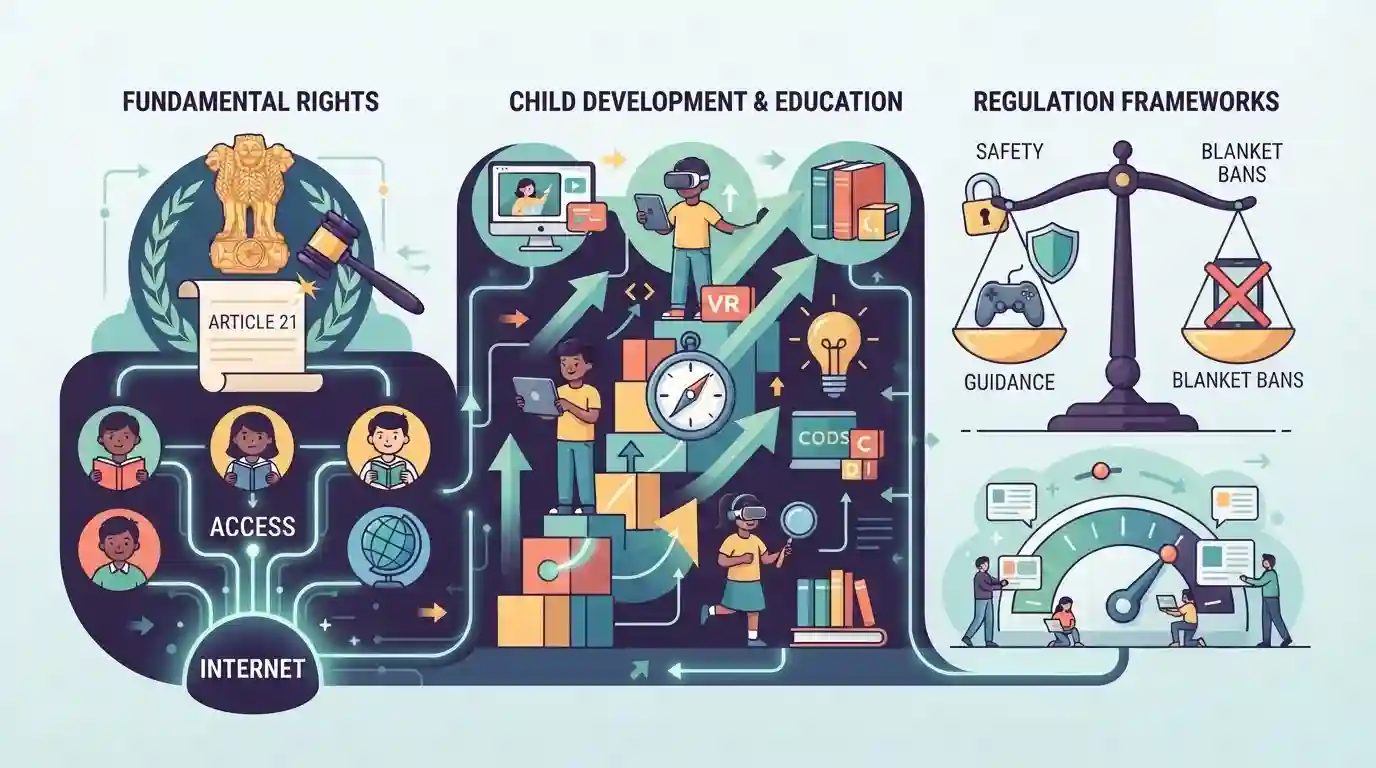
The Supreme Court of India examined the issue of internet access for children, observing that internet access forms an integral part of children's rights, development, and education under Article 21, while ruling against blanket bans on internet usage for minors and calling for balanced, nuanced regulatory frameworks.
મુખ્ય મુદ્દા
- The Supreme Court noted that access to the internet can be considered a fundamental right for children, essential for education, development, and modern participation.
- The court cautioned against blanket bans on internet access for minors, emphasizing proportionality and targeted regulatory measures instead of sweeping restrictions.
- Balances the need to protect children from online harms (such as cyberbullying, addiction, and inappropriate content) with their fundamental rights to education and freedom of expression.
- Highlights the constitutional dimensions of digital inclusion versus child protection in the digital age.
મહત્વપૂર્ણ શબ્દો
Article 21 of the Constitution

Guarantees that no person shall be deprived of life or personal liberty except according to procedure established by law. The Supreme Court has expansively interpreted it to encompass digital access and internet rights for children.
UPSC context
UPSC GS Paper II (Polity and Governance - Fundamental Rights, Judiciary): Tests understanding of judicial activism, expansive interpretation of rights, and evolving digital jurisprudence.
Supreme Court of India
The apex judicial body in India that interprets the Constitution and protects fundamental rights, recently ruling that internet access is a fundamental right for children and barring blanket bans.
UPSC context
UPSC GS Paper II (Indian Constitution - Structure, Powers, and Functioning of Judiciary): Tests role of Supreme Court as guardian of the Constitution and fundamental rights.
પ્રિલિમ્સ ટ્રેપ
Internet access is recognized as a fundamental right under Article 21 exclusively for adult citizens and commercial entities.
Aspirants often assume fundamental rights like Article 21 or 19 apply exclusively to adults. The Supreme Court has repeatedly affirmed that minors also possess constitutional rights, including internet access for education and development.
સંલગ્ન સ્થિર ખ્યાલો
What are the key judicial parameters of the Doctrine of Proportionality in Indian constitutional law?
- Origin & Context: Origin: Derived from German jurisprudence (Verhältnismäßigkeitsprinzip) and firmly established in Indian law through landmark rulings like K.S. Puttaswamy and Anuradha Bhasin.
- Legitimate Aim: Legitimate Aim: The restrictive state action must pursue a legitimate government goal (e.g., national security, public order, child protection).
- Necessity Test: Suitability & Necessity: The measure must be suitable to achieve the goal, and there must be no less restrictive alternative available.
- Balancing Test: Balancing: There must be a proper balance between the importance of the public objective and the severity of the infringement on fundamental rights.
આંતર-વિષય પેટર્ન
Digital Rights + Doctrine of Proportionality
The doctrine of proportionality, established in Anuradha Bhasin and Puttaswamy, is increasingly applied by the Supreme Court to balance fundamental rights against state regulatory measures across digital rights and internet shutdowns.
Right to Education + Digital Infrastructure
Integrating digital inclusion with Article 21 highlights how socio-economic rights and educational access evolve in tandem with technological changes and digital infrastructure initiatives.

Internet access as an Article 21 right + proportionality test in blanket bans is prime material for a Mains GS-2 analytical question.
સંલગ્ન PYQ · 2
સંલગ્ન PYQ · 2
- 2024MainsGS2
Right to privacy is intrinsic to life and personal liberty and is inherently protected under Article 21 of the constitution. Explain. In this reference discuss the law relating to D.N.A. testing of child in the womb to establish its paternity.
- 2025MainsGS2
The National Commission for Protection of Child Rights has to address the challenges faced by children in the digital era. Examine the existing policies and suggest measures the Commission can initiate to tackle the issue.
