Supreme Court Directs Nuanced Digital Access Rules for Children
Source:Indian Express ↗
Why It Matters
It addresses the evolving intersection of fundamental rights, digital access for children, and the judicial view on proportionality versus blanket bans in regulating technology use.
Summary
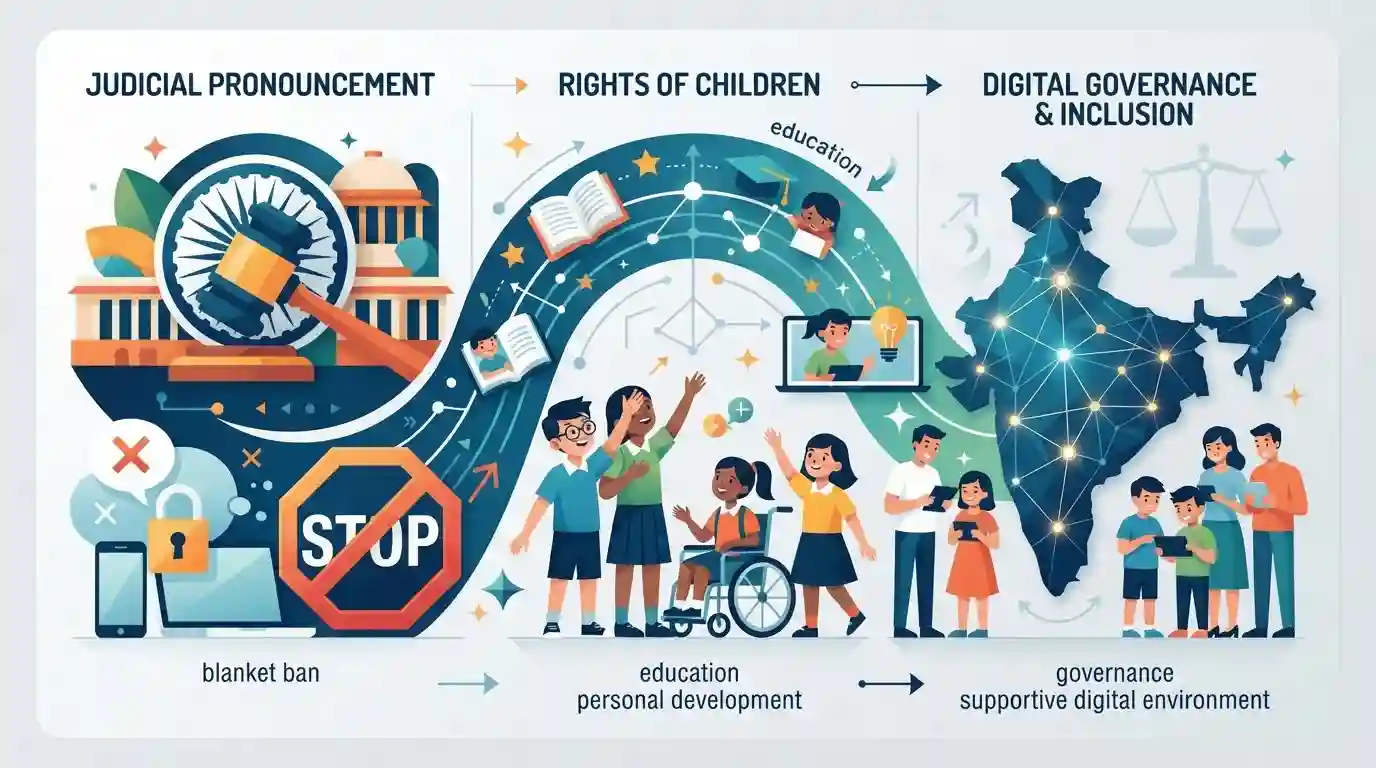
The Supreme Court of India's observations or rulings regarding children's access to the internet, noting that blanket bans on internet use or digital devices are disproportionate and that internet access is closely tied to children's fundamental rights like education and personal development.
Key Points
- The Supreme Court highlighted that access to the internet and digital space is increasingly linked to children's fundamental rights, including education, development, and freedom of expression.
- A blanket ban on internet usage or digital devices for children is viewed as disproportionate and counterproductive, failing to balance safety with rights.
- The ruling emphasizes the need for a nuanced regulatory approach rather than total prohibitions to protect children from online harms while preserving their digital access.
Important Terms
Supreme Court of India

The apex constitutional court of India which ruled that internet access is a fundamental right for children and that blanket digital bans are disproportionate.
UPSC context
UPSC GS Paper II (Polity & Constitution — Judiciary, Fundamental Rights). Tests understanding of judicial pronouncements on digital rights and child welfare.
Child Sexual Exploitative and Abuse Material (CSEAM)
The legal term replacing 'child pornography' in Indian judicial discourse, referring to visual materials depicting the sexual exploitation and abuse of minors.
UPSC context
UPSC GS Paper II (Social Justice — Rights of Children, Cyber Safety). Tests knowledge of evolving legal terminology and child protection laws.
Just Rights for Children Alliance v. S. Harish
A landmark Supreme Court case addressing online safety, intermediary liability, and the protection of minors from CSEAM while evaluating fundamental digital rights.
UPSC context
UPSC GS Paper II (Judicial Pronouncements, Vulnerable Sections). Useful for answers on balancing online safety with fundamental rights of children.
Static Concepts Connected
What are the constitutional provisions and doctrines associated with the right to internet access in India?
- Article 21: Article 21 inclusion: The Supreme Court has read internet access as an integral part of the Right to Life and Personal Liberty under Article 21.
- Article 19(1)(a): Article 19(1)(a): Freedom of speech and expression includes the right to disseminate and receive information through any medium, including the internet.
- Proportionality test: Proportionality Test: Established in the KS Puttaswamy judgment, state action restricting rights must be backed by law, pursue a legitimate aim, and be proportionate.
Cross-Topic Patterns
Internet Access vs Fundamental Rights
The Supreme Court's stance on digital access mirrors the landmark Anuradha Bhasin judgment, balancing national security/public safety with fundamental freedoms under Article 19 and 21.
Child Safety vs Data Privacy Frameworks
Regulating digital platforms for child protection intersects with the IT Intermediary Guidelines and the Digital Personal Data Protection (DPDP) Act, 2023.

Supreme Court rulings on internet as a fundamental right and tests of proportionality frequently appear in Prelims and Mains GS-2.
Linked PYQs · 3
Linked PYQs · 3
- 2025MainsGS2
The National Commission for Protection of Child Rights has to address the challenges faced by children in the digital era. Examine the existing policies and suggest measures the Commission can initiate to tackle the issue.
- 2024MainsGS2
Right to privacy is intrinsic to life and personal liberty and is inherently protected under Article 21 of the constitution. Explain. In this reference discuss the law relating to D.N.A. testing of child in the womb to establish its paternity.
- 2021MainsGS2
Has digital illiteracy, particularly in rural areas, coupled with lack of Information and Communication Technology (ICT) accessibility hindered socio-economic development? Examine with justification.
