Gorakhpur hosts launch of statewide tree plantation campaign
Source:freepressjournal ↗
Why It Matters
Statewide afforestation targets and localized environmental conservation campaigns are highly tested areas in UPPSC Prelims. Environmental statistics (like ISFR data and state planting targets) and the biological components of traditional plantation campaigns (such as 'Triveni' and 'Ek Ped Maa Ke Naam') frequently appear under ecological and geographic questions.
Summary
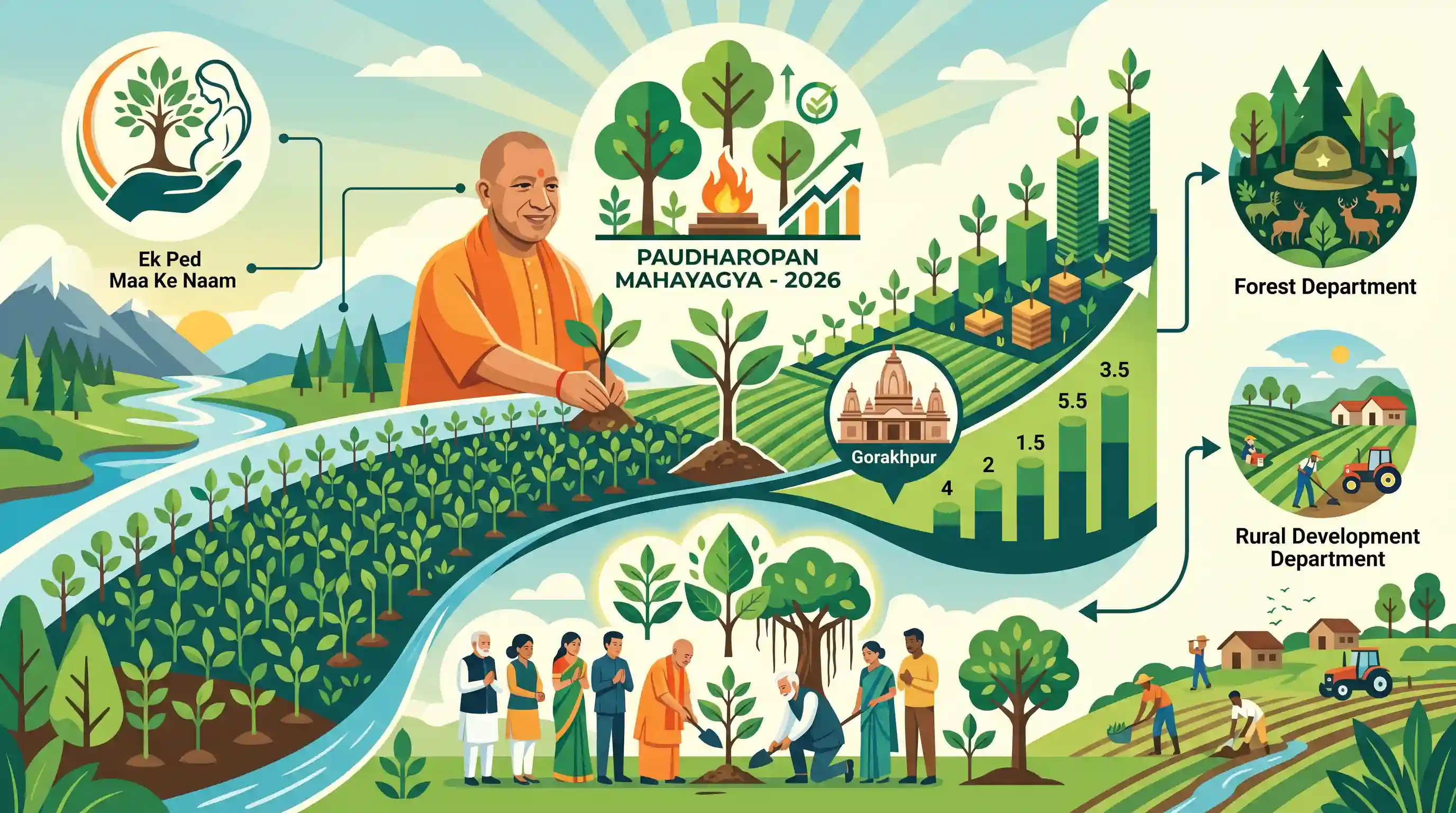
Uttar Pradesh Chief Minister Yogi Adityanath is set to launch the statewide 'Paudharopan Mahayagya - 2026' from Gorakhpur on July 12, 2026. Aligned with the national 'Ek Ped Maa Ke Naam' campaign, the state aims to plant 35 crore saplings this year. Gorakhpur's target is 55,28,600 saplings, with major contributions from the Forest and Rural Development departments. The campaign begins with the planting of the sacred 'Triveni' trees (Neem, Peepal, and Banyan) and Maulshri.
Key Points
- Chief Minister Yogi Adityanath will launch the statewide Paudharopan Mahayagya - 2026 from Gorakhpur on July 12, 2026, under the 'Ek Ped Maa Ke Naam' campaign.
- The Uttar Pradesh state government has set an ambitious target of planting 35 crore (350 million) saplings across the state in 2026.
- Gorakhpur district has been assigned a target of planting 55,28,600 saplings, with the Forest Department driving the largest share (19,37,000) followed by the Rural Development Department (18,61,000).
- To launch the drive, CM Yogi will plant the sacred 'Triveni'—a combination of Neem, Peepal, and Banyan trees—near the Gorakhpur Link Expressway, and a Maulshri sapling along Tal Ring Road.
- The drive involves coordinated efforts across 27 departments, overseen by the state Forest Department and supported by Dr. Arun Kumar Saxena, Minister of State (Independent Charge) for Forest and Environment.
Important Terms
Paudharopan Mahayagya - 2026

A massive, single-day state-wide afforestation campaign launched in Uttar Pradesh to plant 35 crore saplings, aimed at tackling heatwaves, increasing green cover, and advancing climate action goals.
UPSC context
GS Paper III (Environment). Tests understanding of sub-national climate mitigation efforts, afforestation targets, and state-level policy execution.
Ek Ped Maa Ke Naam Campaign
A nationwide citizen-led plantation drive launched by Prime Minister Narendra Modi on World Environment Day 2024, encouraging individuals to plant trees as a tribute to their mothers.
UPSC context
GS Paper III (Social Forestry). Tests understanding of community-driven environmental conservation, citizen participation, and climate action tools.
Forest Department
The state department responsible for managing forest resources, conserving biodiversity, and acting as the nodal agency for implementing large-scale afforestation and compensatory forestry initiatives.
UPSC context
GS Paper III (Environment). Tests administrative mechanisms for resource conservation, policy implementation under the Indian Forest Act, and ecological restoration.
Rural Development Department
A government department focused on raising rural standards of living, executing rural employment schemes (such as MGNREGA), and participating in plantation drives on common village lands.
UPSC context
GS Paper II (Welfare Schemes). Tests understanding of convergence between rural livelihood programs and environmental sustainability through social forestry.
Panchayati Raj Department
The administrative body that empowers local self-governments (Panchayats) and collaborates in decentralized climate action, water conservation, and community-level plantation drives.
UPSC context
GS Paper II (Local Self-Government). Tests understanding of democratic decentralization, rural governance, and localized environmental management.
Environment Department
The state authority tasked with monitoring pollution, conserving natural resources, drafting environment policies, and coordinating climate change adaptation and mitigation frameworks.
UPSC context
GS Paper III (Environment). Tests knowledge of environmental governance, regulatory compliance, and state-level policy formulation.
Prelims Trap
The traditional 'Harishankari' ecological cluster consists of Neem, Peepal, and Banyan.
'Harishankari' actually comprises Peepal, Pakar, and Banyan (representing the Hindu Trinity). 'Triveni' is the cluster that contains Neem, Peepal, and Banyan. UPSC often tests these micro-distinctions.
Static Concepts Connected
Difference between 'Forest Cover' and 'Tree Cover' in India
- Forest Cover: Refers to all lands more than 1 hectare in area with a tree canopy density of more than 10%, irrespective of ownership and legal status.
- Tree Cover: Refers to tree patches outside recorded forest areas (TOF) that are less than 1 hectare in size.
- National Target: National Forest Policy 1988 mandates keeping 33% of India's total geographical area under forest and tree cover.
What is Social Forestry?
- Definition: Management and protection of forests on barren lands with the purpose of helping environmental, social, and rural development.
- Origin: First recognized nationally in 1976 by the National Commission on Agriculture to reduce pressure on traditional forest reserves.
- Components: Divided into Urban forestry, Rural forestry (including Agro-forestry and Community forestry), and Farm forestry.
Cross-Topic Patterns
Green corridors vs. Infrastructure development
Linking mega-expressways with protective afforestation (Mission Chhaya) to address Environment Impact Assessment (EIA) concerns regarding infrastructure-induced habitat fragmentation.
Localizing SDGs via Panchayati Raj
Using UP's 'Green Chaupals' and 'Gram Harit Nidhi' to map climate action directly onto decentralized rural governance under SDG 13 and SDG 15.

Traditional multi-species agroforestry models and local climate funds (Gram Harit Nidhi) likely to feature in GS-3 2026.
Linked PYQs · 3
Linked PYQs · 3
- 2025UPPSC_PRELIMSGS1
As per the India State of Forest Report 2023, which of the following districts in Uttar Pradesh had forest over more than 20% of their total area? 1. Bahraich 2. Chandaili 3. Shravasti Select the correct answer from the code given below:
- 2004UPPSC_PRELIMSGS1
Presently total forest cover in Uttar Pradesh is only.
- 2022UPPSC_PRELIMSGS1
As per the 'India State of Forest Report - 2021' which of the following States has registered maximum increase in the forest cover during the last two years ?
