Jagannath Rath Yatra inaugurated as annual event in Amaravati
Source:The Hindu ↗
ఇది ఎందుకు ముఖ్యం
This article merges cultural patronage with core sociological debates. It highlights the state government's active role in promoting cultural festivals and temple architecture, making it relevant for Art and Culture. Furthermore, the Chief Minister's discourse on the joint family system, mental health, and the social impact of digital media directly aligns with the 'Indian Society' and 'Social Issues' sections of the General Studies syllabus.
సారాంశం
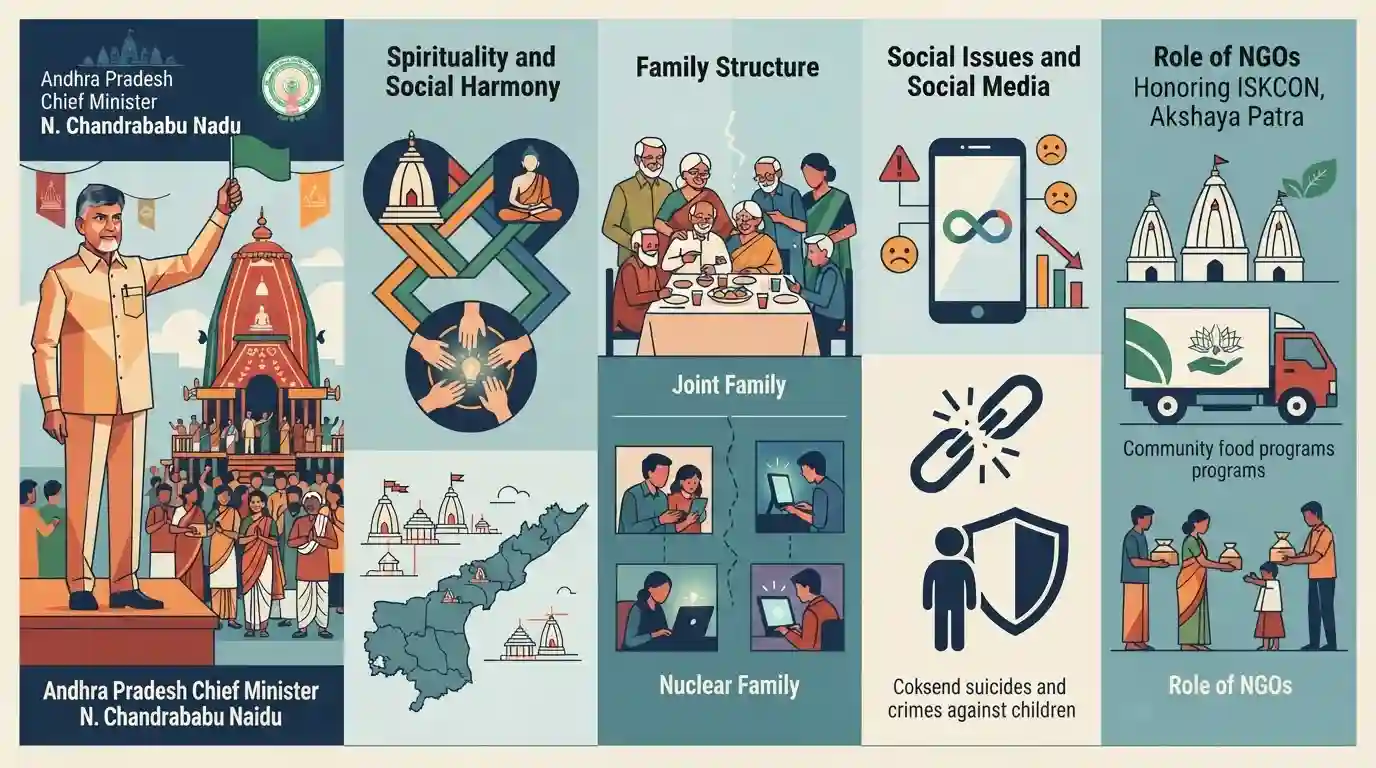
Andhra Pradesh Chief Minister N. Chandrababu Naidu flagged off the ISKCON-organized Jagannath Rath Yatra in Amaravati, declaring it an annual state event. Emphasizing the role of spirituality in maintaining social harmony, he noted that the government is facilitating the construction of 5,000 Sri Venkateswara temples across the state. In his address, Naidu also touched upon critical sociological issues, advocating for a return to the traditional joint family system to counter the emotional detachment of nuclear families. He cautioned against the detrimental effects of excessive social media use, associating it with increased suicides and crimes against children, and praised the societal contributions of ISKCON and the Akshaya Patra Foundation.
ముఖ్య అంశాలు
- The Jagannath Rath Yatra was inaugurated in Amaravati by AP Chief Minister N. Chandrababu Naidu, who announced it will be celebrated as an annual event in the state capital.
- The AP government is undertaking the construction of 5,000 Sri Venkateswara temples across the state to promote spirituality and social harmony.
- The Chief Minister urged citizens to revive the joint family system, highlighting its role in providing emotional support and preventing the isolation inherent in micro-families.
- He warned against the psychological damage caused by excessive social media consumption, linking it to rising suicide rates and crimes against children.
- Philanthropic organizations like ISKCON and the Akshaya Patra Foundation were lauded for their extensive service to society.
ముఖ్యమైన పదాలు
Jagannath Rath Yatra

An annual Hindu chariot festival celebrated in Puri, Odisha, commemorating the ceremonial journey of Lord Jagannath and his siblings to the Gundicha Temple.
UPSC context
GS Paper I (Art and Culture); tests knowledge of major festivals, temple architecture, and cultural traditions.
Joint Family System
A traditional Indian family structure where multiple generations live together under a common roof, sharing property, expenses, resources, and social duties.
UPSC context
GS Paper I (Indian Society); tests understanding of social institutions, changing family structures, and urbanization trends.
ISKCON
The International Society for Krishna Consciousness, a global Gaudiya Vaishnava spiritual organization founded in 1966 by Bhaktivedanta Swami Prabhupada, promoting Bhakti yoga.
UPSC context
GS Paper I (Art and Culture); tests understanding of Bhakti movements, Vaishnavism, and modern socio-religious reformations.
Akshaya Patra Foundation
A non-profit charitable trust in India that serves as a key implementing partner of the PM-POSHAN mid-day meal scheme, fighting school-level hunger.
UPSC context
GS Paper II (Social Justice); tests the role of NGOs, public-private partnerships, and welfare schemes in addressing hunger.
ప్రిలిమ్స్ ఉచ్చు
The Puri Jagannath Temple is historically known as the 'Black Pagoda' due to its dark-colored construction material.
Jagannath Temple is the 'White Pagoda' because of its whitewashed plaster walls. The Sun Temple of Konark is the 'Black Pagoda'.
అనుసంధానమైన స్థిర భావనలు
What are the architectural and ritual hallmarks of the Puri Jagannath Temple?
- Kalinga Style: Characterized by a sanctum (Deula), assembly hall (Jagamohana), and dancing hall (Natamandapa), under the sub-type of Nagara architecture.
- White Pagoda: Historically called the 'White Pagoda' by European sailors due to its whitewashed plaster coating, contrasting with Konark's Black Pagoda.
- Chariot Rituals: The annual Rath Yatra uses three distinct wooden chariots built entirely without metal joints, signifying ancient engineering traditions.
How is the traditional Indian joint family system structurally and functionally defined?
- Five-fold Criteria: Sociologist Iravati Karve identified common residence, common kitchen, common property, joint worship, and mutual kinship ties as structural pillars.
- Nuclearization Trend: Census data shows nuclear families now exceed 50%, driven by urbanization, yet many retain 'functional jointness' through emotional and financial links.
అంతర-అంశ నమూనాలు
NGO-State partnership in nutritional security
Collaborations between state machinery and non-profits like Akshaya Patra demonstrate how religious-backed charities operationalize statutory nutritional targets under the NFSA.
Technology impact on social integration
Rapid digitization and social media consumption are increasingly linked to the weakening of traditional primary social groups like joint families, compounding mental health crises.

Mains 2026 may analyze the decline of traditional joint families as a structural driver of youth isolation and mental health crises.
అనుసంధాన PYQలు · 3
అనుసంధాన PYQలు · 3
- 2024APPSC_PRELIMSGS1
Match the following : | List-I (Kakatiya ruler) | List-II (Event/ Contribution) | |---|---| | A. Rudradeva | I. Shifting the capital from Anamakonda to Orugallu (Warangal) | | B. Ganapatideva | II. Thousand Pillar Temple was built | | C. Rudramadevi | III. Malik Kafur's expedition | | D. Prataparudradeva | IV. Marco Polo's visit to Coastal Andhra | Choose the correct answer using the codes given below : Code: A B C D
- 2023APPSC_PRELIMSGS1
Which of the following subjects are listed in the 11th Schedule? I. Women and Child Development II. Public Distribution System III. Libraries IV. Slum Improvement and Upgradation V. Markets and Fairs Choose the correct answer using the codes given below:
- 2023APPSC_PRELIMSGS1
The following App developed by Government of Andhra Pradesh is an SOS service for women in distress or danger.
