Supreme Court judge appointments and sanctioned strength hike
Source:The Hindu ↗
Why It Matters
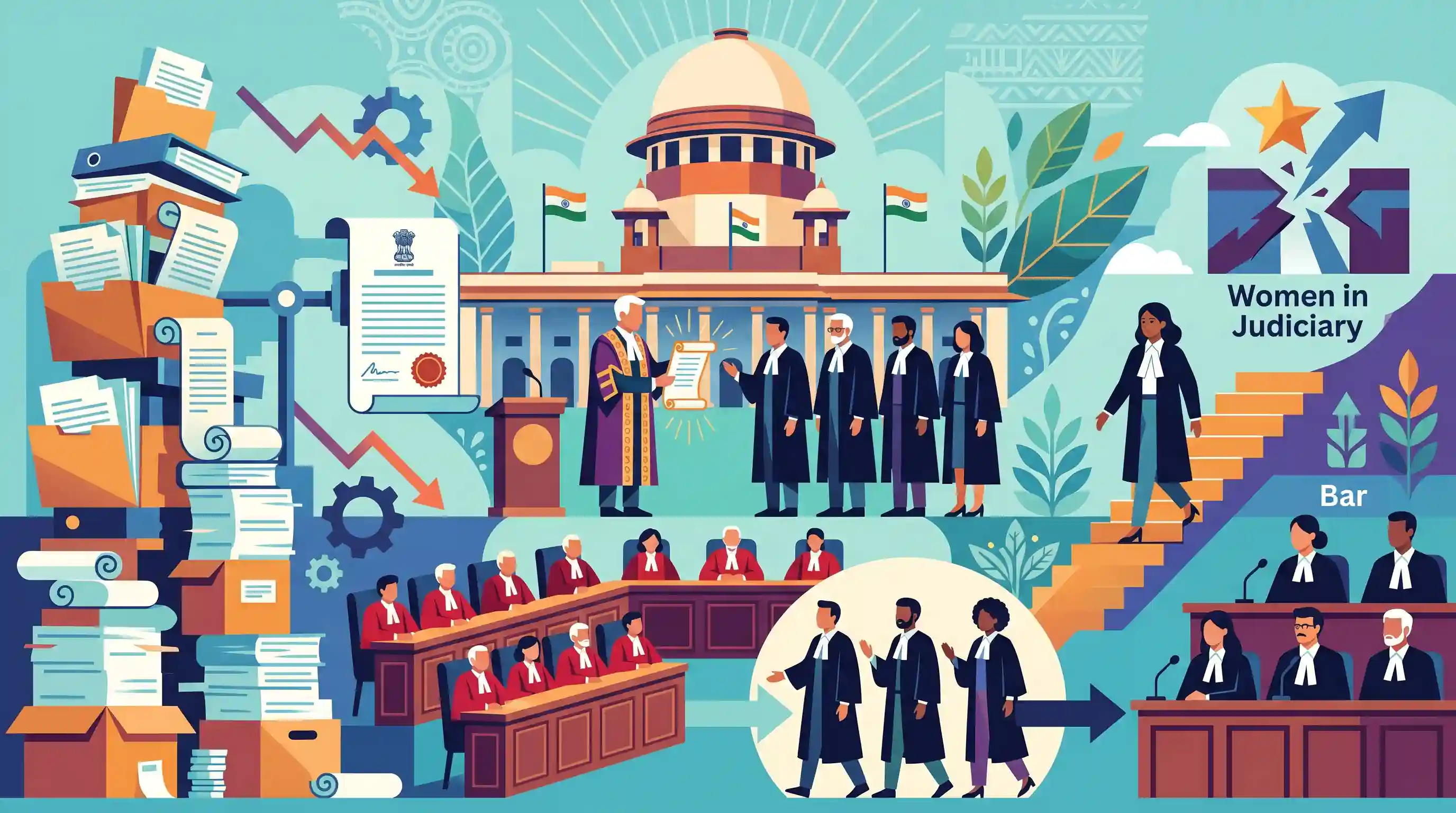
The increase in the Supreme Court's sanctioned strength and subsequent judicial appointments reflect crucial administrative and legislative efforts to address judicial pendency. The appointment of a woman judge directly from the Bar also highlights the evolving demographic diversity of India's higher judiciary.
Summary
Chief Justice of India Surya Kant administered the oath to five new Supreme Court judges, augmenting the court's working strength to 37 following a recent ordinance that increased its sanctioned strength to address high case pendency. The elevation of V.S. Mohana directly from the Bar highlights ongoing efforts to improve gender diversity within the higher judiciary.
Key Points
- Five new judges were sworn in by CJI Surya Kant, bringing the Supreme Court's working strength to 37 and leaving just one vacancy.
- The Union government recently promulgated the Supreme Court (Number of Judges) Amendment Ordinance, 2026, increasing the sanctioned strength from 33 to 37 (excluding the CJI) to tackle a backlog of over 93,000 pending cases.
- Justice V.S. Mohana's elevation is significant as she is only the second woman to be directly elevated from the Bar to the apex court, after Justice Indu Malhotra in 2018.
- The appointments were recommended by a five-member Supreme Court Collegium and formally notified by the President under Article 124(2) of the Constitution.
Important Terms
Supreme Court (Number of Judges) Amendment Ordinance, 2026

A 2026 executive order increasing the Supreme Court's sanctioned judge strength from 34 to 38 (including the Chief Justice) to tackle a record backlog of cases.
UPSC context
GS Paper II (Polity). Tests knowledge of executive's power to expand judicial capacity via Article 123 to address judicial delays.
Article 124(2) of the Constitution
The constitutional provision stating that every Supreme Court judge is appointed by the President after consultation with such judges as deemed necessary, including the Chief Justice.
UPSC context
GS Paper II (Polity). Essential for questions on judicial appointments, independence, and the evolution of the "consultation" vs. "concurrence" debate.
Supreme Court Collegium
A judicial appointment mechanism comprising the Chief Justice of India and the four senior-most judges who recommend candidates for elevation to the Supreme Court.
UPSC context
GS Paper II (Judiciary). A high-yield topic regarding the "Three Judges Cases" and the separation of powers between executive and judiciary.
Direct Elevation from the Bar
The rare appointment of a senior advocate directly to the Supreme Court without prior service as a High Court judge, as seen with Justice V. Mohana.
UPSC context
GS Paper II (Judiciary). Tests understanding of judge eligibility criteria under Article 124(3) and efforts to diversify judicial experience.
Supreme Court of India
India's highest judicial forum and final court of appeal under the Constitution, possessing original, appellate, and advisory jurisdictions to protect fundamental rights.
UPSC context
GS Paper II (Polity). Fundamental institution; syllabus covers its structure, jurisdiction, powers, and role as the "Guardian of the Constitution."
Case Pendency
The cumulative backlog of unresolved legal cases, which reached over 92,000 in the Supreme Court by 2026, prompting measures like increased judge strength.
UPSC context
GS Paper II (Judicial Reforms). Critical for discussing "Justice delayed is justice denied" and administrative challenges in the Indian legal system.
Prelims Trap
Increasing the sanctioned strength of Supreme Court judges requires a Constitutional Amendment.
Under Article 124(1), Parliament prescribes the number of judges via ordinary legislation (Supreme Court (Number of Judges) Act, 1956). No constitutional amendment under Article 368 is needed.
Static Concepts Connected
What are the constitutional qualifications to become a Supreme Court judge?
- Citizenship: The candidate must be a citizen of India.
- Judicial experience: Has been a judge of a High Court (or High Courts in succession) for at least five years.
- Bar experience: Has been an advocate of a High Court (or High Courts in succession) for at least 10 years.
- Distinguished jurist: Is, in the opinion of the President, a distinguished jurist.
How is the sanctioned strength of the Supreme Court altered?
- Parliamentary power: Under Article 124(1), only Parliament has the authority to increase the maximum number of Supreme Court judges.
- Ordinary legislation: It is done by amending the Supreme Court (Number of Judges) Act, 1956, which requires only a simple majority in Parliament.
- Ordinance route: The President can promulgate an ordinance under Article 123 to amend this Act and increase strength when Parliament is not in session.
Cross-Topic Patterns
Women's representation in constitutional courts
With no constitutional reservation for women in the higher judiciary, UPSC frequently links women's elevation trends to debates around Collegium transparency and the Memorandum of Procedure (MoP).
Judicial pendency and Article 128
While augmenting sanctioned strength tackles structural backlog, aspirants should connect this to Article 128, which allows the CJI to appoint retired judges to clear specific arrears.

A 2026 multi-statement question will likely mix Article 124(1) ordinary law powers with Article 124(3) direct Bar elevation rules.
Linked PYQs · 3
Linked PYQs · 3
- 2025MainsGS2
Discuss the evolution of collegium system in India. Critically examine the advantages and disadvantages of the system of appointment of the Judges of the Supreme Court of India and that of the USA.
- 2017MainsGS2
Critically examine the Supreme Court's judgement on 'National Judicial Appointments Commission Act, 2014' with reference to appointment of judges of higher judiciary in India.
- 2021MainsGS2
Discuss the desirability of greater representation to women in the higher judiciary to ensure diversity, equity and inclusiveness.
