Supreme Court Judge Appointments and Judicial Pendency Management
Source:The Hindu ↗
Why It Matters
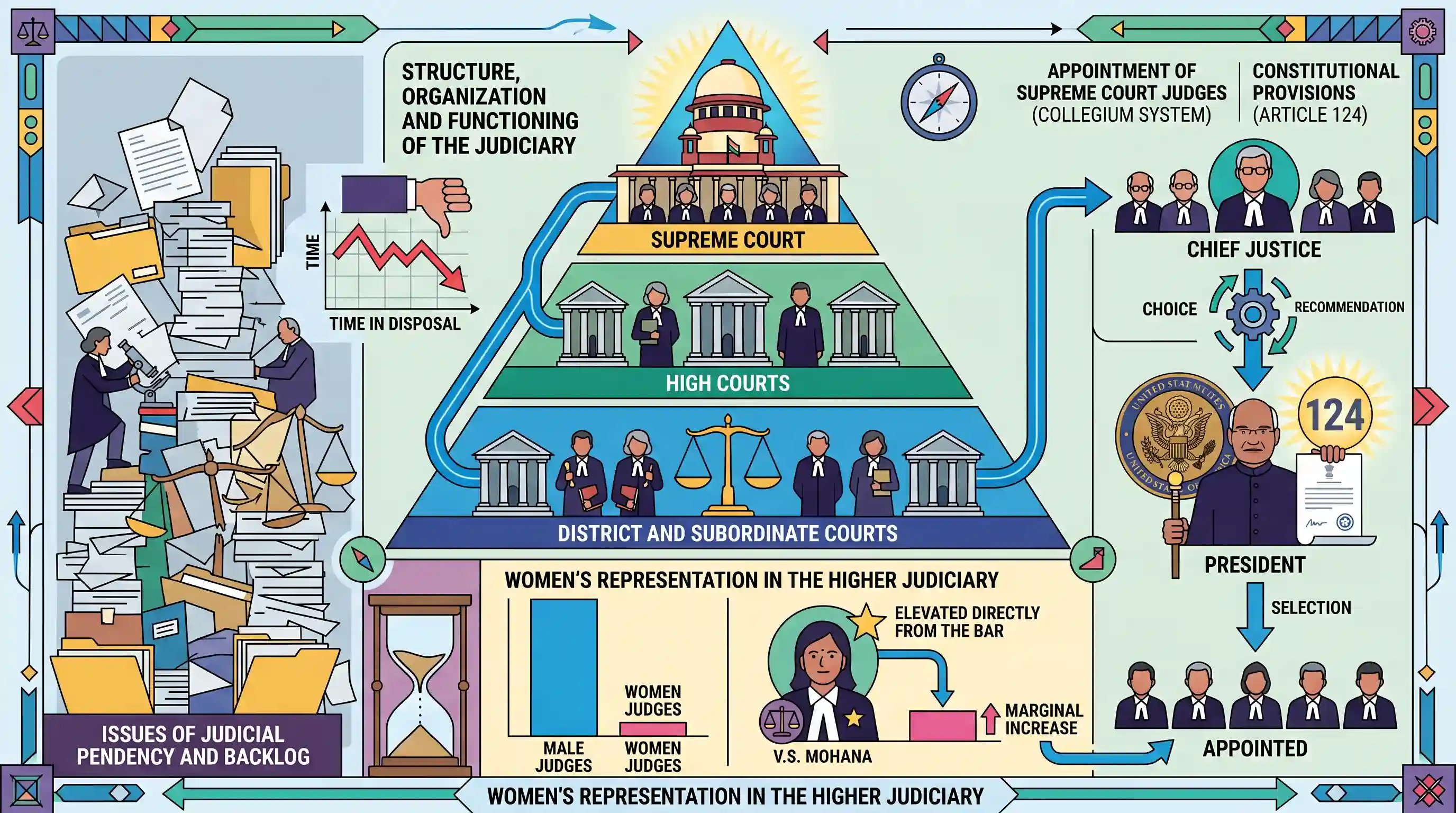
The elevation of judges to the Supreme Court is a central aspect of the Indian constitutional machinery, frequently tested in UPSC GS2. The recent increase in the court's sanctioned strength via an ordinance directly addresses the critical issue of judicial pendency. Furthermore, the direct elevation of a female advocate highlights the ongoing debate on gender diversity, equity, and representation in India's higher judiciary.
Summary
Chief Justice of India Surya Kant administered the oath of office to five new Supreme Court judges, raising the court's working strength to 37. The appointments followed the promulgation of the Supreme Court (Number of Judges) Amendment Ordinance, 2026, which expanded the sanctioned strength to tackle a backlog of over 93,000 cases. Notably, senior advocate V.S. Mohana became the second woman ever to be elevated directly from the Bar to the apex court, marginally improving gender representation on the Bench. The new judges were appointed by the President under Article 124(2) of the Constitution based on the collegium's recommendations.
Key Points
- Five new Supreme Court judges were sworn in by CJI Surya Kant, bringing the working strength of the apex court to 37 judges.
- The sanctioned strength of the Supreme Court was recently increased from 33 to 37 (excluding the CJI) via the Supreme Court (Number of Judges) Amendment Ordinance, 2026.
- The ordinance and subsequent appointments aim to address a mounting backlog of over 93,000 cases and enable more frequent Constitution Benches.
- Senior advocate V.S. Mohana became only the second woman to be elevated directly from the Bar to the Supreme Court, after Justice Indu Malhotra.
- The appointments were made by the President under Article 124(2) of the Constitution following recommendations by the five-judge Supreme Court collegium.
Important Terms
Supreme Court (Number of Judges) Amendment Ordinance, 2026

A 2026 executive order increasing the Supreme Court's sanctioned strength to 38 judges. It aims to tackle a record backlog of over 93,000 pending cases.
UPSC context
GS Paper II (Judiciary); tests understanding of the executive’s role in judicial administration and legislative ordinances.
Article 124(2) of the Constitution
Constitutional provision authorizing the President to appoint Supreme Court judges after consultation. It serves as the legal foundation for the modern Collegium system.
UPSC context
GS Paper II (Indian Constitution); fundamental for questions on judicial appointments and the independence of the judiciary.
Supreme Court of India
The highest judicial body in India, acting as the final court of appeal and guardian of the Constitution. Its strength is regulated by Parliament.
UPSC context
GS Paper II (Judiciary); critical for topics regarding judicial review, original jurisdiction, and constitutional interpretation.
Punjab and Haryana High Court
A significant regional court whose Chief Justice was elevated to the Supreme Court in 2026 to enhance regional representation in the higher judiciary.
UPSC context
GS Paper II (Judiciary); relevant to the recruitment pool and regional balance in Supreme Court appointments.
Bombay High Court
One of India’s oldest High Courts, serving as a key source for senior judicial appointments and regional diversity on the Supreme Court bench.
UPSC context
GS Paper II; illustrates the hierarchical relationship and appointment flow from High Courts to the apex court.
Union government
The central executive body of India, responsible for formally notifying judicial appointments after recommendations from the Supreme Court Collegium.
UPSC context
GS Paper II (Executive); tests the interaction between the executive and judiciary in the appointment process.
Prelims Trap
"The sanctioned strength of the Supreme Court is determined by the President on the advice of the CJI."
Article 124(1) explicitly empowers Parliament, not the President or the CJI, to prescribe and increase the number of Supreme Court judges by law.
Static Concepts Connected
How is the sanctioned strength of the Supreme Court altered?
- Parliamentary Power: Article 124(1) empowers Parliament to prescribe the number of Supreme Court judges by law. The President or Collegium cannot do this independently.
- Initial Strength: The original Constitution fixed the maximum number at eight (one CJI and seven other judges) until Parliament legislated otherwise.
- Legislative Mechanism: It is regulated by the Supreme Court (Number of Judges) Act, 1956, which Parliament amends (or the Executive modifies via Ordinance) to increase capacity.
What are the constitutional qualifications to be elevated directly from the Bar to the SC?
- 10-Year Advocate: Under Article 124(3)(b), a person must have been an advocate of a High Court (or two or more such courts in succession) for at least 10 years.
- Distinguished Jurist: Alternatively, Article 124(3)(c) allows the President to appoint a "distinguished jurist," though historically no one has been appointed to the SC through this specific provision.
- Citizenship Requirement: Regardless of the pathway (Judge, Advocate, or Jurist), the candidate must be a citizen of India.
Cross-Topic Patterns
Women's representation vs. Legislative quotas
Unlike the 106th Constitutional Amendment providing 33% reservation in legislatures, the higher judiciary lacks structural quotas, depending entirely on Collegium discretion for improving gender ratios like V.S. Mohana's elevation.
Pendency: Structural vs. Technological capacity
Expanding bench strength addresses pendency physically, a structural move UPSC frequently contrasts with tech-driven procedural reforms like Phase III of the e-Courts project, NJDG, and AI tools like SUPACE.

Expect a multi-statement question in 2026 contrasting the power to alter SC bench strength (Parliament) vs appointing judges (President).
Linked PYQs · 5
Linked PYQs · 5
- 2025MainsGS2
Discuss the evolution of collegium system in India. Critically examine the advantages and disadvantages of the system of appointment of the Judges of the Supreme Court of India and that of the USA.
- 2017MainsGS2
Critically examine the Supreme Court's judgement on 'National Judicial Appointments Commission Act, 2014' with reference to appointment of judges of higher judiciary in India.
- 2023MainsGS2
“Constitutionally guaranteed judicial independence is a prerequisite of democracy.” Comment.
- 2021MainsGS2
Discuss the desirability of greater representation to women in the higher judiciary to ensure diversity, equity and inclusiveness.
- 2024MainsGS2
Explain the reasons for the growth of public interest litigation in India. As a result of it, has the Indian Supreme Court emerged as the world's most powerful judiciary ?
