Tree Girdling and Encroachments Threaten Udanti Sitanadi Tiger Reserve
Source:Indian Express ↗
ఇది ఎందుకు ముఖ్యం
It highlights critical issues concerning the protection of tiger reserves, illegal forest encroachments, destructive practices like tree girdling, and the challenges of managing biodiversity conservation in central India.
సారాంశం
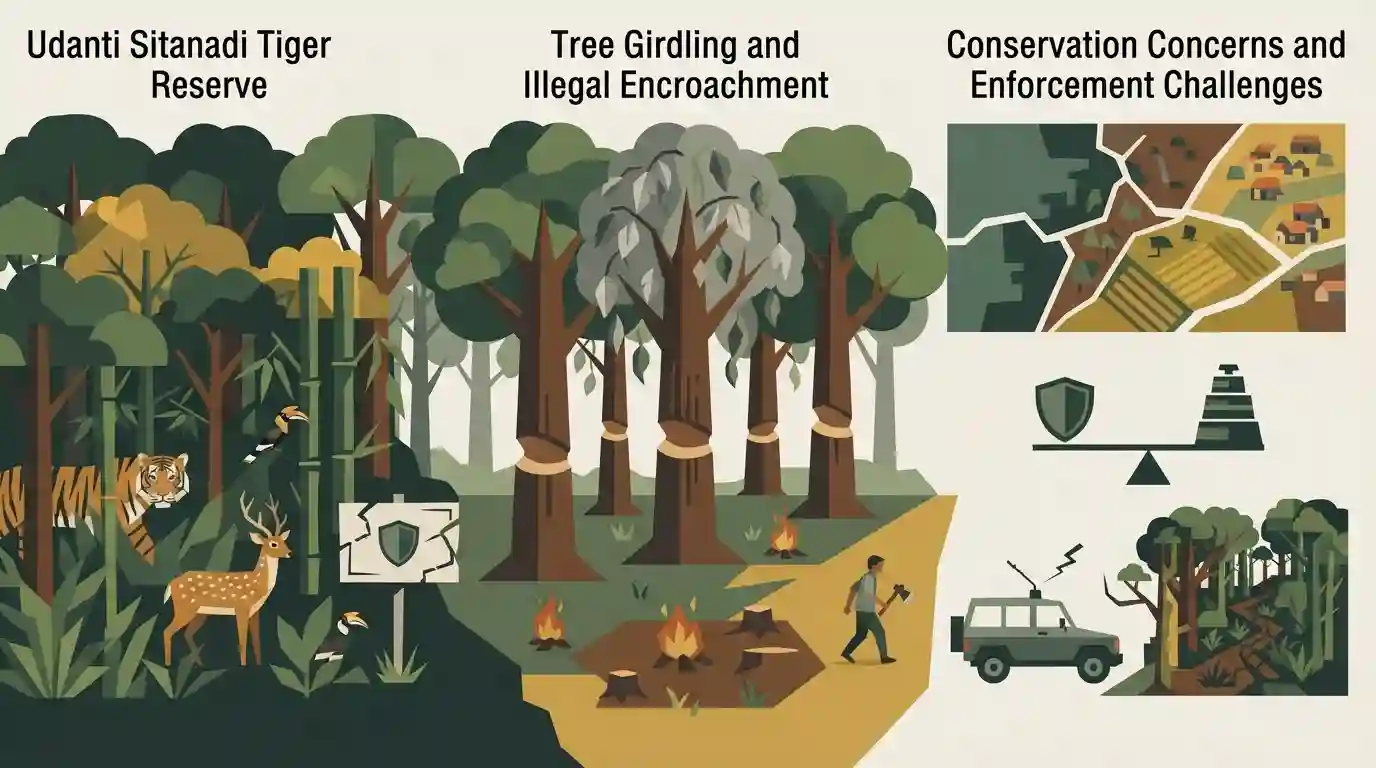
An instance of widespread tree girdling and illegal encroachment has raised serious conservation concerns in the Udanti Sitanadi Tiger Reserve of Chhattisgarh. Tree girdling—a method used to systematically kill trees—highlights ongoing pressures from land clearing, habitat degradation, and enforcement challenges in protected forest areas.
ముఖ్య అంశాలు
- Tree girdling and illegal encroachments have been reported in the Udanti Sitanadi Tiger Reserve in Chhattisgarh, threatening forest cover and wildlife habitats.
- Tree girdling involves stripping bark completely around the circumference of a tree to intentionally kill it, often used covertly to clear forest land for unauthorized farming or habitation.
- Such activities undermine the objectives of tiger conservation, fragment critical wildlife corridors, and violate provisions under the Wild Life (Protection) Act.
- Balancing strict forest protection laws with the rights and livelihoods of traditional forest dwellers remains a critical governance challenge in central Indian forest landscapes.
ప్రిలిమ్స్ ఉచ్చు
Traditional forest dwellers possess absolute rights to clear or girdle trees within core tiger reserve areas under forest conservation laws.
Aspirants often assume forest rights under FRA 2006 automatically permit commercial land-clearing or large-scale modifications like girdling inside core tiger habitats, missing the strict prohibition of non-forestry activities under the WLPA.
అనుసంధానమైన స్థిర భావనలు
What are the core legal provisions and institutional mechanisms governing Tiger Reserves in India?
- Statutory Framework:: Statutory basis established under Section 38V of the Wild Life (Protection) Amendment Act, 2006.
- Zone Classification:: Comprises core/critical tiger habitats (inviolable for eco-development) and buffer/peripheral areas (fostering coexistence).
- NTCA Role:: Statutory body under MoEFCC responsible for allocating tiger conservation funds and evaluating management effectiveness (MEE).
అంతర-అంశ నమూనాలు
Tiger Reserves and Forest Rights Act implementation
Tiger reserve encroachments directly intersect with the implementation challenges of the Forest Rights Act (FRA) 2006, testing the balance between conservation and tribal rights in central India.
Central Indian Wildlife Corridors and Fragmentation
Habitat fragmentation in the Mahanadi river basin highlights the ecological vulnerability of central Indian corridors connecting major reserves like Udanti Sitanadi and Achanakmar.

Tree girdling mechanics combined with Tiger Reserve legal protections under WLPA 1972 make a classic multi-statement prelims question.
