Chhattisgarh River Pollution and Regulatory Enforcement Failure
Source:Indian Express ↗
Why It Matters
This case serves as a prime example of the failure of statutory regulatory bodies (like State Pollution Control Boards) to enforce environmental laws, leading to severe ecological crises. It highlights the intersection of industrial pollution (GS3), governance failure and judicial intervention (GS2), and the ethical dilemma of livelihood versus environmental health and corporate malpractices (GS4).
Summary
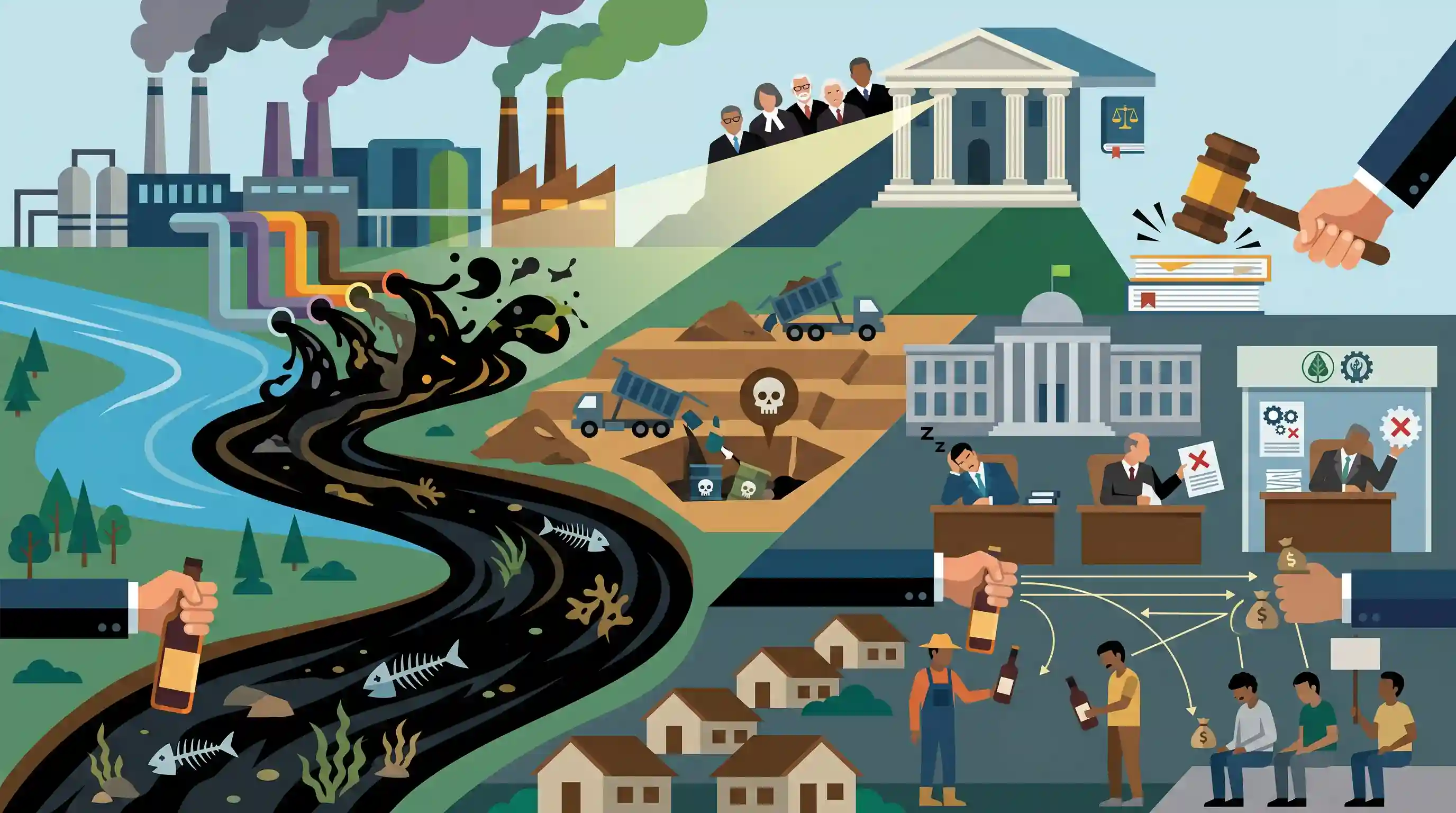
The Chhattisgarh High Court has heavily criticized the state government and the Chhattisgarh Environment Conservation Board (CECB) for their failure to prevent severe industrial pollution in the Shivnath and Kharun rivers. Taking suo motu cognizance, the Court noted that unchecked effluent discharge from factories, specifically a distillery, has turned river waters black and decimated aquatic life. Furthermore, illegal murum mining pits are being used as dumping grounds for toxic waste. The bench condemned the "systematic failure in enforcement" of environmental laws. The case also brought to light a disturbing socio-ethical concern: local communities endure the air and water pollution without protest due to their economic dependence on the polluting industries, exacerbated by the unethical distribution of free liquor to laborers to suppress dissent.
Key Points
- The Chhattisgarh High Court strongly criticized the state government and environment control board for the severe pollution of the Shivnath and Kharun rivers due to industrial effluent discharge.
- The unchecked release of toxic industrial waste, particularly from a distillery, has turned river waters black, causing mass mortality of aquatic life.
- Illegal murum mining has resulted in deep pits which are now being misused to dump untreated, toxic industrial by-products.
- The Court highlighted a 'systematic failure in enforcement' by regulatory bodies, demanding detailed affidavits from the State Secretary and CECB.
- A severe social and ethical issue was raised: local residents refrain from protesting against the factory due to their economic reliance on it for employment and the factory's unethical practice of distributing free liquor to workers.
Important Terms
Chhattisgarh Environment Conservation Board (CECB)

A statutory body established under the Water (Prevention and Control of Pollution) Act, 1974, responsible for enforcing environmental laws and monitoring industrial discharge within the state.
UPSC context
GS Paper III (Environment); relates to the effectiveness of regulatory bodies and statutory enforcement in pollution control.
Judicial Activism
The proactive role played by the judiciary in safeguarding fundamental rights and ensuring environmental protection when the executive or legislative branches fail to act effectively.
UPSC context
GS Paper II (Polity); tests the balance of power and the judiciary's expansion of the 'Right to Life' under Article 21.
Article 21
A Constitutional provision protecting the right to life and personal liberty, which the Indian judiciary has interpreted to include the right to a clean and healthy environment.
UPSC context
GS Paper II (Fundamental Rights); core concept for environmental jurisprudence and the constitutional basis for judicial intervention in pollution cases.
Systematic Failure
A chronic breakdown in administrative and regulatory enforcement where existing laws and institutional mechanisms fail to prevent ongoing legal or environmental violations.
UPSC context
GS Paper II (Governance); highlights issues in administrative accountability and the gap between policy formulation and ground-level implementation.
Suo Motu Cognizance
A legal power allowing courts to take up a case on their own motion without a formal petition, often used to address urgent public interest issues.
UPSC context
GS Paper II (Judiciary); demonstrates the court's role as a guardian of the Constitution and its power to initiate public interest litigation.
Welcome Distilleries Pvt Ltd
One of the key industrial respondents in the Chhattisgarh river pollution case, alleged to have discharged untreated toxic effluents, highlighting challenges in corporate environmental compliance.
UPSC context
GS Paper III (Environment) & GS Paper IV (Ethics); serves as a case study for industrial pollution and corporate social responsibility (CSR) failures.
Prelims Trap
"Shivnath and Kharun rivers are key right-bank tributaries of the Godavari river system flowing through Chhattisgarh."
Shivnath is actually the longest tributary of the Mahanadi River, not Godavari. Kharun is a tributary of the Shivnath. UPSC frequently swaps central Indian river basins to test geographic precision.
Static Concepts Connected
What are the principal tributaries of the Mahanadi river system?
- Left-bank tributaries: Seonath (Shivnath), Hasdeo, Mand, and Ib. The Shivnath is the longest tributary, joining the Mahanadi in Chhattisgarh.
- Right-bank tributaries: Ong, Tel, and Jonk rivers join the Mahanadi from the right bank before it enters the Bay of Bengal.
What is the statutory basis of State Pollution Control Boards (SPCBs)?
- Water Act 1974: SPCBs are primarily constituted under the Water (Prevention and Control of Pollution) Act, 1974, not the Environment (Protection) Act.
- Expanded powers: They were later entrusted with additional functions and powers under the Air (Prevention and Control of Pollution) Act, 1981.
Cross-Topic Patterns
Article 21 vs. Livelihood dependency
The ethical dilemma where marginalized communities accept extreme pollution for wages is a classic GS4 case study theme involving corporate ethics, governance, and basic human rights.
Mining pits as toxic sinks
Links illegal minor mineral extraction (murum/sand) to severe groundwater and riverine pollution, creating secondary environmental hazards that bypass standard industrial effluent tracking.

Expect a 2026 Prelims pair-matching question on Mahanadi tributaries (Shivnath, Hasdeo) or a GS4 case study on pollution vs livelihood.
Linked PYQs · 4
Linked PYQs · 4
- 2024MainsGS3
Industrial pollution of river water is a significant environmental issue in India. Discuss the various mitigation measures to deal with this problem and also the government's initiatives in this regard.
- 2025MainsGS3
Mineral resources are fundamental to the country's economy and these are exploited by mining. Why is mining considered an environmental hazard? Explain the remedial measures required to reduce the environmental hazard due to mining.
- 2018MainsGS2
“Policy contradictions among various competing sectors and stakeholders have resulted in inadequate 'protection and prevention of degradation' to environment.” Comment with relevant illustrations.
- 2024MainsGS4
Global warming and climate change are the outcomes of human greed in the name of development, indicating the direction in which extinction of organisms including human beings is heading towards loss of life on Earth. How do you put an end to this to protect life and bring equilibrium between the society and the environment?
