Surrender policies and elimination timelines for Left Wing Extremism
Source:The Hindu ↗
Why It Matters
The event serves as a concrete case study for UPSC aspirants on how effective surrender and rehabilitation policies, combined with state communication, can neutralise Left Wing Extremism (LWE). It also highlights the Union government's target to eliminate Naxalism by March 2026, relevant for internal security and governance answers.
Summary
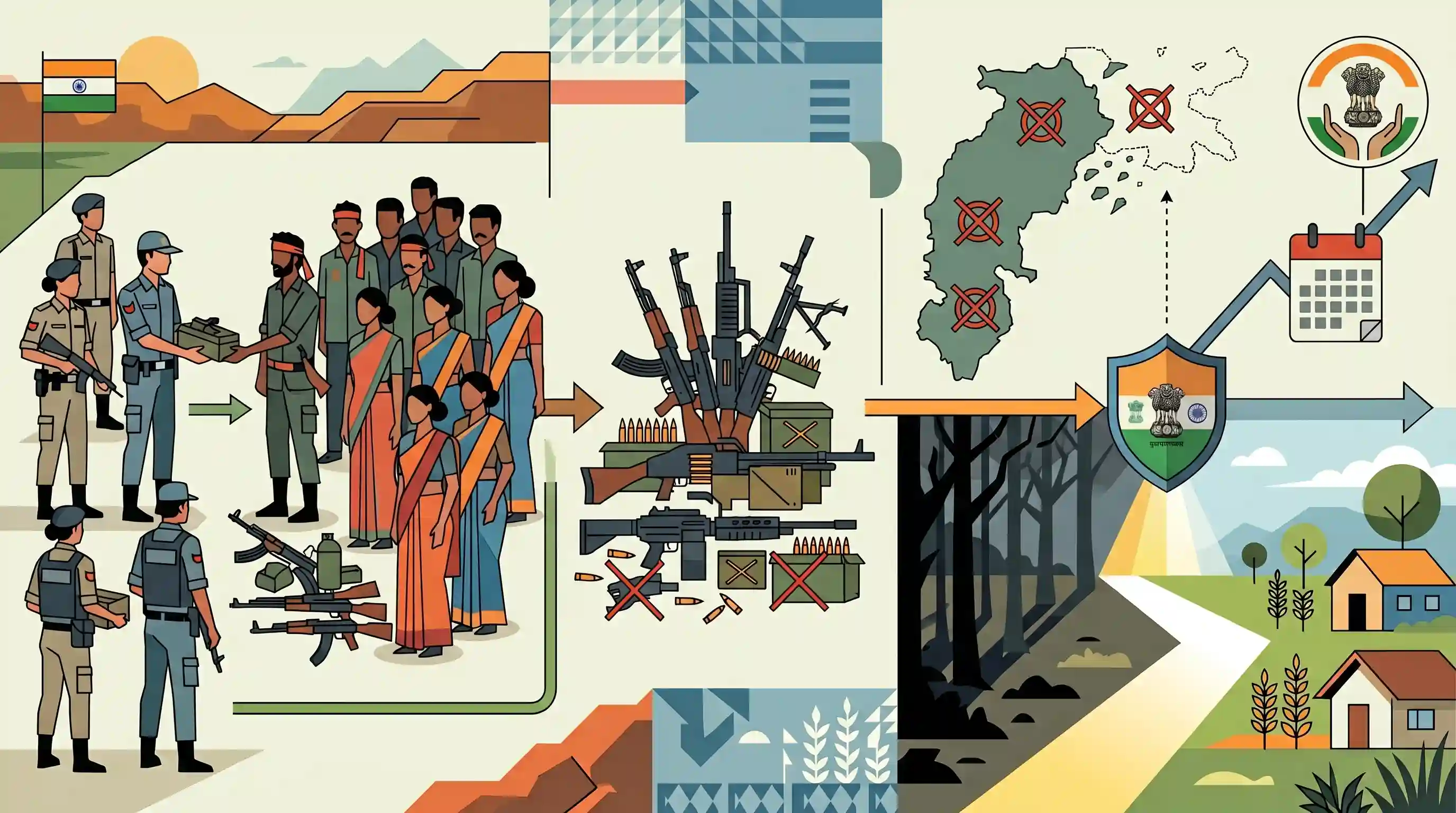
Fifteen Naxalite cadres, including senior leader Vikas and nine women, surrendered to security personnel in Mahasamund district, Chhattisgarh. The cadres, who belonged to the Balangir-Bargarh-Mahasamund (BBM) division of the CPI (Maoists), also deposited a large cache of sophisticated weapons. Deputy Chief Minister Vijay Sharma stated that this development effectively wiped out the BBM division, as the surrendered cadres were its last remaining members. The surrender was facilitated by government assurances under the state's rehabilitation policy. This aligns with the Centre's broader internal security goal of eliminating Naxalism from India by March 31, 2026.
Key Points
- 15 Naxalites, including senior Special Zonal Committee-level member Vikas and nine women, surrendered in Chhattisgarh's Mahasamund district.
- This surrender effectively neutralised the Balangir-Bargarh-Mahasamund (BBM) division of the CPI (Maoists) operating along the Chhattisgarh-Odisha border, as these were the last 15 members of the division.
- The surrender followed written correspondence from Vikas seeking safety assurances, which was addressed through an audio message by Deputy CM Vijay Sharma assuring support under the state's rehabilitation framework.
- The Central government has set a target of completely eliminating Naxalism from the country by March 31, 2026.
Important Terms
Left Wing Extremism (LWE)

An armed Maoist insurgency seeking to overthrow the Indian government through violent rebellion. It typically exploits socio-economic grievances and land alienation in remote tribal and rural areas.
UPSC context
GS Paper III: Internal Security. Tests awareness of non-state actors, their origins, and the multifaceted government response (security vs. development).
CPI (Maoist)
A banned far-left militant organization formed in 2004 through the merger of major Naxalite factions. It is designated as a terrorist organization under the Unlawful Activities (Prevention) Act.
UPSC context
GS Paper III: Internal Security. Crucial for understanding specific extremist groups and the legal frameworks (UAPA) used to combat them.
Surrender and Rehabilitation Policy
A state-led framework providing financial aid, vocational training, and legal leniency to encourage insurgents to renounce violence. Chhattisgarh’s 2025 policy includes stipends and housing to facilitate mainstreaming.
UPSC context
GS Paper III: Internal Security. Evaluates the efficacy of non-military 'soft power' measures in resolving long-standing internal conflicts.
Balangir-Bargarh-Mahasamund (BBM) Division
A specific tactical unit of the CPI (Maoist) operating along the Odisha-Chhattisgarh border. Its dismantling is a strategic victory that renders districts like Balangir and Bargarh 'Naxal-free'.
UPSC context
GS Paper III: Internal Security / GS Paper I: Geography. Relates to regional security dynamics and the significance of border-crossing insurgent corridors.
Protracted People’s War
The Maoist military doctrine of surrounding urban centers from rural strongholds through a long-term armed struggle. It aims to deplete state resources and build 'liberated zones'.
UPSC context
GS Paper III: Internal Security. Tests the candidate's depth in understanding the ideological and tactical strategies of Maoist insurgencies.
Red Corridor
A geographic region in central and eastern India, characterized by high levels of LWE activity and socio-economic underdevelopment. It spans states like Chhattisgarh, Jharkhand, Odisha, and Maharashtra.
UPSC context
GS Paper III: Internal Security. A staple term for identifying the spatial concentration of Naxalism and related developmental challenges.
Prelims Trap
The Central Government directly implements and administers the Surrender and Rehabilitation Policy for LWE cadres.
Police and Public Order are State subjects. The Centre provides guidelines and financial reimbursement (via the SRE scheme), but states implement the actual surrender policies.
Static Concepts Connected
What are the core pillars of the SAMADHAN doctrine for tackling LWE?
- S-A-M: Smart Leadership, Aggressive Strategy, Motivation and Training. These form the action-oriented and tactical pillars on the ground.
- A-D-H: Actionable Intelligence, Dashboard Based KPIs, Harnessing Technology. These focus on intelligence networks and technological supremacy.
- A-N: Action plan for each theatre, No access to financing. These focus on localized operational plans and squeezing the economic lifeblood of the insurgency.
How does the Surrender-cum-Rehabilitation policy function for LWE cadres?
- Financial Aid: Surrenderees receive an immediate grant (e.g., ₹5 lakh for higher ranks) kept in a fixed deposit, plus a monthly stipend for 3 years during vocational training.
- Weapon Incentive: Additional monetary incentives are provided for surrendering specific weapons (e.g., AK-47, LMGs) to encourage disarming the ecosystem.
- SRE Scheme Funding: Costs incurred by state governments are reimbursed by the Central Government under the Security Related Expenditure (SRE) scheme.
Cross-Topic Patterns
Feminisation of LWE cadres
With 9 of 15 surrendered cadres being women, the intersection of tribal poverty, caste atrocities, and insurgency underscores the need for gender-sensitive rehabilitation (linking GS1 Society with GS3 Security).
LWE and Aspirational Districts
The Centre's strategy to transform "Red Zones" into "Growth Corridors" maps directly onto the Aspirational Districts Programme, merging kinetic security operations with socio-economic developmental metrics.

The Centre's explicit March 2026 deadline for eradicating LWE makes SAMADHAN and border-state security coordination a prime 2026 target.
Linked PYQs · 2
Linked PYQs · 2
- 2022MainsGS3
Naxalism is a social, economic and developmental issue manifesting as a violent internal security threat. In this context, discuss the emerging issues and suggest a multilayered strategy to tackle the menace of Naxalism.
- 2018MainsGS3
Left Wing Extremism (LWE) is showing a downward trend, but still affects many parts of the country. Briefly explain the Government of India's approach to counter the challenges posed by LWE.
