Vedanta plant boiler blast in Chhattisgarh causes 21 fatalities
Source:Indian Express ↗
Why It Matters
This tragedy underscores the persistent challenges in enforcing industrial safety regulations and occupational health standards in India. It highlights issues pertinent to GS-3 (Disaster Management, Industrial Policies, Labour Reforms) and GS-4 (Corporate Ethics, Professional Accountability).
Summary
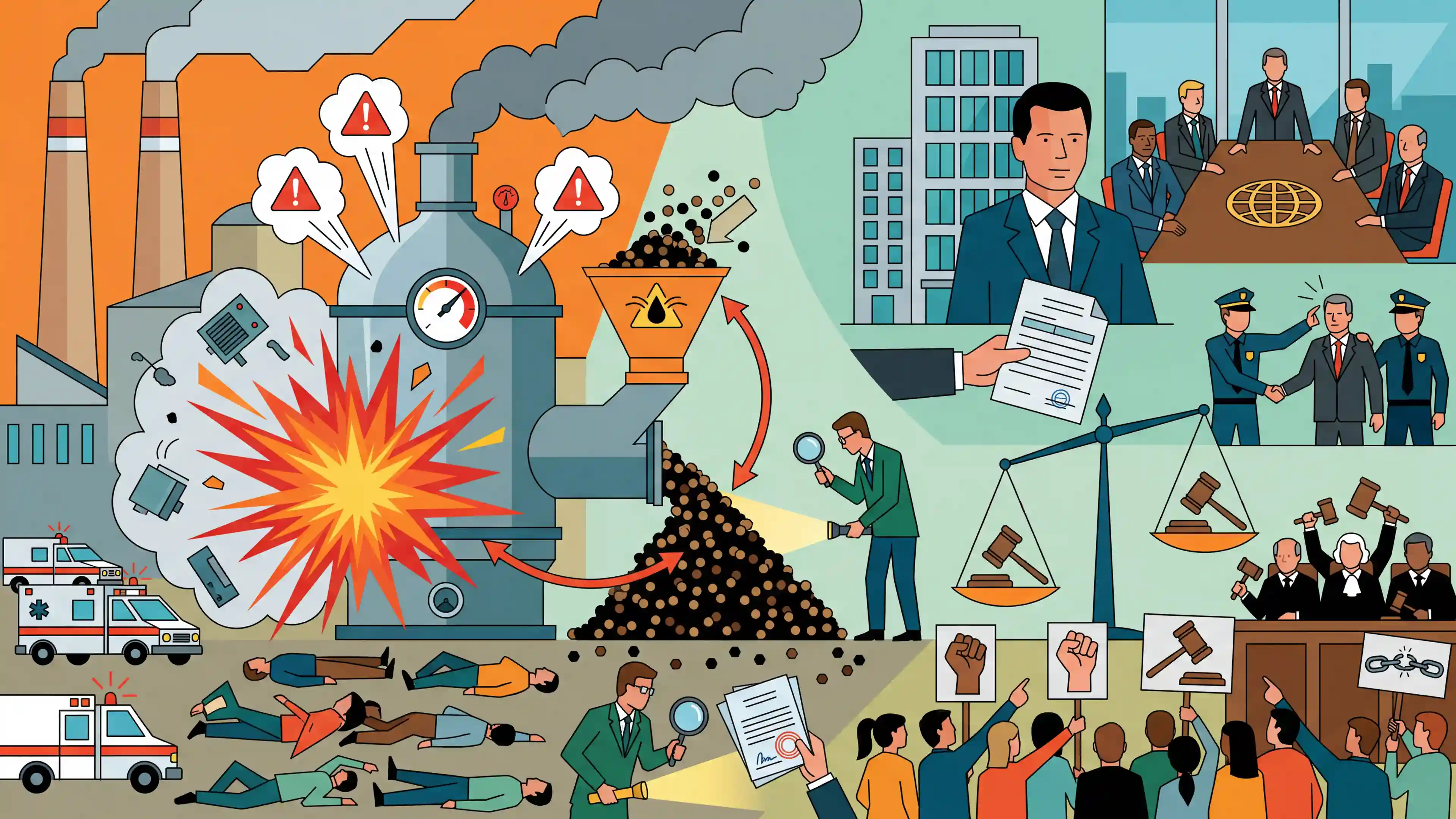
The death toll from a boiler explosion at a Vedanta Ltd power plant in Chhattisgarh's Sakti district has risen to 21. A preliminary investigation revealed that excessive fuel accumulation in the furnace led to an extreme pressure build-up, triggering the blast. An FIR has been filed under the Bharatiya Nyaya Sanhita (BNS) for death by negligence against Vedanta executives, including director Anil Agarwal. However, the Opposition is demanding a judicial probe and the invocation of culpable homicide charges, highlighting severe lapses in industrial safety and corporate accountability.
Key Points
- A boiler explosion at a Vedanta Ltd power plant in Chhattisgarh's Sakti district has resulted in 21 fatalities.
- A preliminary technical report attributed the blast to extreme pressure caused by the excessive accumulation of fuel in the furnace.
- An FIR was registered under Section 106 (1) of the Bharatiya Nyaya Sanhita (BNS) for causing death by negligence against Vedanta officials, including director Anil Agarwal.
- Opposition leaders are demanding a judicial inquiry and pushing for culpable homicide charges against the company's top management.
- The incident raises serious concerns about corporate accountability, adherence to industrial safety standards, and occupational hazard management.
Important Terms
Bharatiya Nyaya Sanhita (BNS)

The comprehensive penal code that replaced the Indian Penal Code (IPC) on July 1, 2024, to modernize India's criminal justice system.
UPSC context
GS-II (Polity/Laws); essential for questions on legal reforms and the transition from colonial-era codes.
Culpable Homicide (Section 105, BNS)
Causing death with the intention or knowledge that the act is likely to cause death, but without the specific premeditation of murder.
UPSC context
GS-II (Judiciary); tests ability to distinguish between varying degrees of criminal intent and culpability.
Death by Negligence (Section 106, BNS)
An offence under BNS where death results from a rash or negligent act. Punishment was increased to five years from the IPC's two years.
UPSC context
GS-II (Polity); relevant for discussions on industrial accountability and recent changes in punitive measures.
Absolute Liability
A legal doctrine established in M.C. Mehta v. Union of India making industries strictly liable for hazardous accidents regardless of whether negligence occurred.
UPSC context
GS-II/III (Law/Environment); critical for questions on judicial activism and corporate accountability in industrial disasters.
Factories Act, 1948
Social legislation regulating labor and safety in manufacturing units, mandating specific health, safety, and welfare measures for industrial workers.
UPSC context
GS-II/III (Labor Laws/Safety); tests knowledge of the statutory framework governing industrial safety and worker rights.
Industrial Disaster Management
A systematic process of planning and response to man-made accidents, focusing on mitigation, preparedness, and fixing corporate or regulatory accountability.
UPSC context
GS-III (Disaster Management); frequently tested via case studies on safety lapses and emergency response frameworks.
Prelims Trap
Companies can use 'Act of God' as a defense in fatal industrial explosions under strict liability.
India follows the 'Absolute Liability' principle for hazardous industries (M.C. Mehta case), which entirely strips away defenses like 'Act of God' or third-party sabotage.
Static Concepts Connected
What is the principle of Absolute Liability?
- Origin: Evolved by the Supreme Court in the M.C. Mehta (Oleum Gas Leak) case, moving beyond the British strict liability rule.
- Core Rule: Enterprises engaged in inherently hazardous activities are absolutely liable for resulting harm.
- No Defenses: Companies cannot claim 'Act of God' or third-party negligence to escape liability for industrial disasters.
How does the OSH Code 2020 regulate workplace safety?
- Consolidation: It subsumes 13 central labour laws, including the Factories Act of 1948, to create a unified statutory framework.
- Advisory Board: Establishes a National Occupational Safety and Health Advisory Board to guide the government on policy.
- Employer Duties: Mandates employers to provide a hazard-free workplace and free annual health check-ups for employees.
Cross-Topic Patterns
Corporate Liability & Article 21
Industrial accidents repeatedly test India's absolute liability doctrine, linking corporate governance and OSH Code directly to the fundamental right to life (Article 21).
Ethics: Profit vs. Moral Integrity
Accidents stemming from equipment neglect highlight the GS4 ethical tension between professional efficiency (corporate cost-cutting) and moral integrity (prioritizing human life and safety).

GS3 Mains may test the adequacy of India's OSH Code 2020 versus recurrent industrial disasters and corporate accountability frameworks.
Linked PYQs · 5
Linked PYQs · 5
- 2024MainsGS3
Discuss the merits and demerits of the four 'Labour Codes' in the context of labour market reforms in India. What has been the progress so far in this regard?
- 2019MainsGS3
Vulnerability is an essential element for defining disaster impacts and its threat to people. How and in what ways can vulnerability to disasters be characterized? Discuss different types of vulnerability with reference to disasters.
- 2024MainsGS3
What is disaster resilience? How is it determined? Describe various elements of a resilience framework. Also mention the global targets of Sendai Framework for Disaster Risk Reduction (2015–2030).
- 2024MainsGS4
“Ethics encompasses several key dimensions that are crucial in guiding individuals and organizations towards morally responsible behaviour.” Explain the key dimensions of ethics that influence human actions. Discuss how these dimensions shape ethical decision-making in the professional context.
- 2025MainsGS4
It is said that for an ethical work culture, there must be code of ethics in place in every organisation. To ensure value-based and compliance-based work culture, what suitable measures would you adopt in your work place?
