Chennai outlines vision for deep tech cluster and climate resilience
Source:The Hindu ↗
Why It Matters
The article provides a practical case study of how Indian megacities are incorporating climate resilience, green mobility, and disaster management into long-term urban planning. This directly maps to UPSC syllabus themes on urban flooding, infrastructure investment, and smart city strategies.
Summary
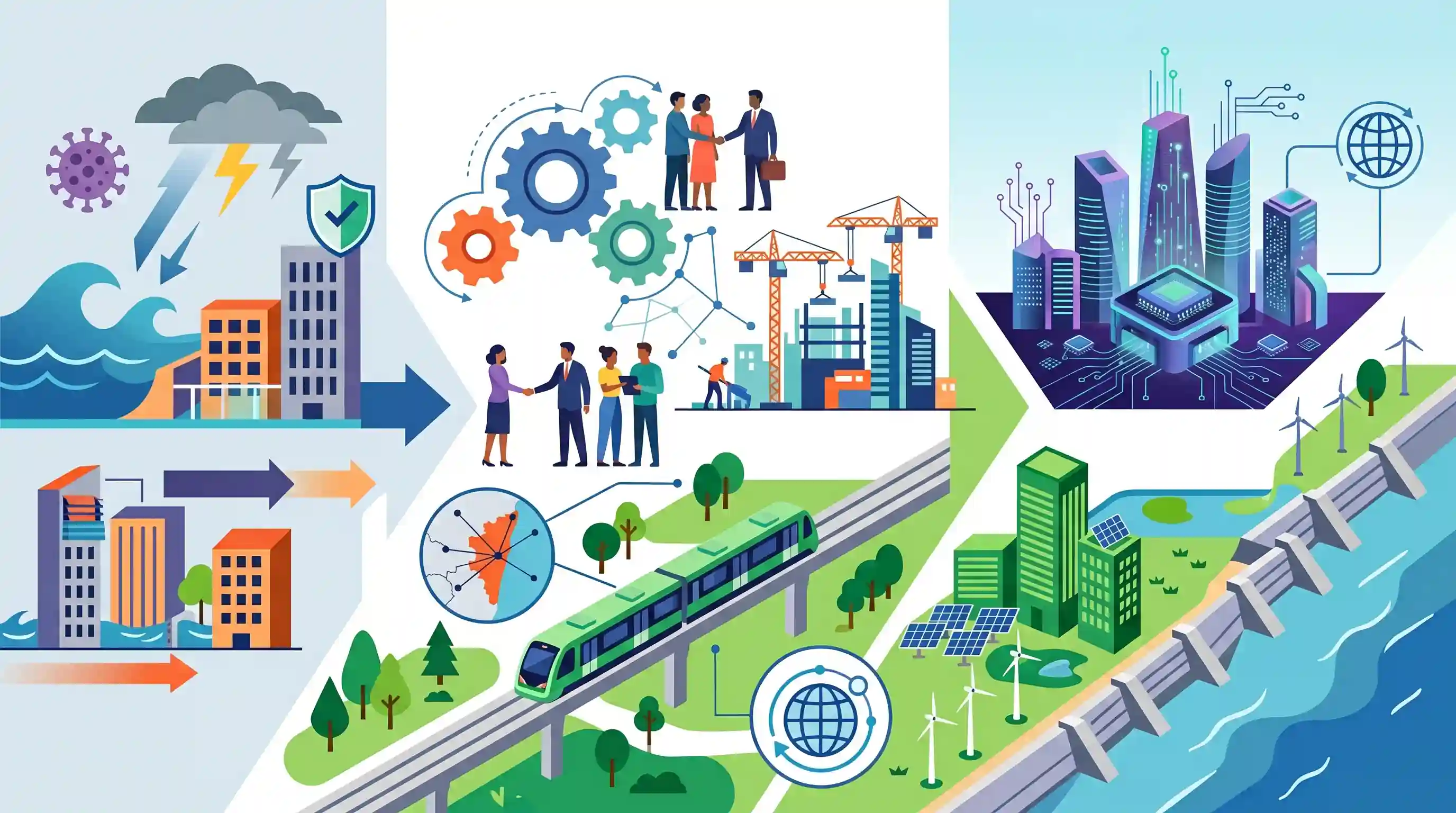
Speaking at the Super Chennai Conclave, TNEB Chairman J. Radhakrishnan outlined a vision for Chennai to evolve into a global deep-tech cluster and a resilient coastal city by 2040. He emphasized the necessity of speed, scale, and shared purpose in urban planning, citing the city's proven resilience against floods, cyclones, and the pandemic. The strategy involves robust infrastructure development, including the expansion of green mobility through the Chennai Metro, alongside regional integration with neighboring districts. The 'Super Chennai' initiative by CREDAI further underscores the role of citizen and private sector collaboration in achieving these climate resilience and urban development goals.
Key Points
- Chennai is projected to become a global deep-tech cluster, a model coastal city for climate resilience, and a healthcare capital by 2040.
- TNEB Chairman J. Radhakrishnan highlighted the city's resilience against climate-induced disasters like floods and cyclones, emphasizing that disaster resilience is Chennai's defining identity.
- Future urban planning will prioritize integrated green mobility, reliable infrastructure (such as CMRL), and assured power to boost the liveability index.
- The holistic development model demands regional alignment, extending beyond Chennai to neighboring districts like Kancheepuram and Chengalpattu, with collaboration across government, private sectors, and citizen groups.
- The citizen-driven 'Super Chennai' initiative by CREDAI aims to foster collaborative efforts to make Chennai a future-ready global city.
Important Terms
Deep-tech Cluster

A geographical concentration of enterprises developing advanced science-based solutions (e.g., AI, biotech) requiring high-risk R&D and long gestation periods.
UPSC context
GS Paper 3: Science and Technology and Economy; tests knowledge of India's startup ecosystem and industrial policy.
Climate Resilience
The ability of urban systems and infrastructure to withstand, recover from, and adapt to climate-related shocks like sea-level rise and cyclones.
UPSC context
GS Paper 3: Environment and Disaster Management; critical for coastal urban planning and sustainable development goals.
Urban Flooding
Inundation of built-up areas caused by heavy rainfall overwhelming drainage systems, often exacerbated by unplanned construction and wetland encroachment.
UPSC context
GS Paper 3: Disaster Management; tests analysis of urban planning failures and disaster mitigation strategies.
Super Chennai
A citizen-driven initiative by CREDAI aimed at transforming Chennai into a globally competitive, resilient, and livable city by 2040.
UPSC context
GS Paper 2: Governance; relevant for studying participatory urban governance and public-private partnerships.
CREDAI
The apex body of private Real Estate developers in India; the Chennai chapter drives local infrastructure and urban development collaboration.
UPSC context
GS Paper 1 & 3: Urbanization and Infrastructure; relevant for private sector involvement in housing and urban missions.
Green Mobility
Sustainable transportation solutions, such as Metro networks and electric vehicles, designed to reduce carbon footprints and urban congestion.
UPSC context
GS Paper 3: Infrastructure and Climate Change; focuses on sustainable transport and carbon mitigation strategies.
Prelims Trap
Deep tech startups primarily focus on service delivery platforms and digital e-commerce aggregation models.
Deep Tech specifically requires tangible scientific discoveries or engineering innovations (like robotics or quantum tech). General software-as-a-service or e-commerce aggregators do not qualify.
Static Concepts Connected
What are the key strategies for mitigating urban flooding in coastal cities?
- Sponge City approach: Developing permeable pavements, restoring wetlands, and integrating green roofs to naturally absorb rainwater rather than channel it away.
- Regional alignment: Planning that integrates the core city with peri-urban districts to prevent uncoordinated sprawl from blocking natural drainage channels.
- Structural balance: Combining physical infrastructure (like stormwater drains) with early warning systems, floodplain zoning, and community-level disaster preparedness.
What characterizes a 'Deep Tech' ecosystem under India's framework?
- Fundamental innovation: They are built on significant scientific advances or engineering innovations, requiring high R&D capabilities.
- High gestation period: They feature a longer time-to-market and demand substantial, patient capital compared to traditional software models.
- IP-driven growth: They are heavily reliant on generating, protecting, and commercializing novel intellectual property (patents).
Cross-Topic Patterns
Urban flooding + Peri-urban sprawl
Coastal flooding is increasingly linked not just to extreme rainfall, but to uncoordinated peri-urban expansion that blindly encroaches on natural drainage basins, wetlands, and floodplains.
Deep tech driving climate resilience
The pivot toward deep-tech clusters inherently supports climate resilience, as these hubs drive innovations in advanced materials, predictive AI for disaster warnings, and smart grid optimization.

Peri-urban sprawl + urban flooding in coastal megacities is a highly probable integrated GS1/GS3 mains linkage for 2026.
Linked PYQs · 5
Linked PYQs · 5
- 2024MainsGS3
Flooding in urban areas is an emerging climate-induced disaster. Discuss the causes of this disaster. Mention the features of two such major floods in the last two decades in India. Describe the policies and frameworks in India that aim at tackling such floods.
- 2024MainsGS3
What is disaster resilience? How is it determined? Describe various elements of a resilience framework. Also mention the global targets of Sendai Framework for Disaster Risk Reduction (2015–2030).
- 2020MainsGS1
Account for the huge flooding of million cities in India including the smart ones like Hyderabad and Pune. Suggest lasting remedial measures.
- 2016MainsGS1
With a brief background of quality of urban life in India, introduce the objectives and strategy of the 'Smart City Programme'.
- 2021MainsGS3
“Investment in infrastructure is essential for more rapid and inclusive economic growth.” Discuss in the light of India's experience.
