Chennai urban floods and delayed mitigation infrastructure challenges
Source:The Hindu ↗
Why It Matters
The article serves as a practical case study for GS3 Disaster Management and Environment, highlighting the real-world consequences of floodplain encroachment and delayed infrastructural upgrades on urban flooding. It also touches upon GS2 Governance by illustrating the responsibilities and challenges of urban local bodies in managing disaster preparedness and civic amenities.
Summary
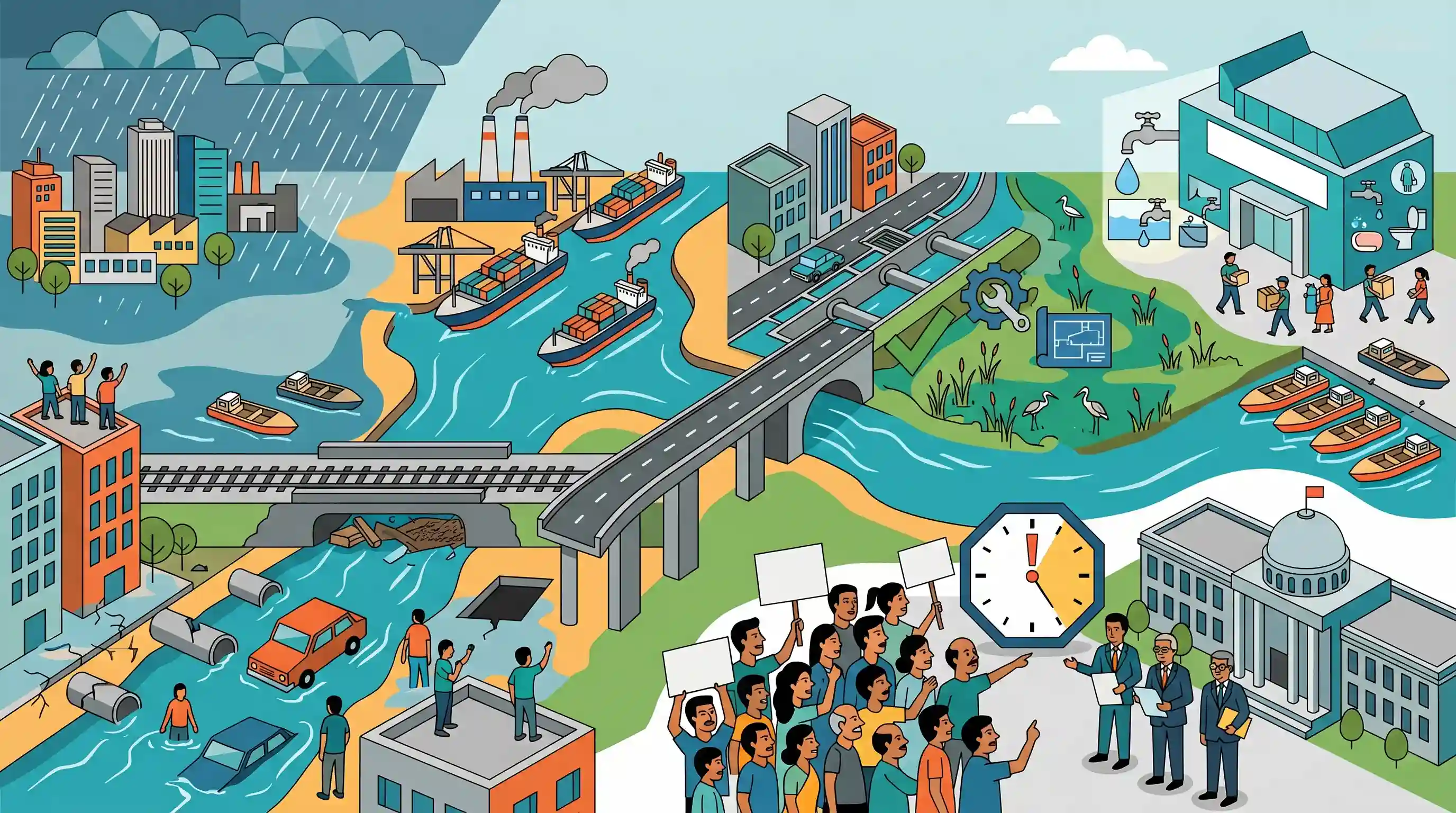
Residents of Chennai are raising alarms over the sluggish pace of flood mitigation projects being executed by the Greater Chennai Corporation (GCC) and other civic bodies. Despite the deployment of heavy-duty pumps and the preparation of relief centres, critical infrastructural works—such as the construction of storm-water drains, railway culverts, and elevated roads near vulnerable areas like the Pallikaranai marshland—remain incomplete. Furthermore, massive industrial and port encroachments on the Kosasthalaiyar floodplain have worsened the city's flood risks. Citizens are urging the authorities to expedite these projects, provide sufficient boats for emergency evacuations, and ensure adequate sanitation facilities at relief centres to better prepare for upcoming monsoons.
Key Points
- Chennai residents expressed concerns regarding the delay by the Greater Chennai Corporation (GCC) and the Highways Department in completing critical flood mitigation projects, such as elevated roads and storm-water drains.
- Incomplete infrastructure projects, including drainage works in Muthamizh Nagar and railway culverts in Korattur, elevate the risk of urban flooding.
- Encroachments by port, power plant, and industrial facilities across 8,000 acres of the Kosasthalaiyar floodplain have significantly exacerbated the city's vulnerability to inundation.
- While civic agencies have installed heavy-duty pumps and set up relief centres, residents demand an adequate supply of boats for emergency evacuations and improved amenities, such as toilets, at relief camps.
Important Terms
Urban Flooding

The inundation of property in built-up environments caused by rainfall overwhelming drainage systems, exacerbated by unplanned urbanization and loss of natural sinks.
UPSC context
GS Paper 3: Disaster Management; critical for questions on climate-induced disasters and urban resilience.
Greater Chennai Corporation (GCC)
The oldest municipal institution in India (est. 1688) responsible for Chennai's civic infrastructure, including roads, sanitation, and flood mitigation projects.
UPSC context
GS Paper 2: Local Governance; relevant for Urban Local Bodies (ULBs) and decentralization.
Pallikaranai Marshland
A critical freshwater marsh and designated Ramsar site in Chennai that serves as a natural flood buffer and biodiversity hotspot.
UPSC context
GS Paper 3: Environment/Conservation; important for wetland protection and ecosystem-based disaster risk reduction.
Kosasthalaiyar River
A major river in northern Chennai with a basin highly prone to flooding, currently the focus of ADB-funded integrated flood management projects.
UPSC context
GS Paper 3: Disaster Management; specific case study for climate-resilient infrastructure and river basin management.
Storm-water Drains (SWD)
Infrastructure designed to divert rainwater from impervious surfaces; Indian cities often face challenges with outdated design norms and siltation.
UPSC context
GS Paper 3: Urbanization/Infrastructure; tests knowledge of urban planning failures and technical mitigation strategies.
Floodplain Encroachment
The occupation of low-lying areas adjacent to water bodies by infrastructure or housing, which restricts natural flow and elevates flood risks.
UPSC context
GS Paper 1 & 3: Urbanization/Disaster Management; focuses on land-use policy and causes of human-made disasters.
Prelims Trap
NDMA classifies urban flooding as a sub-category of riverine flooding, utilizing the same mitigation guidelines.
NDMA recognized Urban Flooding as a distinct disaster in 2010 because its causes (impervious urban surfaces, overwhelmed drains) differ fundamentally from riverine overflows.
Static Concepts Connected
What is the ecological role of the Pallikaranai marshland in Chennai?
- Urban Sponge: It acts as a critical natural buffer that absorbs excess stormwater runoff, thereby mitigating peak flood levels in the highly impervious Chennai metropolitan area.
- Ramsar Site: Designated as a Ramsar Wetland of International Importance, preserving its hydrology is globally recognized as vital for the region's climate resilience and biodiversity.
How do the NDMA Guidelines address Urban Flooding?
- Distinct Disaster: In 2010, NDMA delinked urban flooding from riverine flooding, treating it as a separate, primarily human-made disaster that requires customized, localized mitigation.
- Watershed Approach: NDMA mandates that drainage systems and urban planning be based on natural watersheds rather than artificial municipal or administrative boundaries.
- Protection of Sinks: The guidelines emphasize protecting and desilting natural sinks (lakes, wetlands) to maintain the city's natural flood-carrying and absorption capacity.
Cross-Topic Patterns
74th CAA & Urban Disaster Resilience
Weak devolution of funds and functions to Urban Local Bodies (ULBs) directly cripples pre-monsoon desilting and infrastructural execution, exacerbating flood risks.
Ramsar Sites as Urban Sinks
Encroachment of wetlands like Pallikaranai links static geography topics to GS3 disaster management, highlighting how lost natural 'sponges' amplify man-made flooding.

Expect a 2026 GS3 question integrating wetland encroachment (e.g., Pallikaranai) and 74th CAA ULB funding deficits into urban flood crises.
Linked PYQs · 3
Linked PYQs · 3
- 2024MainsGS3
Flooding in urban areas is an emerging climate-induced disaster. Discuss the causes of this disaster. Mention the features of two such major floods in the last two decades in India. Describe the policies and frameworks in India that aim at tackling such floods.
- 2018MainsGS3
What is wetland? Explain the Ramsar concept of 'wise use' in the context of wetland conservation. Cite two examples of Ramsar sites from India.
- 2024MainsGS2
Analyse the role of local bodies in providing good governance at local level and bring out the pros and cons merging the rural local bodies with the urban local bodies.
