Chennai City Biodiversity Index Reveals Urban Governance Deficits
Source:The Hindu ↗
Why It Matters
Provides a tangible case study of how Indian megacities are evaluated using global standards like the Singapore Index. It underscores the recurring GS3 themes of urban environmental degradation, the vital role of wetlands (like Ramsar sites) in urban resilience, and the governance deficits driving vulnerability to climate change and disasters.
Summary
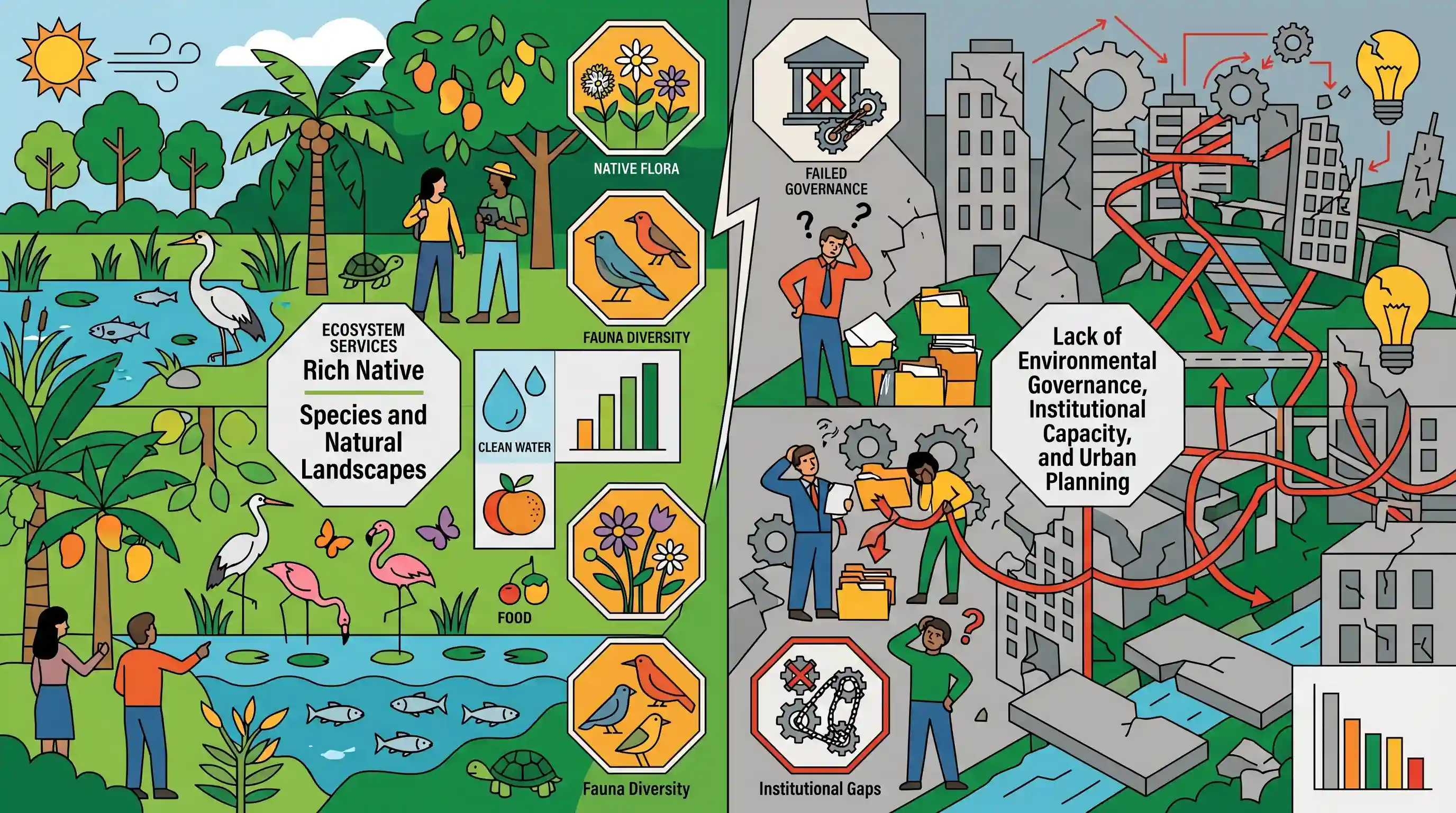
Chennai’s first City Biodiversity Index (Singapore Index) assessment revealed that despite harbouring rich native species and natural landscapes, the city suffers from a severe lack of environmental governance, institutional capacity, and urban planning integration.
Key Points
- Chennai scored 38/72 on its first City Biodiversity Index (CBI), performing well on native biodiversity metrics in ecologically rich patches like Guindy National Park and Pallikaranai Marsh.
- The city scored critically low on biodiversity governance and management, lacking a Local Biodiversity Strategy and Action Plan, explicit biodiversity projects, and an adequate conservation budget.
- Only 5.02% of the city's land area is under legal protection, with pressing threats to wetlands from encroachment, solid waste, sewage, and invasive alien species.
- Officials stressed the need for a paradigm shift from a 'Nature in City' model to a 'City in Nature' approach, mainstreaming biodiversity into routine urban planning across all state departments.
Important Terms
City Biodiversity Index (Singapore Index)

A self-assessment tool for cities to monitor biodiversity conservation against their own baselines, using 23 indicators across native biodiversity, ecosystem services, and governance. Developed by Singapore with the CBD.
UPSC context
GS Paper 3: Environment. Relevant for urban planning, sustainability metrics, and localized conservation efforts under global frameworks like the CBD.
Convention on Biological Diversity (CBD)
A legally binding multilateral treaty (1992 Earth Summit) with three goals: biodiversity conservation, sustainable use of its components, and fair sharing of benefits from genetic resources.
UPSC context
GS Paper 3: Environment. A core international agreement; tests knowledge on global targets (like Kunming-Montreal) and India's Biological Diversity Act.
Ramsar Convention
An intergovernmental treaty (1971) focused on the conservation and 'wise use' of wetlands. It emphasizes maintenance of ecological character through international cooperation and national action.
UPSC context
GS Paper 3: Environment & Ecology. High-yield topic regarding wetland protection, groundwater recharge, and specific Indian sites (e.g., Pallikaranai).
ICLEI South Asia
A regional network of local governments committed to sustainable development. It provides technical assistance to Indian cities to implement tools like the City Biodiversity Index and Action Plans.
UPSC context
GS Paper 2 & 3: Governance and Environment. Demonstrates the role of international NGOs and municipal cooperation in urban resilience.
Ecosystem Services
Direct and indirect contributions of ecosystems to human well-being, including provisioning (food/water), regulating (climate/floods), supporting (nutrient cycling), and cultural (recreation) benefits.
UPSC context
GS Paper 3: Environment. Essential for understanding the economic valuation of nature and the benefits of urban green-blue infrastructure.
Greater Chennai Corporation (GCC)
The municipal body responsible for Chennai's administration. It leads local urban planning, infrastructure, and green initiatives like 'sponge parks' and city-level biodiversity assessments.
UPSC context
GS Paper 2: Governance. Illustrates the role of Urban Local Bodies (ULBs) in environmental management post-74th Amendment Act.
Tamil Nadu Forest Department
The state agency managing Tamil Nadu's forests and wildlife. It executes urban forest projects (Nagar Van Yojana) and missions to increase green cover outside traditional forests.
UPSC context
GS Paper 3: Environment. Key for state-level conservation initiatives, afforestation schemes, and public-private-local body partnerships.
Prelims Trap
The Singapore Index is a legally binding urban mandate under the Kunming-Montreal Global Biodiversity Framework.
It is a voluntary self-assessment tool developed by Singapore and the CBD Secretariat, not a legally binding UN mandate.
Static Concepts Connected
What is the Singapore Index on Cities' Biodiversity?
- Origin: Developed by Singapore National Parks Board in collaboration with the Secretariat of the Convention on Biological Diversity (CBD).
- Core Components: Evaluates cities on 23 indicators grouped into three categories: native biodiversity, ecosystem services, and biodiversity governance and management.
What are the features of Tropical Dry Evergreen Forests?
- Distribution: Endemic largely to the Coromandel Coast of India, which receives its primary rainfall from the retreating Northeast Monsoon.
- Characteristics: Features short-boled, hard-leaved evergreen trees. Guindy National Park in Chennai is one of its last remaining protected patches.
Cross-Topic Patterns
Urban Flooding + Wetland Sponges
Pallikaranai marsh's encroachment directly links biodiversity loss to GS3 Disaster Management. The degradation of such natural sponges exacerbates climate-induced urban floods.
Decentralised Eco-Governance
The lack of Local Biodiversity Strategy and Action Plans (LBSAP) exposes a governance gap between national CBD commitments and municipal execution under the 74th Amendment.

Expect a 2026 Prelims question testing the Singapore Index's CBD linkage, alongside urban Ramsar sites like Pallikaranai.
Linked PYQs · 3
Linked PYQs · 3
- 2019MainsGS3
Define the concept of carrying capacity of an ecosystem as relevant to an environment. Explain how understanding this concept is vital while planning for sustainable development of a region.
- 2024MainsGS3
Flooding in urban areas is an emerging climate-induced disaster. Discuss the causes of this disaster. Mention the features of two such major floods in the last two decades in India. Describe the policies and frameworks in India that aim at tackling such floods.
- 2021PrelimsGS1
'R2 Code of Practices' constitutes a tool available for promoting the adoption of
