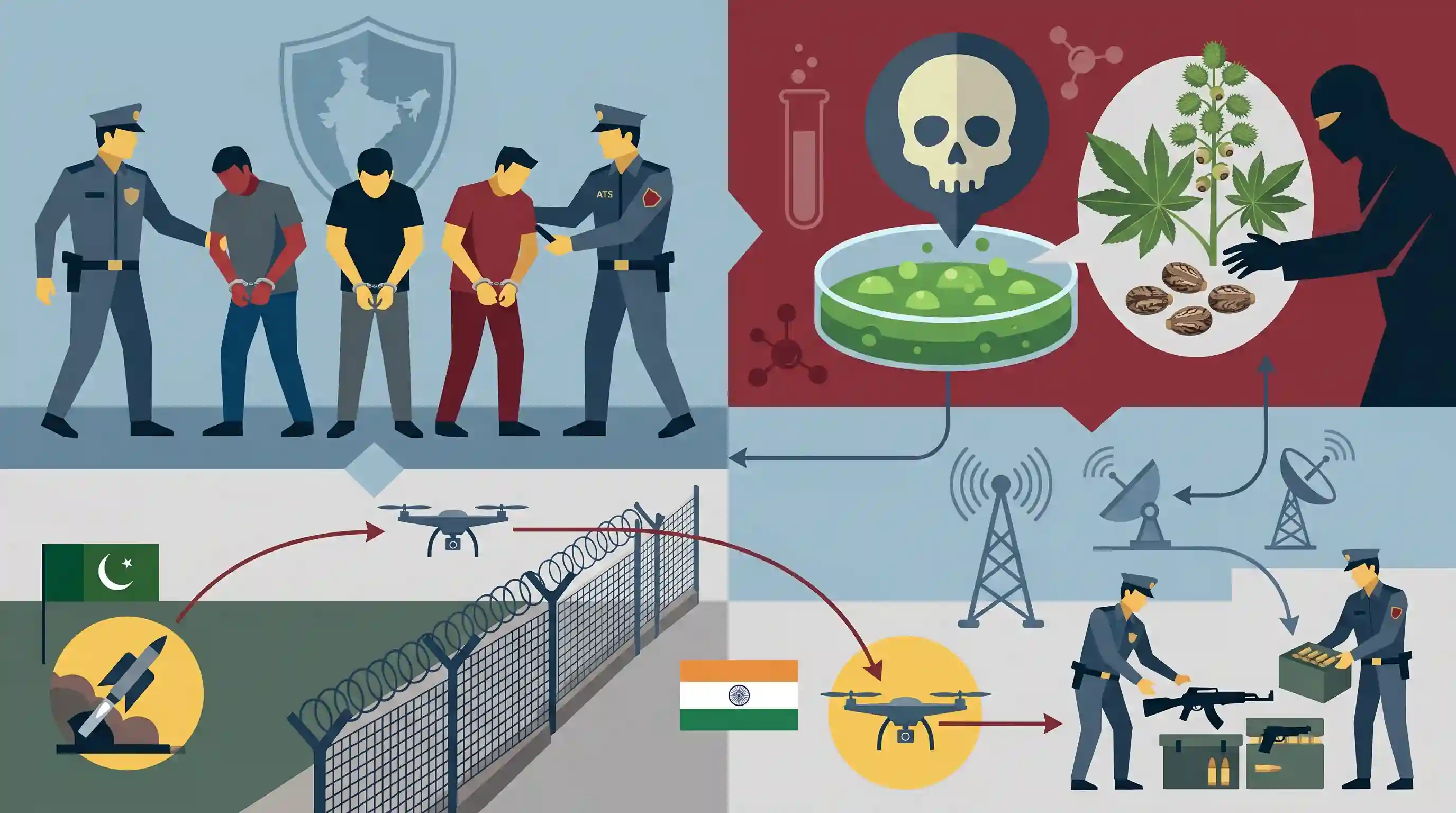
Gujarat ATS Busters ISKP Terror Module Planning Ricin Attack
Source:Indian Express ↗
Why It Matters
Highlights the dynamic and evolving nature of internal security threats, particularly the convergence of cross-border drone smuggling, international terror syndicates like ISKP, and the grave risk of biological/chemical warfare (Ricin) — all highly relevant to GS-3 Security and Science & Tech syllabi.
Summary
The Gujarat Anti-Terrorist Squad (ATS) busted a terror conspiracy by arresting three individuals linked to the Islamic State Khorasan Province (ISKP). The operatives were allegedly planning to carry out attacks in India using Ricin, a deadly biological toxin extracted from castor beans and strictly regulated under the Chemical Weapons Convention (CWC). Additionally, authorities recovered firearms that were reportedly smuggled from Pakistan via drones. The suspects, who had conducted reconnaissance in multiple cities, face charges under the Unlawful Activities (Prevention) Act (UAPA). This incident highlights the evolving internal security threats posed by cross-border drone smuggling and the risk of chemical and biological terrorism.
Key Points
- Gujarat ATS foiled a terror plot allegedly linked to the Islamic State Khorasan Province (ISKP) and handlers based in Pakistan and Afghanistan.
- The accused attempted to produce Ricin, a highly lethal toxin extracted from castor beans and listed under Schedule-1 of the Chemical Weapons Convention (CWC).
- Weapons and ammunition recovered from the accused were allegedly smuggled across the India-Pakistan border using drones.
- The arrested individuals were booked under stringent laws, including the Unlawful Activities (Prevention) Act (UAPA) and the Arms Act.
Important Terms
Unlawful Activities (Prevention) Act (UAPA)

India's primary anti-terror legislation (1967) designed to prevent activities that threaten the nation's sovereignty and integrity; allows for designating individuals as terrorists.
UPSC context
GS Paper III (Internal Security); tests understanding of legal frameworks for counter-terrorism and state powers.
Islamic State Khorasan Province (ISKP)
A regional affiliate of the Islamic State active in Afghanistan and Pakistan, seeking to establish a transnational caliphate through violence.
UPSC context
GS Paper III (Security Challenges); critical for analyzing non-state actors and cross-border terrorism threats.
Chemical Weapons Convention (CWC)
A 1997 multilateral treaty prohibiting the development, production, stockpiling, and use of chemical weapons, requiring the destruction of existing stockpiles.
UPSC context
GS Paper II/III (International Relations/S&T); tests knowledge of global disarmament protocols.
Organisation for the Prohibition of Chemical Weapons (OPCW)
The intergovernmental body based in The Hague that implements the Chemical Weapons Convention and conducts global inspections to verify compliance.
UPSC context
GS Paper II (International Institutions); focuses on international security governance and verification regimes.
Bharatiya Nyaya Sanhita (BNS)
India's modern criminal code (2023) replacing the IPC; it notably incorporates a specific definition of "terrorist act" under Section 113.
UPSC context
GS Paper II (Polity/Laws); tests knowledge of evolving criminal justice and security laws in India.
Ricin
A highly potent toxin extracted from castor beans, classified as a Schedule 1 controlled substance under the Chemical Weapons Convention.
UPSC context
GS Paper III (S&T/Internal Security); tests awareness of biological and chemical warfare agents.
Gujarat Anti-Terrorist Squad (ATS)
A specialized state police unit in Gujarat dedicated to counter-terrorism, intelligence gathering, and investigating serious threats to national security.
UPSC context
GS Paper III (Security Forces); relevant for understanding the roles of state-level security agencies.
Prelims Trap
Ricin is exclusively regulated under the Biological Weapons Convention because it is a naturally occurring plant toxin.
Ricin is a unique dual-threat toxin. Though naturally extracted from castor beans, it is explicitly listed under Schedule-1 of the Chemical Weapons Convention (CWC) alongside BWC.
Static Concepts Connected
How does the Chemical Weapons Convention (CWC) classify toxic substances?
- Schedule 1: Chemicals with few or no legitimate uses besides chemical weapons (e.g., Ricin, Sarin, Mustard Gas). Production is strictly limited and regulated.
- Schedule 2 and 3: Dual-use chemicals with legitimate small-scale or large-scale industrial applications. Subject to strict verification and declarations to the OPCW.
- OPCW enforcement: The Organisation for the Prohibition of Chemical Weapons enforces the CWC by conducting rigorous inspections to verify compliance.
What are the key investigative powers under UAPA post-2019 amendment?
- Individual designation: Empowers the Central Government to designate individuals (not just organizations) as terrorists on specific grounds.
- Property attachment: Grants the NIA Director-General power to approve the seizure or attachment of property without needing the respective State DGP's permission.
- Investigating officer rank: Allows NIA officers of Inspector rank (previously restricted to DSP or ACP rank) to investigate terrorism cases.
Cross-Topic Patterns
UAVs bypassing physical border fences
Smuggling via UAVs in Gujarat/Punjab borders connects internal security with defense technology. Expect questions on anti-drone systems (e.g., soft vs hard kill, Indrajaal) countering low-flying autonomous threats.
Bioterrorism and disaster management frameworks
The use of biological toxins like Ricin links counter-terrorism directly to NDMA guidelines on biological disasters, bio-safety levels (BSL), and epidemiological surveillance networks.

Expect a multi-statement Prelims question mixing Ricin's biological origin with its Chemical Weapons Convention (CWC) Schedule-1 status.
Linked PYQs · 3
Linked PYQs · 3
- 2023MainsGS3
The use of unmanned aerial vehicles (UAVs) by our adversaries across the borders to ferry arms/ammunitions, drugs, etc., is a serious threat to the internal security. Comment on the measures being taken to tackle this threat.
- 2019MainsGS3
Indian Government has recently strengthened the anti-terrorism laws by amending the Unlawful Activities (Prevention) Act (UAPA), 1967 and the NIA Act. Analyze the changes in the context of prevailing security environment while discussing the scope and reasons for opposing the UAPA by human rights organizations.
- 2016PrelimsGS1
With reference to 'Organization for the Prohibition of Chemical Weapons (OPCW)', consider the following statements: 1. It is an organization of European Union in working relation with NATO and WHO. 2. It monitors chemical industry to prevent new weapons from emerging. 3. It provides assistance and protection to States (Parties) against chemical weapons threats. Which of the statements given above is/are correct?
