Caste Census Methodology and Affirmative Action Data Collection
Source:The Hindu ↗
हे का महत्त्वाचे आहे
The methodology and policy implications of a nationwide caste census directly impact India's affirmative action framework. Aspirants must understand the administrative challenges (data collection methodology) and the socio-political necessity (creamy layer, sub-categorisation) of counting caste to answer questions on social justice, governance, and fundamental rights.
सारांश
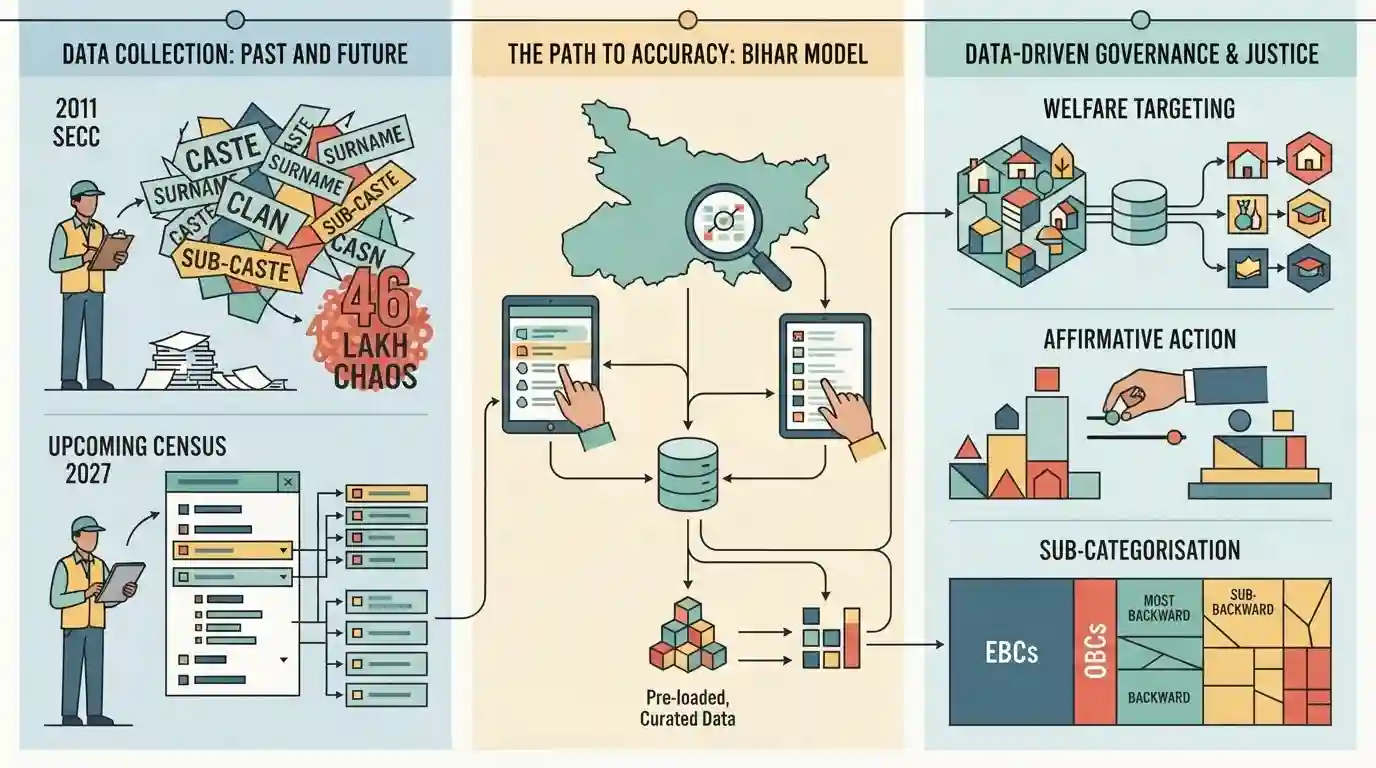
The upcoming Census 2027 features an 'open column' for caste enumeration, a significant shift from the 2011 SECC as it now carries statutory backing. However, the article warns that open-ended questions lead to chaotic, unusable data—evidenced by the 46 lakh caste names recorded in 2011 when respondents conflated castes, surnames, and clans. To prevent this, the government should adopt the methodology used in the 2022-23 Bihar caste survey, which utilized pre-loaded, curated drop-down lists on digital devices. Obtaining accurate, empirical data is vital not to entrench casteism, but to target welfare measures effectively, rationalize affirmative action, and inform debates on sub-categorisation and the creamy layer.
मुख्य मुद्दे
- The ongoing rehearsal for the second phase of Census 2027 includes an open column for self-declaration of caste, which, unlike the 2011 SECC, has statutory backing.
- Open-ended caste questions yield unusable data because respondents often enter surnames, clan names, or sub-castes, as seen when the 2011 SECC returned over 46 lakh caste names.
- To gather accurate data, the upcoming Census should utilize digital hand-held devices pre-loaded with curated lists of castes, following the successful model of the 2022-23 Bihar caste survey.
- Despite the Constitution's aim to eliminate casteism (e.g., by abolishing untouchability), gathering empirical caste data is considered necessary to effectively target affirmative action and welfare.
- Accurate caste data will help resolve ongoing policy challenges such as determining the creamy layer and guiding the sub-categorisation of castes within reserved categories.
महत्त्वाच्या संज्ञा
Census 2027

India's upcoming digital demographic exercise. It will feature the first synchronous nationwide caste enumeration since Independence, utilizing an open column format to self-record responses without predefined drop-down categories.
UPSC context
GS Paper 1 & 2 (Population & Social Justice). Tests knowledge of census methodology, data governance, and welfare planning.
Socio-Economic and Caste Census (SECC) 2011
A 2011 door-to-door enumeration to identify poverty-stricken households and collect caste data. Its caste findings were withheld because open-ended questions yielded over 46 lakh unstandardized and chaotic caste entries.
UPSC context
GS Paper 2 (Governance/Welfare). Highlights challenges of data collection, identity politics, and identifying beneficiaries for targeted welfare.
1931 Census
The last nationwide population census under British rule that comprehensively enumerated and published caste data. Its findings heavily influenced India's post-independence affirmative action policies, including the Mandal Commission recommendations.
UPSC context
GS Paper 1 (Indian Society/History). Tests historical baselines for modern caste-based reservations and the evolution of demographic policies.
2022-23 Bihar Caste Survey
A state-led digital survey mapping socio-economic indicators and caste demographics using a curated drop-down list of 215 codes. It revealed that OBCs and EBCs constitute 63% of Bihar's population.
UPSC context
GS Paper 2 (Social Justice). Relevant for analyzing state-level affirmative action, evidence-based policymaking, and federal issues in enumeration.
Sub-categorisation of Backward Classes
The administrative process of subdividing broad quota categories (like OBCs or SCs) to ensure that reservation benefits reach the most marginalized subsets, preventing dominance by relatively advanced groups.
UPSC context
GS Paper 2 (Social Justice/Constitution). Tests constitutional mechanisms for equitable affirmative action (e.g., Article 340, Rohini Commission).
Creamy Layer
A legal concept used to identify and exclude socially, educationally, and economically advanced individuals within Backward Classes from reservation benefits, ensuring affirmative action targets those genuinely deprived.
UPSC context
GS Paper 2 (Social Justice). Tests understanding of the Right to Equality and Supreme Court jurisprudence on limits of reservations.
पूर्वपरीक्षा सापळा
"The 2011 Socio-Economic and Caste Census (SECC) was conducted under the statutory framework of the Census Act, 1948."
SECC 2011 was an administrative survey by rural and urban ministries, lacking the statutory backing of the Census Act, 1948. Census 2027 will carry this backing.
संबंधित स्थिर संकल्पना
What are the constitutional and legal bases for the Census and backward classes?
- Union List: Entry 69 of the Seventh Schedule vests the power to conduct a census exclusively with the Union government.
- Article 340: Empowers the President to appoint a commission to investigate the conditions of socially and educationally backward classes.
- Census Act, 1948: Provides the statutory framework, penalizes non-compliance, and guarantees confidentiality for data collected during the decennial population census.
What is the framework for OBC sub-categorisation and affirmative action rationalization?
- Rohini Commission: Constituted under Article 340 to examine the equitable distribution of reservation benefits among OBCs and propose sub-categorisation.
- Indra Sawhney Judgment: The 1992 Supreme Court verdict established the 'creamy layer' concept to exclude socially and economically advanced OBCs from reservations.
आंतर-विषय नमुने
Federalism + State-led Surveys
Bihar’s caste survey bypassed the Union’s exclusive census power (Entry 69) by framing it as a state administrative survey for welfare targeting, reflecting federal tensions in data collection.
OBC Data + SC/ST Sub-classification
The push for granular OBC data to rationalize affirmative action directly parallels the recent Supreme Court constitutional bench ruling that permitted states to sub-classify Scheduled Castes for targeted quota benefits.

Caste Census methodology + SECC 2011's lack of statutory backing + Article 340 powers likely to merge in a 2026 Prelims statement question.
संबंधित PYQ · 3
संबंधित PYQ · 3
- 2020PrelimsGS1
Which one of the following categories of Fundamental Rights incorporates protection against untouchability as a form of discrimination?
- 2022MainsGS1
Analyse the salience of 'sect' in Indian society vis-a-vis caste, region and religion.
- 2022MainsGS2
Discuss the role of the National Commission for Backward Classes in the wake of its transformation from a statutory body to a constitutional body.
